
Official statement
Other statements from this video 7 ▾
- □ Do ccTLDs really impose automatic geographic targeting that's impossible to override?
- □ Should you use HTML or XML sitemap for hreflang? Which method truly matters for international SEO?
- □ Can you really use noscript tags in the <head> without SEO penalties?
- □ Does Google really see your website the same way browsers do?
- □ Can iframes in your <head> really break your technical SEO?
- □ Why is cross-referencing multiple data sources critical for accurate SEO diagnostics?
- □ Can you test the Googlebot user-agent directly in Chrome without third-party extensions?
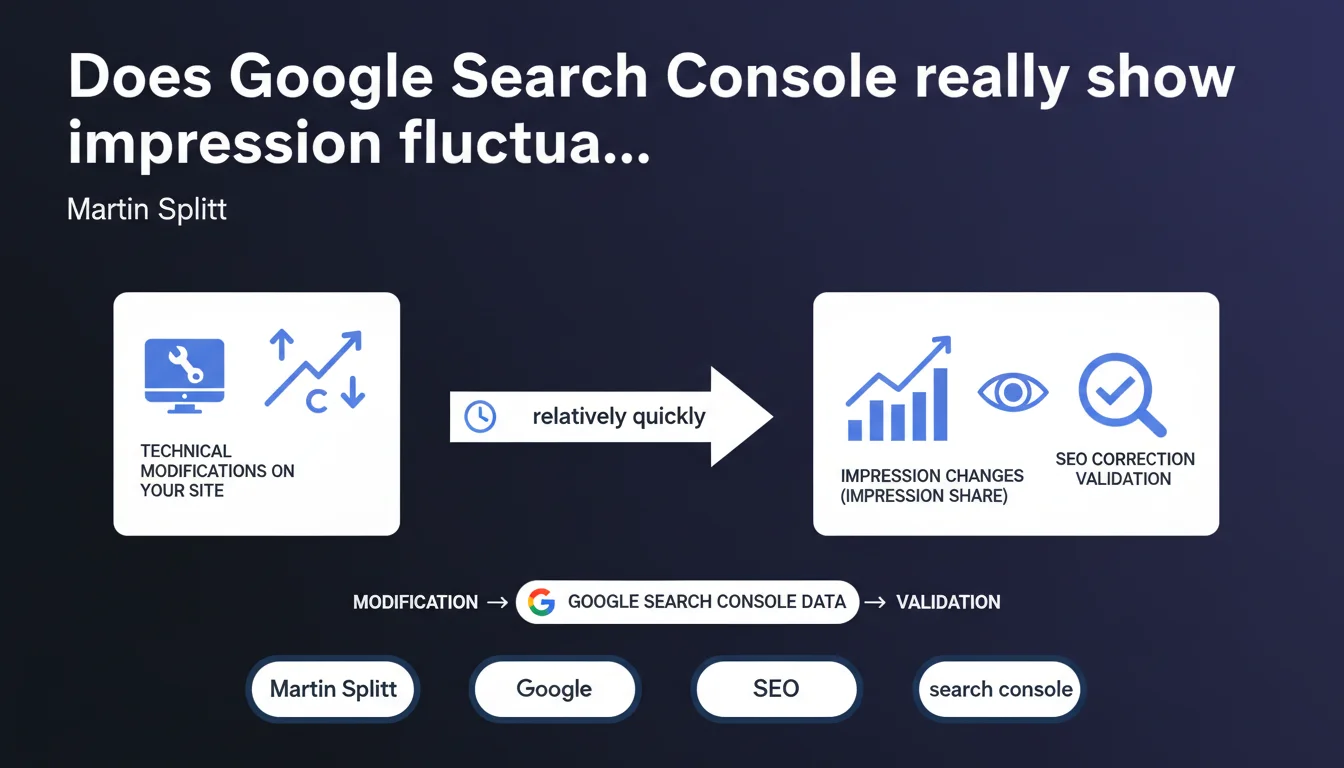
Google Search Console allows you to visualize impression changes relatively quickly following technical modifications to your site. This makes it an effective validation tool for measuring the impact of SEO corrections, even though 'quickly' remains a relative concept in Google's ecosystem.
What you need to understand
What does 'quickly' really mean in the Search Console context?
When Martin Splitt talks about 'relatively quick' visualization, he's referring to Google Search Console's ability to reflect impression variations within a reasonable timeframe after a technical modification. Concretely, we're talking about a few days to a few weeks, depending on how frequently your site is crawled.
This responsiveness contrasts with other SEO metrics that can take months to stabilize. Impressions, on the other hand, react as soon as Googlebot recrawls the modified pages and the index is updated.
Why are impressions such a reliable indicator?
Impressions represent the number of times your pages appear in search results. It's a direct signal of your site's visibility in Google's index.
Unlike clicks or organic traffic, impressions don't depend on user behavior. They purely reflect Google's ability to display your pages for relevant queries. An increase in impressions after a technical correction confirms that Google is indexing and serving your content better.
In which cases is this responsiveness particularly valuable?
You've just fixed major technical errors: broken canonical tags, blocking robots.txt files, massive 5xx errors. Search Console lets you quickly verify whether these fixes are paying off.
It's also invaluable after deploying new pages or restructuring your site. Seeing impressions climb confirms that Google is discovering and serving your new content without friction.
- Impressions respond faster than organic traffic or rankings
- They directly reflect visibility in Google's index
- Particularly useful for validating technical corrections (canonical, robots.txt, server errors)
- The timeframe remains variable depending on your site's crawl frequency
- Don't confuse 'quickly' with 'instantly' — expect several days minimum
SEO Expert opinion
Is this statement consistent with real-world observations?
Yes, but with important nuances. On sites with high crawl frequency (media outlets, active e-commerce platforms), impressions can indeed fluctuate within a few days of a technical modification. On less prioritized sites, expect 2 to 4 weeks instead.
The problem is that Splitt doesn't give any precise figures. 'Relatively quickly' is a convenient phrasing that doesn't commit Google to anything. [Worth verifying] with your own data: systematically note the date of your modifications and compare them with impression trends in GSC.
What limitations should you keep in mind?
Impressions are good, but they tell you nothing about ranking quality. You could see your impressions skyrocket because Google is showing you on page 3 for low-volume queries. Traffic won't budge an inch.
Another point: Search Console aggregates data with a 24 to 48 hour delay. The 'rapid changes' you observe are actually from the day before yesterday. For real-time monitoring, you need to cross-reference with other tools — server logs, position tracking tools, Analytics.
In which cases doesn't this rule apply?
If your site is only crawled once a month (small sites, infrequent updates), don't expect to see impressions move quickly. Google can only reflect what it has recrawled.
Similarly, if you're only modifying editorial content without touching technical elements, the impact on impressions will be much slower and diffuse. Impressions mainly react to structural changes: indexability, architecture, tags.
Practical impact and recommendations
What should you concretely do to leverage this insight?
Use Search Console as a validation tool after each major technical modification. Create a tracking spreadsheet with the deployment date, type of modification, and impression evolution over 2 to 4 weeks.
Compare impressions before/after for specific segments: corrected URLs, new pages, restructured categories. Don't just look at global figures — they often mask true trends.
- Systematically note the date of each technical modification (robots.txt file, canonical, redirects, structure)
- Isolate the affected URLs in GSC via filters or custom segments
- Wait at least 7 days before drawing conclusions — better yet, 14 to 21 days for less frequently crawled sites
- Cross-reference impressions with clicks and CTR: a surge in impressions without clicks often reveals a ranking or meta issue
- Also monitor coverage errors in GSC: a drop in impressions could stem from an undetected indexing problem
What mistakes should you avoid?
Never draw conclusions from a single 24-hour period. Search Console data is aggregated, filtered, and delayed. A drop in impressions on any given day could be a statistical artifact, not a real signal.
Also avoid confusing correlation with causation. If your impressions rise after a modification, verify it was actually caused by the modification — not seasonality, a competitor dropping in the rankings, or a parallel algorithm update.
How do you integrate this into an effective SEO workflow?
Incorporate GSC into your weekly monitoring rituals. After each technical deployment, schedule check-ins at Day 7, Day 14, and Day 21 to track impression evolution for the affected pages.
Automate as much as possible: use the Search Console API to extract impression data and cross-reference it with your server logs or position tracking tools. This will give you a much sharper picture than the web interface alone.
Search Console is an excellent tool for quickly validating the impact of your technical modifications on visibility in Google's index. But 'quickly' is relative, and impressions alone aren't enough — always cross-reference with traffic, clicks, and rankings.
Setting up a rigorous monitoring system takes time and specialized expertise. If you don't have the internal resources to follow these metrics consistently, consider partnering with a specialized SEO agency that can configure appropriate dashboards and guide you through data interpretation.
❓ Frequently Asked Questions
Combien de temps faut-il attendre pour voir les impressions évoluer après une modification technique ?
Les impressions dans la Search Console sont-elles fiables à 100 % ?
Une hausse d'impressions garantit-elle une hausse de trafic ?
Quels types de modifications techniques impactent le plus rapidement les impressions ?
Peut-on utiliser la Search Console pour monitorer l'impact d'une mise à jour d'algorithme ?
🎥 From the same video 7
Other SEO insights extracted from this same Google Search Central video · published on 18/10/2022
🎥 Watch the full video on YouTube →
💬 Comments (0)
Be the first to comment.