
Official statement
Other statements from this video 5 ▾
- □ Google ralentit-il vraiment le crawl lors d'un changement d'hébergement ?
- □ La localisation géographique du serveur ralentit-elle vraiment le chargement de votre site ?
- □ La distance géographique du serveur peut-elle vraiment pénaliser votre Page Experience ?
- □ Les CDN multi-serveurs sont-ils réellement sans risque pour le SEO ?
- □ L'hébergement géographique influence-t-il vraiment le référencement local ?
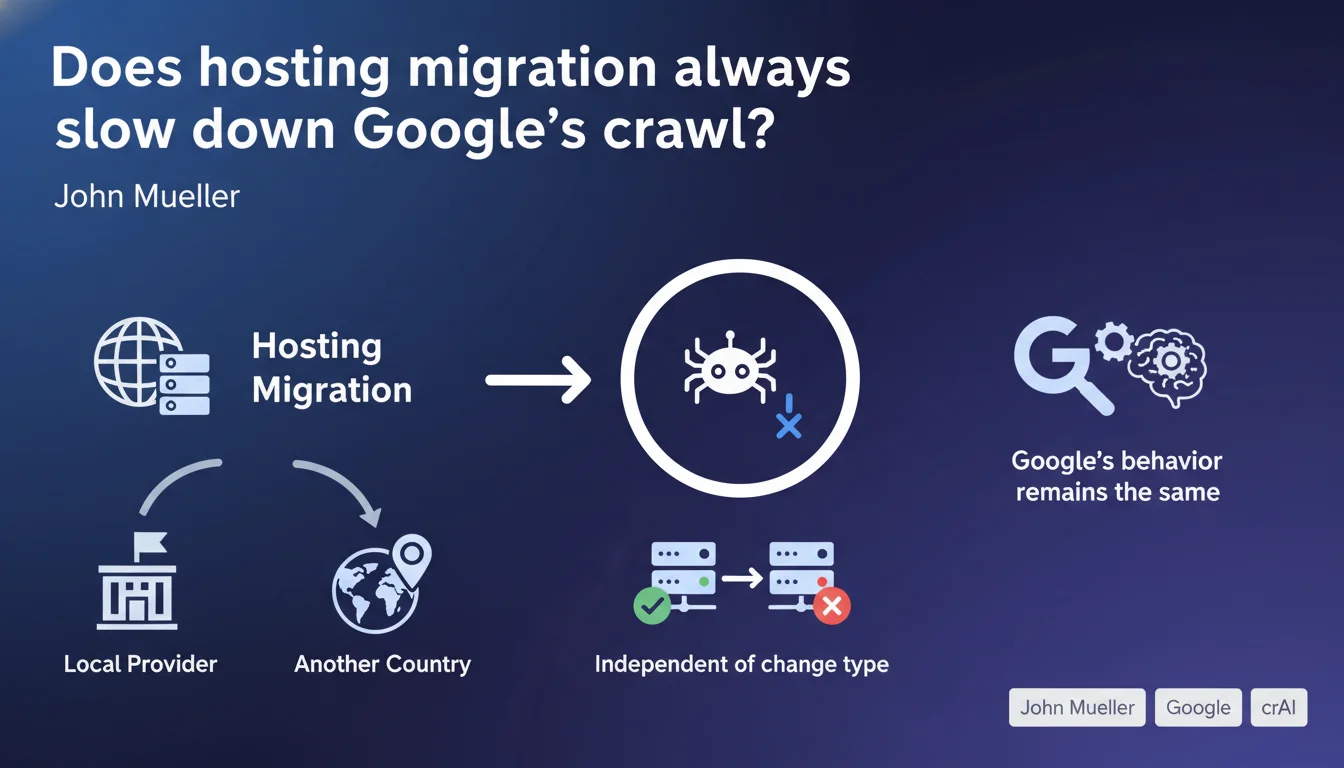
Google systematically slows down its crawl during a hosting change, regardless of the nature of the change (same provider, new country, new datacenter). The type of migration does not influence this behavior: Google adopts the same cautious approach in all cases. Plan for an unavoidable observation period.
What you need to understand
Why does Google slow down its crawl during a hosting change?
Google detects infrastructure changes through several signals: modification of response times, variation of the server's IP address, changes in HTTP headers. As soon as an unusual pattern appears, Googlebot enters conservative mode.
This caution is explained by a real risk: unstable or undersized hosting might not support a normal crawl load. Google therefore prefers to progressively test the capacity of the new server rather than overload it. Defensive logic, not technical.
Are all types of migration really treated the same way?
Mueller affirms that yes — and that's where it gets tricky. A datacenter change with the same hosting provider (IP changes, identical infrastructure) should theoretically be less risky than a complete migration to a new provider in another country.
Yet, according to this statement, Google applies the same slowdown in both cases. This suggests that the crawl algorithm does not distinguish the nature of the change, only its detection. Binary approach: change detected = slowdown activated.
How long does this slowdown last?
Google provides no figures. No indicative duration, no order of magnitude. Real-world observations show variable periods: from a few days to several weeks depending on site size and its reliability history.
- The slowdown is systematic and automatic regardless of the type of hosting change
- Google does not distinguish between local and international migration
- The duration of the slowdown is not communicated and varies across sites
- This behavior aims to protect servers whose stability has not yet been verified
- Impossible to bypass this mechanism via Search Console or otherwise
SEO Expert opinion
Is this statement consistent with real-world observations?
Partially. We do observe post-migration slowdowns, but their intensity varies considerably. A site that migrates to more powerful infrastructure (response times cut in half, greater capacity) sometimes experiences the same slowdown as a site switching to limited hosting.
Mueller's statement suggests uniform treatment, but [To be verified] because several documented cases show accelerated crawl recovery when the new server displays excellent performance metrics from the start. Google claims not to differentiate, but its algorithm may respond faster to positive signals than it admits.
What nuances should be added depending on the migration context?
Let's be honest: not all hosting changes are equal. Migrating from a saturated server to scalable cloud infrastructure is nothing like an IP change with the same hosting provider. Yet Google claims to apply the same caution.
The problem — and Mueller doesn't address it — is that this approach penalizes well-prepared migrations. A site that invests in premium infrastructure suffers the same slowdown as a site switching to the first hosting provider available. No reward for technical quality.
In what cases might this rule not apply strictly?
Mueller speaks of "hosting change," but what about hybrid configurations? A site using a CDN with multiple points of presence technically changes IP depending on crawler geolocation. Is this detected as a hosting change? [To be verified] because Google remains vague on this point.
Another gray area: sites already hosted on distributed infrastructure (multi-zone cloud). Their IP address can fluctuate without real "migration." Does the slowdown apply to each detected change? The statement does not allow us to decide.
Practical impact and recommendations
What should you concretely plan before a hosting migration?
First priority: anticipate a temporary drop in crawl. If your site publishes time-sensitive content (news, e-commerce with rapid renewal), schedule the migration during a slow period. The slowdown is non-negotiable.
Second crucial point: size the new server with comfortable margin. Google will test your infrastructure — it might as well respond perfectly on first requests. Server response time under 200ms, capacity to handle spikes, clean logs without 5xx errors.
How to minimize the impact of slowdown on indexation?
Impossible to avoid, but you can limit damage. Optimize your crawl budget before migration: clean up unnecessary URLs, fix redirect chains, block sections without SEO value. Every crawl must count double during this period.
On monitoring side: activate Search Console alerts to detect any anomaly (server errors, sudden drop in crawled pages). The faster you identify a technical problem, the less the slowdown period will drag on. Google gradually resumes normal crawl only if signals remain in the green.
- Schedule migration during a low-stakes business period
- Size the new server with minimum 30% capacity margin
- Clean up crawl budget before switchover (redirects, unnecessary URLs, duplicate content)
- Configure automatic alerts on Search Console and server response time
- Plan for 24/7 monitoring during the first 72 hours post-migration
- Verify that all robots.txt files and sitemaps correctly point to the new server
- Test server load before migration with stress test tools
- Document response times and crawl volumes before/after to measure actual impact
❓ Frequently Asked Questions
Le ralentissement du crawl affecte-t-il tous les sites de la même manière ?
Peut-on accélérer la reprise du crawl normal après une migration ?
Une migration vers un hébergement plus performant subit-elle le même ralentissement ?
Faut-il informer Google via Search Console avant une migration d'hébergement ?
Les migrations progressives permettent-elles d'éviter le ralentissement du crawl ?
🎥 From the same video 5
Other SEO insights extracted from this same Google Search Central video · published on 23/02/2022
🎥 Watch the full video on YouTube →
💬 Comments (0)
Be the first to comment.