
Official statement
Other statements from this video 5 ▾
- □ Google ralentit-il vraiment le crawl lors d'un changement d'hébergement ?
- □ Le changement d'hébergement ralentit-il toujours le crawl de Google ?
- □ La localisation géographique du serveur ralentit-elle vraiment le chargement de votre site ?
- □ Les CDN multi-serveurs sont-ils réellement sans risque pour le SEO ?
- □ L'hébergement géographique influence-t-il vraiment le référencement local ?
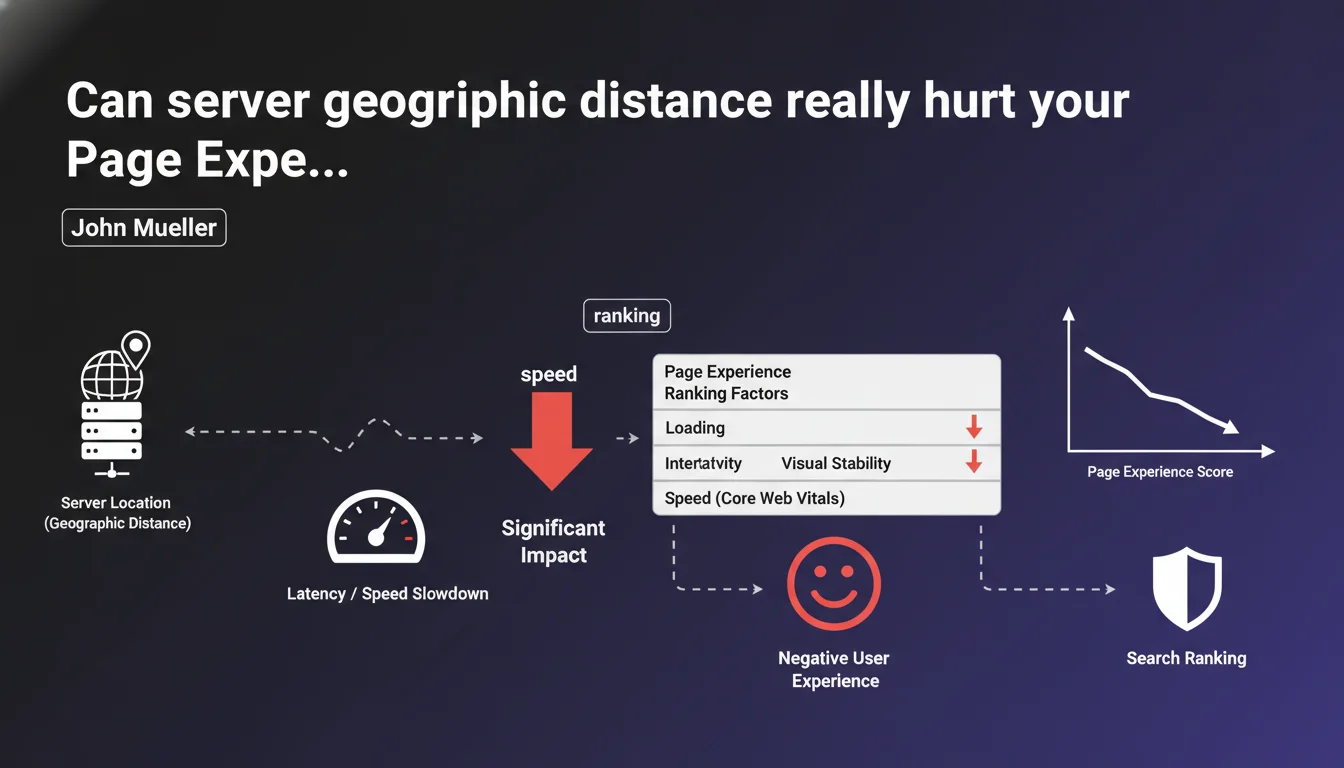
John Mueller confirms that a server located too far away geographically can slow down your site enough to affect the Page Experience score and, by extension, your rankings. Speed remains a measurable criterion of the Page Experience signal. If your users experience significant slowdowns due to network latency, it counts.
What you need to understand
What exactly does Google mean by "significant slowdown"?
Mueller provides no specific threshold. He talks about a slowdown caused by geographic distance that would be "significant" — in other words, measurable enough to degrade user experience.
In practice, this refers to the Core Web Vitals, particularly LCP (Largest Contentful Paint) and FID (First Input Delay). If network latency pushes these metrics beyond the "Good" thresholds, you fall into the orange or red zone. And there, yes, Page Experience can suffer.
Is Page Experience still really a ranking factor?
Yes, but its weight remains modest in the overall algorithm. Google has always presented it as a "tie-breaker": with equivalent content, a better Page Experience score can make the difference.
The problem is that "with equivalent content" rarely happens in practice. If your competitor has better internal linking, stronger backlinks, or better search intent match, a fast server won't be enough to beat them.
Why does geographic distance impact speed?
It's a matter of network latency. The farther the server is physically from the user, the longer data takes to make the round trip. Every HTTP request experiences this delay.
A server in Paris for an audience in Australia can add 200-300 ms of pure latency, before even counting page generation time. On mobile connections or slow networks, this quickly becomes visible in metrics.
- Network latency increases with physical distance between server and user
- A measurable slowdown in Core Web Vitals can affect Page Experience
- Page Experience remains a modest ranking factor, not the primary lever
- No official numeric threshold: Google speaks of "significant" without defining the limit
SEO Expert opinion
Is this statement consistent with what we observe in the field?
Broadly, yes. We regularly see sites hosted far from their main audience displaying high TTFB and degraded LCP. But the devil is in the details: a well-configured CDN can completely eliminate this effect.
If your main server is in New York but you serve cached content via Cloudflare or Fastly from worldwide edge nodes, the impact of distance becomes negligible. Mueller doesn't mention CDN here — and that's unfortunate, because it's the obvious solution to the problem he raises.
What nuances should we add?
Geographic distance alone isn't enough to tank your SEO. What matters is measurable impact on user metrics. If your site remains fast despite a distant server (thanks to a CDN, aggressive caching optimization, HTTP/2 push, etc.), you won't be penalized.
However, if you host a French site on a single California server, without a CDN or optimization, and your users see LCP at 4 seconds, then yes, you will suffer. [To verify]: Mueller doesn't specify whether Google measures actual distance or only perceived impact in CrUX (Chrome User Experience Report). We assume it's the latter, but no official confirmation.
In what cases does this rule not apply?
If your site uses a performant global CDN, the physical distance of the origin server becomes almost anecdotal. Static content is served from edge nodes close to the user, and only dynamic requests return to the main server.
Another case: sites with a highly localized audience. If 99% of your users are in Paris and your server is too, geographic distance isn't an issue. The problem mainly arises for international sites or those with geographically dispersed audiences.
Practical impact and recommendations
What should you do concretely to limit the impact of server distance?
First, measure the actual impact. Check your Core Web Vitals in Search Console, segmented by country if possible. If you see degraded LCP or FID in certain geographic zones, that's a signal.
Next, implement a CDN. Cloudflare (free or paid), Fastly, KeyCDN, BunnyCDN — it doesn't matter, but at least serve static assets (images, CSS, JS) from edge nodes close to your users. This drastically reduces the impact of distance.
What mistakes should you avoid at all costs?
Don't choose a hosting provider based on price alone without checking the location of datacenters and network quality. A server in Singapore for a French audience guarantees catastrophic TTFB.
Also avoid over-optimizing the origin server while neglecting caching. An ultra-fast server in California is still slow viewed from Paris if every request must cross the Atlantic. Prioritize caching and CDN before throwing money at a more powerful server.
How do you verify your infrastructure is compliant?
Use WebPageTest with multiple locations. Test from Paris, New York, Sydney, etc. Compare TTFB and LCP. If you see differences of hundreds of milliseconds depending on the zone, you have a distance problem.
Cross-reference with CrUX (Chrome User Experience Report) data in PageSpeed Insights or BigQuery. These are the data Google uses to evaluate Page Experience. If CrUX shows red, you're in the spotlight.
- Analyze Core Web Vitals by geographic zone in Search Console
- Implement a CDN to serve static content from edge nodes
- Test speed from multiple locations with WebPageTest
- Check CrUX data in PageSpeed Insights to see what Google actually measures
- Choose a hosting provider with datacenters close to your main audience
- Optimize server cache and HTTP headers to minimize roundtrips
❓ Frequently Asked Questions
Un CDN suffit-il à compenser un serveur trop éloigné ?
Google mesure-t-il la distance réelle ou seulement l'impact sur la vitesse ?
Mon site est lent mais mon hébergeur est proche géographiquement, pourquoi ?
Faut-il un serveur par pays pour un site international ?
Quel impact réel sur le classement si mon Page Experience est orange ?
🎥 From the same video 5
Other SEO insights extracted from this same Google Search Central video · published on 23/02/2022
🎥 Watch the full video on YouTube →
💬 Comments (0)
Be the first to comment.