
Official statement
Other statements from this video 5 ▾
- □ Google ralentit-il vraiment le crawl lors d'un changement d'hébergement ?
- □ Le changement d'hébergement ralentit-il toujours le crawl de Google ?
- □ La localisation géographique du serveur ralentit-elle vraiment le chargement de votre site ?
- □ La distance géographique du serveur peut-elle vraiment pénaliser votre Page Experience ?
- □ Les CDN multi-serveurs sont-ils réellement sans risque pour le SEO ?
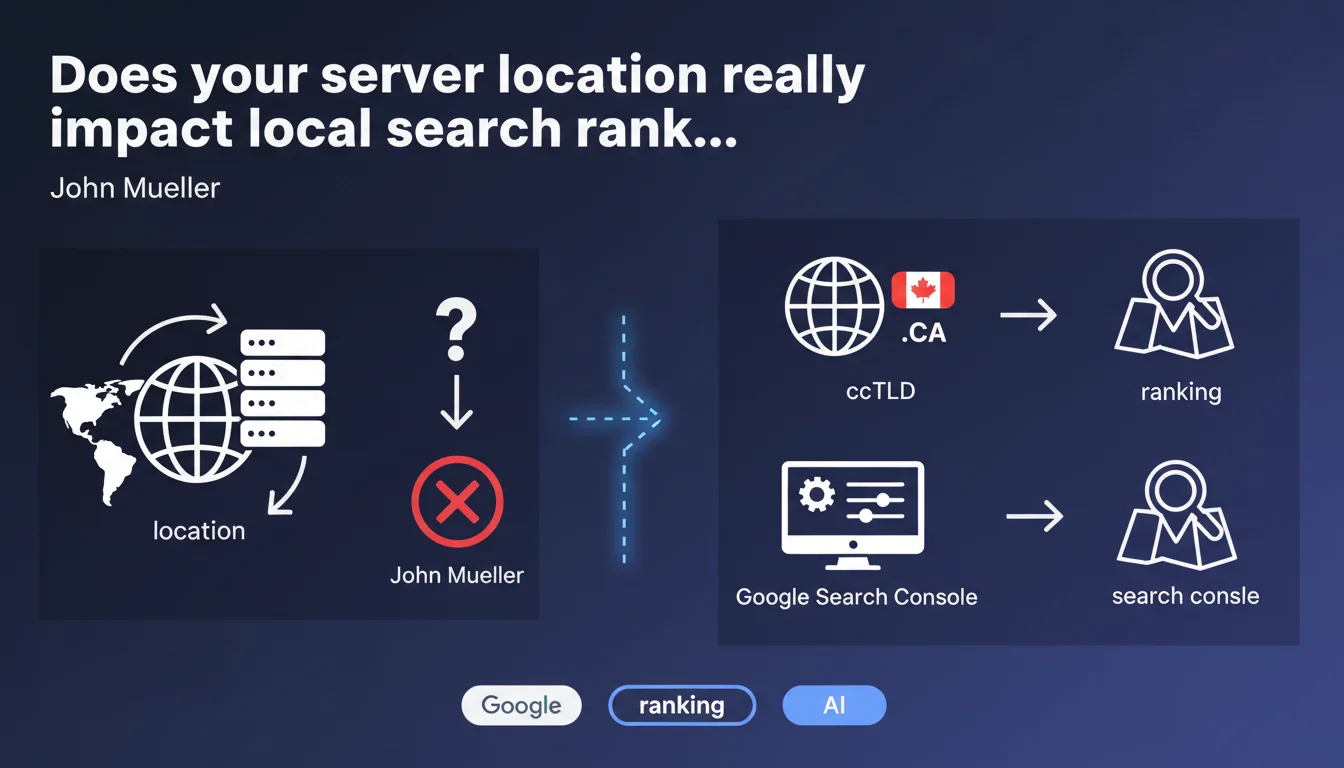
Google does not base geo-targeting on the physical location of your server. Only the ccTLD (country-code domain) and the geo-targeting parameter in Search Console actually matter. If you host a .fr site in Ireland or the United States, there is zero impact on your rankings in France.
What you need to understand
Why does this server location confusion keep persisting?
For years, the recommendation to use local hosting circulated through SEO training materials. The idea seemed logical: a French server to target France, a German server for Germany. Some hosting providers even built their sales pitch around this.
Yet the technical reality has been crystal clear for a long time. Google uses explicit geo-targeting signals, not indirect clues like server IP address. This clarification from Mueller puts an end to a debate that should have been settled a decade ago.
What signals does Google actually use in practice?
Two main levers: the country-code top-level domain (ccTLD) such as .fr, .de, .co.uk, and the geo-targeting parameter available in Google Search Console for generic domains (.com, .net, .org).
These signals are explicit, configurable, and allow Google to understand without ambiguity which audience you're targeting. The server IP address, on the other hand, can change whenever your infrastructure migrates — it would be an unstable and unreliable signal.
- A ccTLD automatically signals the target country without additional configuration
- On a generic domain, the Search Console parameter manually defines the geographic scope
- Server IP is ignored in this geo-targeting calculation
- Multilingual content and hreflang tags complement the setup for international targeting
Does server location affect page load speed?
This is where people often confuse two distinct issues. Server location can influence network latency, which may potentially impact Core Web Vitals. But this optimization falls under technical performance, not SEO geo-targeting.
With a properly configured CDN, the physical location of your origin server becomes marginal. Resources are distributed from nodes close to users. So even this performance argument doesn't really hold water anymore.
SEO Expert opinion
Is this statement consistent with observed industry practices?
Absolutely. Field tests have confirmed it for years — which is why Mueller's communication reads more like a reminder. .com sites hosted anywhere rank perfectly fine on local markets as long as they correctly use Search Console and hreflang.
The real limitation is that not all geo-targeting tools are created equal. A ccTLD remains the strongest and most immediate signal for Google. The Search Console parameter works, but it doesn't compensate for poorly adapted content or a lack of local signals on the page itself.
What nuances matter in the real world?
SEO geo-targeting is never about a single parameter. Google combines dozens of signals to determine geographic relevance: physical address on the site, local phone number, currencies, language, local backlinks, mentions in Google Business Profile.
Saying that server IP doesn't matter is true. Concluding that you just need to check a box in Search Console to "target France" is an analytical error. Geographic targeting is a holistic strategy, not an isolated technical adjustment.
In what cases could this rule create problems?
Local data residency regulations can force certain businesses to host locally — think healthcare, finance, sensitive personal data. In that case, local hosting is a legal constraint, not an SEO one.
Another edge case: countries with degraded network infrastructure or active censorship. If your server is inaccessible from your target country due to national firewalls, technical geo-targeting becomes secondary to the underlying accessibility problem.
Practical impact and recommendations
What should you do concretely to optimize geo-targeting?
First, choose the right domain architecture. For a single country, a ccTLD remains the clearest solution. For multi-country, three options: subdomains with ccTLD (fr.example.com, de.example.com), subdirectories on a generic domain (/fr/, /de/) with Search Console configuration, or separate domains per country.
Next, configure Search Console properly. If you use a .com or .net, explicitly set the geo-targeting in your property settings. Never leave this parameter on "Not set" if you have a clear target market.
Finally, deploy hreflang rigorously for multilingual or multi-country versions. This is the signal that helps Google serve the right version based on user language and location. And check regularly — hreflang errors are extremely common.
What mistakes should you absolutely avoid?
Stop wasting time (and money) moving your hosting for SEO geo-targeting reasons. If your current hosting is performing well and reliable, keep it. Focus your resources on levers that actually matter.
Also avoid mixing geographic signals inconsistently. A French-language site targeting France in Search Console but with a Belgian address, Swiss phone number, and prices in dollars — Google will struggle to understand your intent.
- Verify the geo-targeting parameter in Google Search Console
- Ensure your ccTLD matches your target market (or use subdirectories with explicit targeting)
- Audit hreflang tags on all multi-country sites
- Harmonize local signals: currency, phone, address, language
- Monitor rankings by country using a geo-localized tracking tool
- Don't move hosting for SEO reasons unless there's a legal requirement
How do you measure the effectiveness of your geographic targeting?
Use the country reports in Google Search Console to check where your impressions and clicks come from. If you're targeting France but 80% of your organic traffic comes from Belgium, you have a targeting problem — not an IP server issue.
Compare rankings across different countries with a tool that supports geographic SERP targeting. Ranking gaps between countries often reveal inconsistencies in your overall targeting strategy.
❓ Frequently Asked Questions
Dois-je migrer mon hébergement si mon serveur est à l'étranger ?
Un CDN suffit-il pour optimiser le géociblage ?
Peut-on cibler plusieurs pays avec un seul domaine .com ?
Le ccTLD est-il plus efficace que le paramétrage Search Console ?
L'adresse IP influence-t-elle au moins la vitesse de crawl ?
🎥 From the same video 5
Other SEO insights extracted from this same Google Search Central video · published on 23/02/2022
🎥 Watch the full video on YouTube →
💬 Comments (0)
Be the first to comment.