
Official statement
Other statements from this video 5 ▾
- □ Google ralentit-il vraiment le crawl lors d'un changement d'hébergement ?
- □ Le changement d'hébergement ralentit-il toujours le crawl de Google ?
- □ La localisation géographique du serveur ralentit-elle vraiment le chargement de votre site ?
- □ La distance géographique du serveur peut-elle vraiment pénaliser votre Page Experience ?
- □ L'hébergement géographique influence-t-il vraiment le référencement local ?
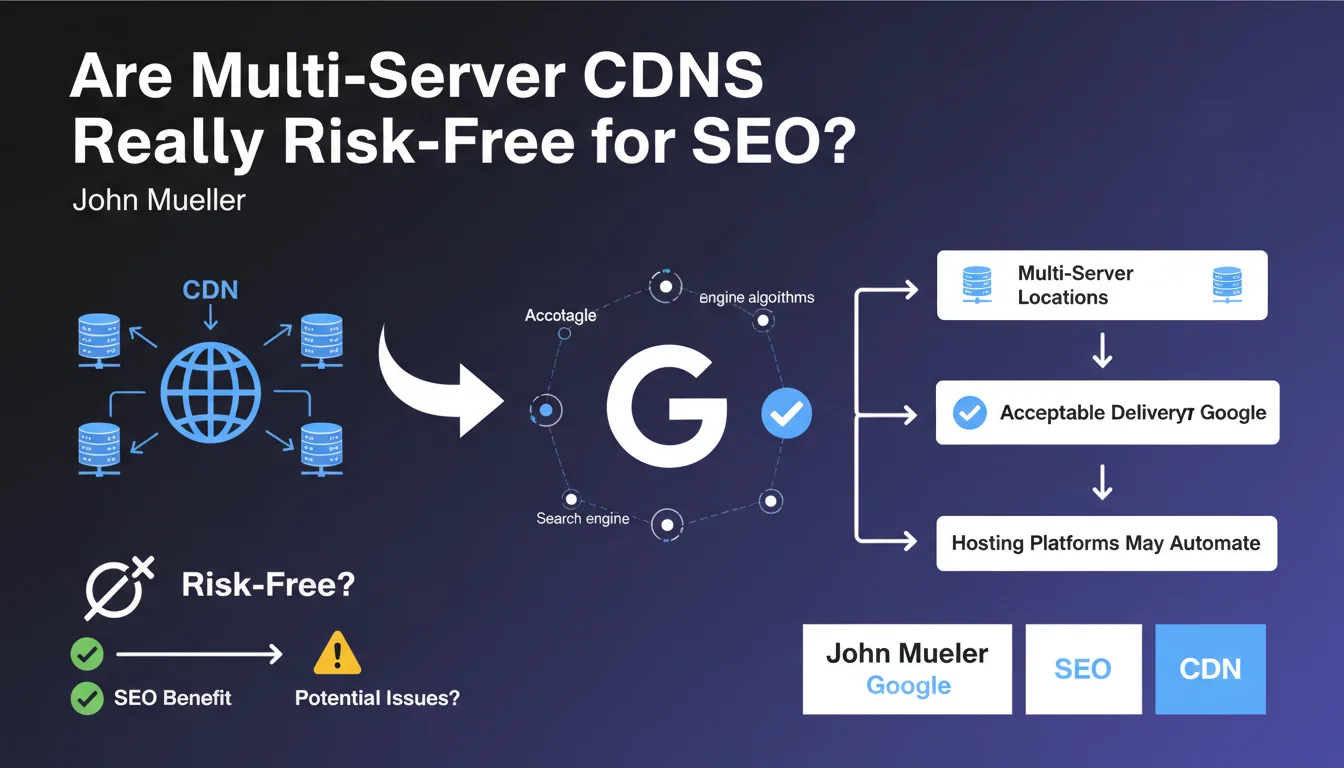
Google confirms that using CDNs with geographically distributed servers poses no indexation or ranking problems. This statement ends persistent concerns about the SEO impact of content distribution across multiple locations. Many modern hosting providers enable this configuration by default.
What you need to understand
Why This Google Clarification on Multi-Location CDNs?
Some SEO practitioners worried that content served from multiple geographically dispersed IP addresses could be perceived by Google as duplicate content or degrade geographic relevance signals. This confusion stemmed partly from older recommendations about local hosting for international SEO.
Google removes all ambiguity here: modern CDNs that automatically distribute content via edge servers spread worldwide generate no indexation problems. The search engine fully understands this now-standard technical architecture.
What's the Difference Between a Standard CDN and Multi-Server Hosting?
A CDN (Content Delivery Network) uses distributed cache servers to serve static resources — images, CSS, JavaScript — from the point closest to the user. Multi-server hosting can also concern the main HTML content, not just assets.
In both cases, Google confirms this geographic distribution is acceptable. The search engine correctly identifies content origin regardless of which server physically delivers it.
Does This Statement Apply Only to Static Resources?
No, Mueller explicitly discusses "servers in multiple different locations" without restricting to static files alone. This potentially includes dynamic HTML served via edge computing configurations or geographic load balancing.
Some modern hosting platforms automatically distribute entire sites via multiple servers — Google indicates this practice doesn't penalize crawling or indexation.
- Multi-server CDNs don't create duplicate content issues for Google
- Geographically distributed hosting is an accepted technical configuration, even for main HTML content
- Many modern hosting providers activate this distribution automatically without manual intervention
- Google correctly identifies content origin regardless of the delivery server
- This clarification ends concerns about negative SEO impact from distributed architectures
SEO Expert opinion
Is This Statement Really News?
Let's be honest: most high-traffic sites have used CDNs for years without observing SEO penalties. Mueller's statement simply formalizes a ground reality already widely accepted by experienced practitioners.
What's interesting is that Google feels the need to officially confirm it. This suggests that concerns still persist in the SEO community, likely fueled by poorly diagnosed edge cases or persistent myths about geographic IP importance.
What Nuances Should Be Added to This Claim?
Mueller speaks of "acceptable" configurations, not "optimal" ones. There's a difference. A well-configured CDN improves Core Web Vitals — loading times, TTFB — which positively impacts SEO. But a poorly configured CDN can block Googlebot, serve stale content via aggressive caching, or generate intermittent 5xx errors.
The statement also doesn't clarify how Google handles content variations by geolocation. If your CDN serves different content based on user location (not just language, but truly different pages), this can create inconsistencies between what Googlebot crawls and what users see. [To verify] in edge computing cases with server-side edge generation.
In Which Cases Might This Configuration Still Cause Problems?
Three scenarios warrant vigilance. First case: CDNs that modify HTML via automatic optimizations — aggressive minification, injected lazy-loading, DOM modifications. If Googlebot receives a transformed version different from the user version, this violates the principle of crawled/rendered content consistency.
Second case: configurations with unintentional geographic cloaking. If your CDN blocks or redirects certain IPs, and Googlebot ends up in an unexpected zone, it may receive a 403 response or inappropriate default content.
Third case: sites with international targeting via subdomains or subdirectories. A global CDN serving all language versions indiscriminately from all servers is acceptable, but it doesn't replace hreflang signals and URL structuring for international SEO. Don't confuse technical distribution with semantic targeting.
Practical impact and recommendations
What Should You Actually Check on Your CDN Configuration?
First step: validate that Googlebot accesses your content via all edge servers. Use the URL inspection tool in Search Console on several key pages and compare the HTML rendered by Google with what you see in normal browsing. No divergence should appear.
Second check: examine HTTP headers returned by your CDN. Cache-Control, Vary, and X-Robots-Tag headers must be consistent with your indexation strategy. A CDN that overwrites your directives can block indexation without you realizing it immediately.
Third point: test latency and TTFB from multiple locations. The main benefit of multi-server CDNs is performance improvement — if your TTFB remains high, the CDN isn't serving its purpose and brings no tangible SEO benefit.
What Common CDN Configuration Errors Still Hurt Sites?
Classic mistake: cache TTL too long on frequently updated pages. Your CDN serves stale content for hours, Googlebot crawls this outdated version, and your SEO updates don't reflect in the index. Configure automatic purges or TTLs matching your publishing pace.
Another trap: not including query parameters in the cache key when they modify content. If ?filter=X generates different content but your CDN ignores this parameter, all variations return the same cached page — catastrophic for e-commerce sites with dynamic filters.
Last frequent error: blocking Googlebot at the CDN level via overly strict security rules. Some integrated WAF (Web Application Firewall) tools consider crawlers as threats and limit or block them. Check your CDN logs for potential 403s or rate-limiting on the Googlebot user-agent.
How to Ensure Your Distributed Architecture Stays SEO-Friendly?
- Verify HTML content consistency between edge servers via Search Console
- Test TTFB from multiple geographic zones to confirm performance gains
- Audit HTTP headers Cache-Control, Vary, X-Robots-Tag returned by the CDN
- Configure cache TTLs suited to your content update frequency
- Validate that relevant query parameters are included in cache keys
- Ensure Googlebot isn't blocked or rate-limited by the CDN WAF
- Monitor crawl times and 5xx errors in Search Console after CDN activation
- Test mobile separately — some CDNs apply different optimizations by user-agent
❓ Frequently Asked Questions
Un CDN peut-il nuire au SEO international avec hreflang ?
Faut-il configurer différemment un CDN pour Googlebot ?
Les CDN qui minifient automatiquement le HTML posent-ils problème ?
Un temps de cache long sur CDN retarde-t-il l'indexation des nouvelles pages ?
Les CDN avec edge computing qui génèrent du HTML dynamiquement sont-ils acceptables ?
🎥 From the same video 5
Other SEO insights extracted from this same Google Search Central video · published on 23/02/2022
🎥 Watch the full video on YouTube →
💬 Comments (0)
Be the first to comment.