
Official statement
Other statements from this video 9 ▾
- □ Pourquoi Google ignore-t-il vos balises meta placées dans le <body> ?
- □ Pourquoi Google refuse-t-il les balises canonical placées dans le <body> ?
- □ Les balises hreflang dans le <body> sont-elles vraiment ignorées par Google ?
- □ Le code HTML valide W3C améliore-t-il vraiment le référencement ?
- □ Pourquoi modifier les canonicals en JavaScript crée-t-il des signaux contradictoires pour Google ?
- □ Faut-il optimiser les hints de préchargement pour Googlebot ?
- □ La performance web améliore-t-elle vraiment votre référencement naturel ?
- □ Google parse-t-il vraiment le HTML comme un navigateur ?
- □ Pourquoi Googlebot ignore-t-il vos hints de préchargement des ressources ?
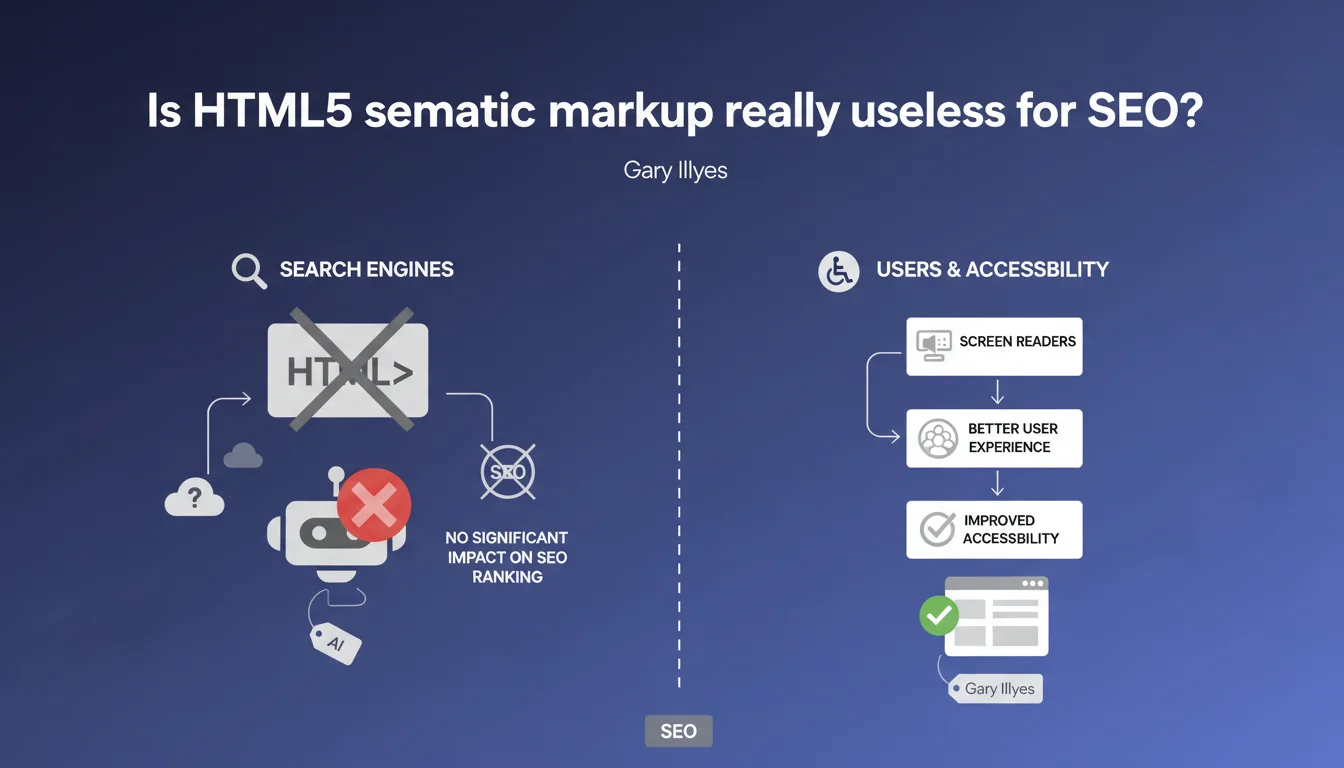
Gary Illyes confirms that HTML5 semantic tags (article, section, nav) and strict heading hierarchy (single H1, cascading H2s) have no significant impact on rankings. Google values content and user experience, not HTML syntactic perfection. These elements remain essential for accessibility, but shouldn't be a pure SEO priority.
What you need to understand
What exactly does "no major impact" mean?
Google doesn't read HTML like a purist developer. The algorithm focuses on content meaning, not the formal semantics of tags. Whether you use <div> or <article> makes no difference to how Googlebot understands your page.
This statement demolishes a persistent belief in the SEO community: that strictly following HTML5 standards would give a ranking advantage. Concretely? A site with three H1s and <div> everywhere can easily outrank a site that's impeccable in semantics but weak in content.
Why has this confusion existed for so long?
W3C recommendations and accessibility best practices have long been conflated with ranking criteria. Many agencies have sold HTML5 audits as SEO levers, when the actual impact was zero or marginal.
Gary Illyes says it plainly: what matters is that content is understandable and user experience is smooth. The semantic structure helps screen readers, but Google doesn't need it to index and rank.
What really remains important for Google?
Headings (H1, H2, etc.) keep their usefulness — but not strict hierarchy. Google understands very well that an H2 introduces a subsection, even if there are two H1s on the page. What matters most: content clarity and relevance to search intent.
- HTML5 semantic tags don't influence crawl or ranking
- Strict heading hierarchy (single H1, then H2, etc.) is not a ranking criterion
- Accessibility and UX remain valid reasons to use these tags
- Content and its logical structure matter far more than HTML syntax
SEO Expert opinion
Does this statement contradict real-world observations?
No, it confirms what we've been observing for years. WordPress sites with anarchic markup and poorly coded themes regularly dominate competitive SERPs. The correlation between HTML5 quality and ranking has always been nonexistent.
However — and this is where it gets tricky — accessibility and UX indirectly influence SEO. A site that's difficult to navigate generates pogo-sticking, poor engagement, and Google detects that. So yes, semantic markup can help… but through an indirect path, not directly.
Should you abandon all HTML rigor then?
Let's be honest: no. Clean code facilitates maintenance, speeds up debugging, and improves experience for users with disabilities. It's an investment in site longevity, not for Google.
The real trap is spending 20 hours fixing semantic tags when your internal linking is broken, page load speed is catastrophic, or content lacks depth. Prioritize initiatives that actually impact ranking.
What nuances doesn't Gary Illyes provide?
[To verify] He doesn't specify whether certain structural tags — like <main> or <nav> — help Google identify main content areas versus navigation. We know Googlebot segments pages, but the exact role of markup remains unclear.
Practical impact and recommendations
What should you concretely change on your site?
Nothing, if your code works. If you have three H1s, a <div> for the header, and no <article>, don't waste time refactoring everything. Focus on signals that actually move the needle: content, internal linking, Core Web Vitals, backlinks.
However, if you're launching a new project or complete redesign, you might as well adopt clean markup from the start. It's zero additional cost and makes your life easier long-term — even if Google doesn't care.
What heading management mistakes should you avoid?
The classic mistake: overthinking "how many H1s are allowed?". The answer: Google doesn't care. What matters is that each H1/H2 provides structuring information, not that they respect a perfect hierarchical pyramid.
Also avoid stuffing headings with keywords just to "optimize". A natural, descriptive H2 beats "Plumber Paris 15 | Plumbing Service Paris 15 | Emergency".
How do you verify your site is well-structured?
- Verify that each page has at least one heading (H1 or equivalent) describing the main topic
- Make sure headings are in logical order, even if they don't strictly follow H1 > H2 > H3
- Test accessibility with a screen reader (NVDA, JAWS) to spot inconsistencies
- Don't waste resources fixing markup if SEO fundamentals (content, links, technical) are failing
- Use Google Search Console and PageSpeed Insights to identify real performance issues
❓ Frequently Asked Questions
Combien de H1 peut-on mettre sur une page sans pénalité SEO ?
Les balises <article> et <section> ont-elles un impact sur le crawl budget ?
Faut-il quand même respecter les standards W3C pour le SEO ?
Est-ce que Google utilise les balises sémantiques pour générer des featured snippets ?
Peut-on ignorer complètement la hiérarchie des titres ?
🎥 From the same video 9
Other SEO insights extracted from this same Google Search Central video · published on 26/02/2026
🎥 Watch the full video on YouTube →
💬 Comments (0)
Be the first to comment.