
Official statement
Other statements from this video 9 ▾
- □ Pourquoi Google ignore-t-il vos balises meta placées dans le <body> ?
- □ Pourquoi Google refuse-t-il les balises canonical placées dans le <body> ?
- □ Les balises hreflang dans le <body> sont-elles vraiment ignorées par Google ?
- □ Le code HTML valide W3C améliore-t-il vraiment le référencement ?
- □ Pourquoi modifier les canonicals en JavaScript crée-t-il des signaux contradictoires pour Google ?
- □ Faut-il optimiser les hints de préchargement pour Googlebot ?
- □ Le markup sémantique HTML5 est-il vraiment inutile pour le SEO ?
- □ La performance web améliore-t-elle vraiment votre référencement naturel ?
- □ Google parse-t-il vraiment le HTML comme un navigateur ?
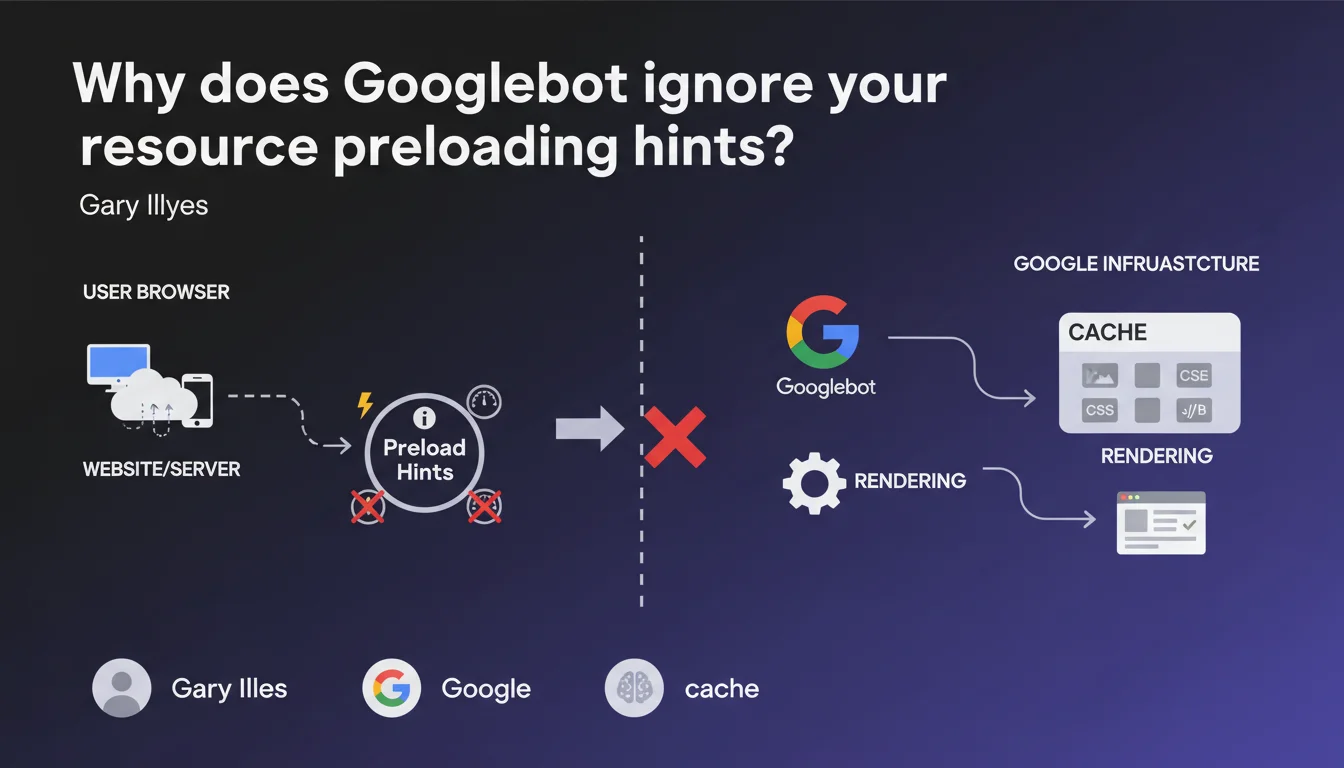
Google caches the resources needed for rendering on Googlebot's side rather than fetching them on every crawl. This internal optimization strategy explains why certain preloading hints (preload, prefetch) have no impact on the bot's behavior. The goal: reduce server load and save bandwidth, not speed up rendering for Google.
What you need to understand
What exactly does Google cache?
Googlebot caches static resources (CSS, JavaScript, images, fonts) needed to render the pages it crawls. In practice, when the bot visits a page on your site, it stores these elements in its infrastructure.
On subsequent visits, it reuses these cached resources instead of downloading them again from your servers. This mechanism applies to resources identified as stable — those whose URL and content don't change with each request.
Why does this approach make preloading hints pointless for Google?
Resource hints (preload, prefetch, dns-prefetch, preconnect) are designed to optimize loading in a real user's browser. They tell the browser what to anticipate to speed up display.
But Googlebot doesn't work like a standard browser discovering a page for the first time. It has already visited your pages, it has already fetched your resources. Signaling them via hints does nothing — it already has them in stock.
What are the concrete implications for server load?
This Google-side caching strategy drastically reduces the volume of HTTP requests your servers must handle during bot visits. This is particularly visible on sites with high page volume or heavy resources.
On the other hand, it also means Google may not detect a CSS or JS change immediately if the resource is still cached on its side. Something to keep in mind during deployments.
- Googlebot caches static resources to avoid re-downloading them on every crawl
- Preloading hints (preload, prefetch) serve no purpose for the bot — it already has the resources
- This strategy reduces server load and saves bandwidth on the hosting side
- Caution: a resource change may take time to be taken into account if Google is using its cached version
SEO Expert opinion
Is this practice consistent with field observations?
Yes, and it explains several behaviors observed for years. Server logs show that Googlebot does not systematically re-download all static resources on every visit. It focuses on HTML, new resources, or those that have changed.
That said, Google remains vague about the cache retention duration and the exact conditions for refresh. Is it linked to a TTL? To crawl frequency? To change signals (Last-Modified, ETag)? [To be verified] — no official data on these exact mechanisms.
What nuances should be added to this statement?
Gary Illyes speaks of « certain hints » that are not relevant. He doesn't say that all hints are useless. dns-prefetch or preconnect can still make sense if Googlebot needs to establish connections to third-party domains it has never encountered.
Furthermore, these hints remain crucial for user experience and Core Web Vitals. Don't remove them under the pretext that they don't serve Google — they serve your real visitors, and that's what matters for ranking.
In what cases does this caching logic pose a problem?
During a redesign or major CSS/JS change, Google's cache can delay taking modifications into account. If the bot uses an old version of your stylesheet, the rendering it analyzes doesn't match reality.
Solution: force refresh via a change in resource URL (cache busting with query string or hash). But again, Google doesn't specify if a simple ?v=2 is enough or if a full file hash is needed. [To be verified] depending on your context.
Practical impact and recommendations
What should you concretely do with this information?
First, stop optimizing your preloading hints specifically for Googlebot. Focus on the real user: they're the ones who benefit from preload, prefetch, dns-prefetch.
Next, make sure your static resources are properly versioned. Use a cache busting system (file hash in the URL) to force refresh when you modify a CSS or JS critical for rendering.
What mistakes should you absolutely avoid?
Don't remove your resource hints under the pretext that they don't impact Googlebot. They remain essential for Core Web Vitals and user experience, which are confirmed ranking factors.
Also avoid over-optimizing for a hypothetical « crawl budget » related to resources. Google handles that on its side with its cache. Your challenge: ensure that resources critical for rendering are accessible and up to date.
How can you verify that your site is well managed by Google?
- Inspect your key pages in Search Console (URL inspection tool) and check mobile/desktop rendering
- Compare the rendering displayed by Google with actual rendering in a browser — identify discrepancies
- After a major CSS/JS deployment, request reindexing via Search Console to speed up uptake
- Use versioned URLs (cache busting) for your critical resources rather than relying on HTTP headers alone
- Monitor your server logs to identify which resources Googlebot actually fetches on every visit
❓ Frequently Asked Questions
Dois-je supprimer mes balises preload et prefetch puisque Google ne les utilise pas ?
Comment forcer Google à récupérer la dernière version de mon CSS après une mise à jour ?
Combien de temps Google garde-t-il les ressources en cache ?
Cette mise en cache peut-elle affecter le rendu analysé par Google ?
Les hints de préconnexion (preconnect, dns-prefetch) sont-ils aussi inutiles pour Google ?
🎥 From the same video 9
Other SEO insights extracted from this same Google Search Central video · published on 26/02/2026
🎥 Watch the full video on YouTube →
💬 Comments (0)
Be the first to comment.