
Official statement
Other statements from this video 4 ▾
- 1:10 How can you measure the impact of AI Overviews on your SEO traffic?
- 2:34 Why does Google reject SVG favicons in its search results?
- 2:43 How will the new site reputation policy in the EEA transform your SEO strategies?
- 5:48 Could the favorite sources button be a game changer for niche site SEO?
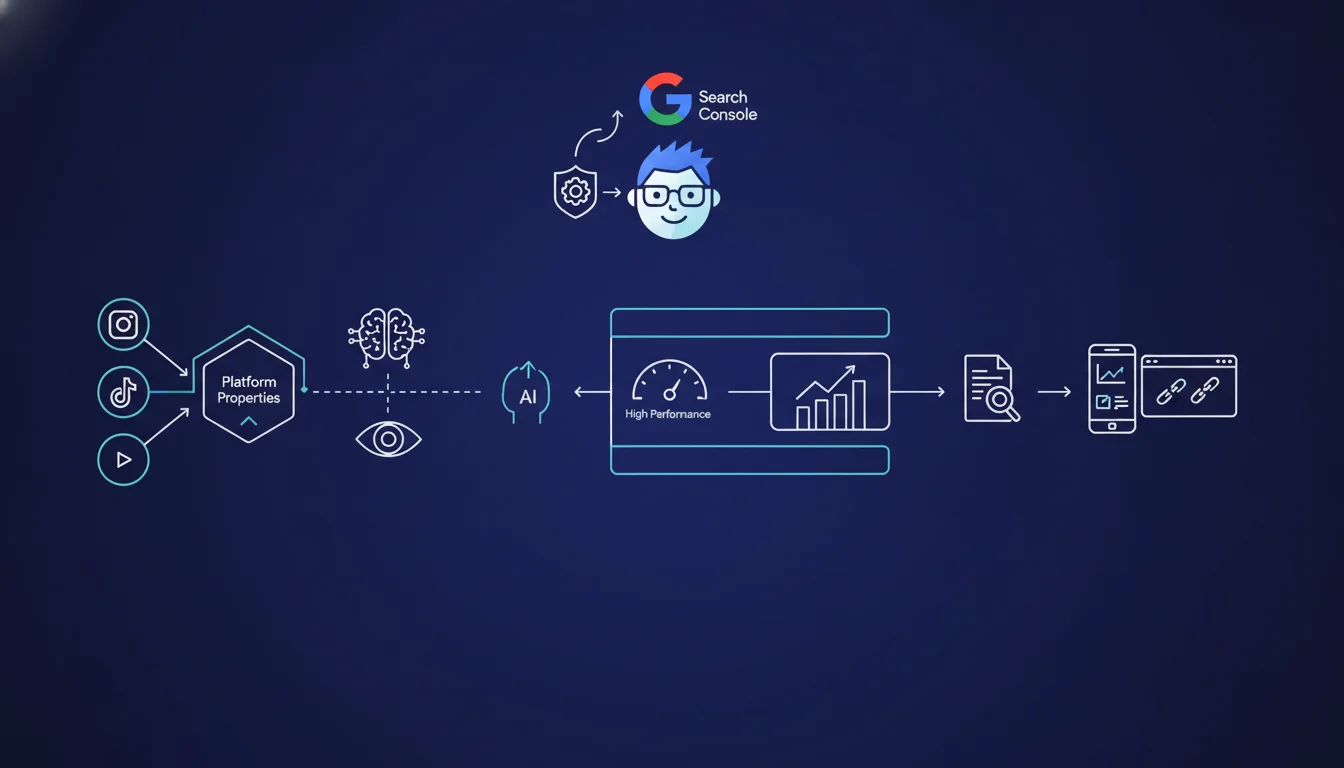
Google Search Console now integrates Platform Properties, a feature that allows creators to track the performance of their content published on Instagram, TikTok, and YouTube directly from the console. For SEO professionals, this means Google is officially recognizing the link between social presence and visibility in its results. The real question is whether this data truly enhances SEO strategies or if it’s primarily a monitoring tool disconnected from organic ranking.
What you need to understand
What exactly is Platform Properties?
Platform Properties is a new section in Google Search Console that centralizes performance data for your content published on third-party platforms. Essentially, you can now see how many times your TikTok videos, Instagram posts, or YouTube videos appear in Google search results, how many clicks they generate, and their average position.
This development marks a significant change: Google is officially acknowledging that social content is part of the search ecosystem. Until now, these platforms remained in separate silos. Now, you can treat your social profiles like traditional web properties in GSC, with reports similar to those of a conventional website.
Why is Google launching this feature now?
The answer can be summed up in one word: SGE (Search Generative Experience) and recent changes in the SERPs. Google is increasingly incorporating multimedia content and a variety of sources into its results. TikTok or YouTube videos frequently show up in position zero, with Instagram carousels appearing in image searches.
By centralizing this data, Google makes life easier for creators juggling multiple platforms. But more importantly, it positions itself as the central analytics hub for your overall digital presence. A clever way to maintain control over an ecosystem that partially escaped its grasp.
Which platforms are included and how does it work?
Currently, there are three platforms: Instagram, TikTok, and YouTube. To enable Platform Properties, you need to verify ownership of your social profile in Search Console, just like you would verify a web domain. Google provides a specific validation process for each platform.
Once validated, data is updated within the usual timeframe of 24-48 hours. You will then see impressions, clicks, CTR, and average position of your social content in Google results. This does not include the platforms themselves, only when they appear in Google search.
- Data centralization: all your web and social properties in one interface
- Identical metrics: the same indicators as for a classic website (impressions, clicks, CTR, position)
- Validation required: specific verification process for each social profile
- Limited scope: only appearances in Google Search are counted, not native performance on the platforms
- Three pilot platforms: Instagram, TikTok, YouTube to start
SEO Expert opinion
Does this feature really change the game for SEO?
Let’s be honest: Platform Properties is primarily a monitoring tool. It does not change ranking algorithms, nor does it create new ranking signals. What you’re measuring here is the visibility that Google already grants to your social content in its results.
The real benefit? Identifying which types of social content Google deems worthy of appearing in its SERPs. If your TikTok videos generate thousands of impressions in Google but have a poor CTR, you have a clear signal: the format appeals to the algorithm, but your titles or thumbnails are not converting. Conversely, a high CTR on low impressions suggests that Google is testing you on niche queries.
What data is still missing?
Google remains silent on several critical points. First, No information on the criteria that determine whether social content appears in the results. Is it related to native view counts on the platform? Engagement? Freshness? [To be verified] as no official correlation is documented.
Next, it’s impossible to know if these appearances have an indirect impact on the ranking of your main site. If your YouTube video ranks well, does that strengthen your web domain's authority? Google does not clarify this. Empirical tests show conflicting results depending on the niches.
Should we fear increased dependence on third-party platforms?
This is a risk. By officially tracking social performance in GSC, Google implicitly encourages creators to multiply channels. The problem is you do not control Instagram, TikTok, or even YouTube as you control your own site.
A change in the algorithm on TikTok, an account suspension on Instagram, and you lose a source of traffic you thought was secured. Platform Properties does not change this structural fragility. It’s a thermometer, not an action lever. Do not confuse measured visibility with strategic mastery.
Practical impact and recommendations
How to activate Platform Properties for your social profiles?
Go to Google Search Console, Settings section. Click on "Add a property" and select the platform type (Instagram, TikTok, or YouTube). Google will ask you to verify your identity via a specific code or OAuth login depending on the platform.
Once validated, data starts updating within 48 hours. You will find your social profiles listed alongside your web domains in the property selector. Each profile has its own performance report with the same filters (queries, pages, countries, devices) as for a traditional site.
Which metrics to prioritize and why?
The click-through rate (CTR) is your number one indicator. A low CTR on high impressions signals a packaging problem: your titles, descriptions, or visuals are not converting. Conversely, a high CTR on low impressions indicates that Google is testing you on highly targeted queries.
The average position remains relevant but should be contextualized. Social content often appears in video carousels or dedicated sections, not in the classic 10 blue links. An 8th position for a YouTube video does not hold the same value as an 8th position for a standard web page. Look at the trend over time instead.
Should we adapt our content strategy based on this data?
Yes, but without overhauling everything. If Platform Properties reveals that your TikTok short videos are generating qualified traffic from Google, invest more in that format. If your Instagram posts stagnate despite a good native audience, it indicates that Google does not find them relevant for its users.
The mistake would be to produce content solely to please Google at the expense of the native audience for each platform. Keep in mind that 90% of your social visibility comes from the internal algorithms of the platforms, not from Google. Platform Properties is there to identify complementary opportunities, not to drive your entire strategy.
- Check and activate all your eligible social profiles in GSC now
- Compare the CTR of your social content vs your web pages on similar queries
- Identify the types of content (tutorials, reviews, FAQs) that rank best in Google from your platforms
- Cross-reference GSC data with native analytics (TikTok Analytics, Instagram Insights, YouTube Studio)
- Test optimizing titles and descriptions of your social content to improve Google CTR
- Monitor the monthly evolution of impressions to detect algorithmic trends
❓ Frequently Asked Questions
Platform Properties affiche-t-il les performances natives sur TikTok ou seulement dans Google ?
Puis-je suivre plusieurs comptes Instagram ou YouTube dans la même Search Console ?
Les données Platform Properties influencent-elles le classement de mon site web principal ?
Combien de temps faut-il pour que les données Platform Properties apparaissent ?
Peut-on exporter les données Platform Properties pour des analyses croisées ?
🎥 From the same video 4
Other SEO insights extracted from this same Google Search Central video · duration 6 min · published on 26/10/2026
🎥 Watch the full video on YouTube →
💬 Comments (0)
Be the first to comment.