
Official statement
Other statements from this video 14 ▾
- □ Do ccTLDs Really Give You a Geographic SEO Advantage?
- □ Does your domain extension really impact SEO rankings?
- □ Should you really avoid cheap domain extensions for your SEO?
- □ Why does Google treat certain ccTLDs the same way as generic domain extensions?
- □ Do .edu and .gov domains really provide an SEO advantage?
- □ Does your domain extension (TLD) really impact your search rankings?
- □ Does a .coffee or .tech domain really boost your search rankings?
- □ Should you always verify a domain's history before buying it?
- □ Why can't you detect manual actions before buying an expired domain?
- □ Do hyphens in domain names really hurt your SEO rankings?
- □ Should you prioritize branding over exact keywords in your domain name?
- □ Does your choice between www and non-www really impact your search rankings?
- □ Is it time to ditch the m. subdomain for mobile?
- □ Should you really avoid publishing a 'Coming Soon' page on a new domain?
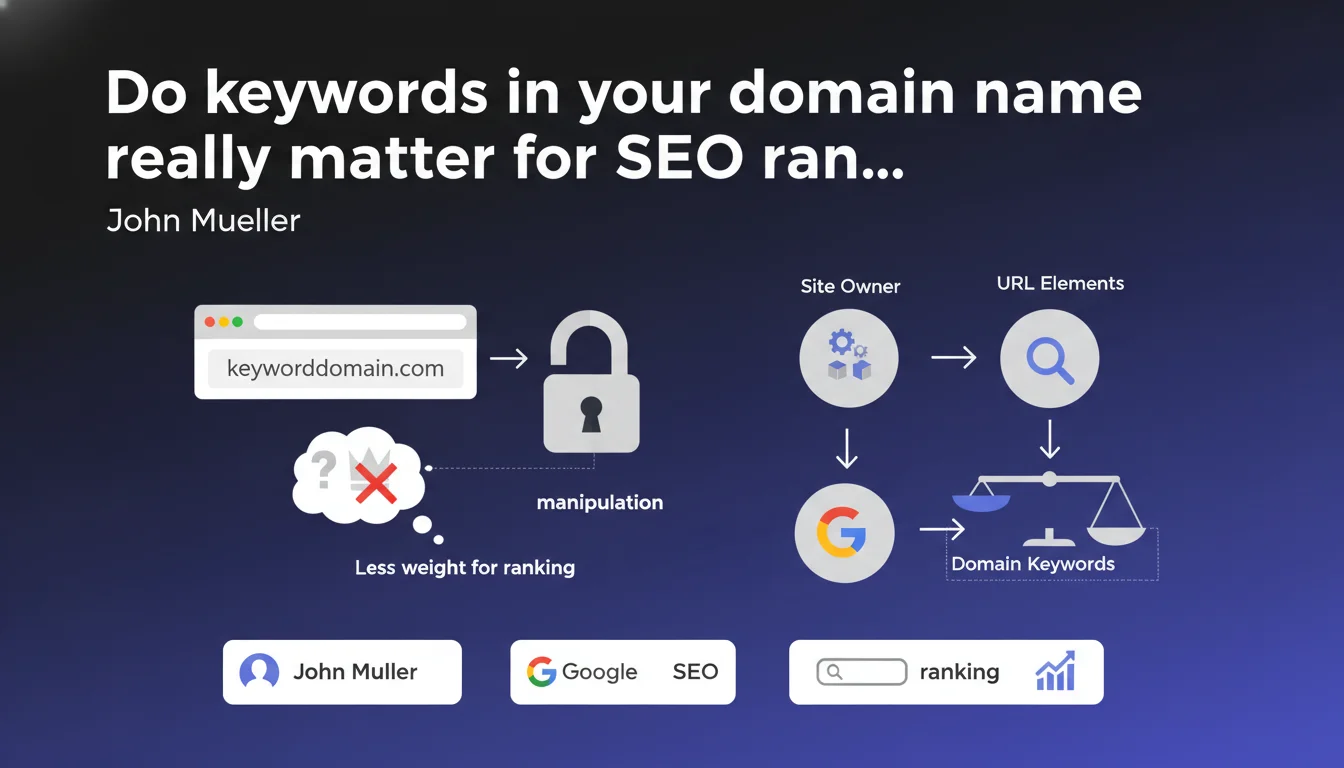
Google likely doesn't give much weight to keywords in the domain name for ranking purposes, since these elements can be easily manipulated by the site owner. John Mueller makes it clear: anything in the URL is controllable, so Google doesn't trust it as much as people think.
What you need to understand
For years, buying a domain containing a strategic keyword was considered an easy SEO boost. A site about running shoes was called running-shoes.com, and that was almost enough to position it in the top results.
Mueller's statement clarifies what was already office gossip: those days are over. Google has been gradually reducing the weight of Exact Match Domains (EMDs) for years.
Why doesn't Google trust keywords in the domain anymore?
The reason is straightforward — these elements are easily manipulable. Anyone can buy a domain stuffed with keywords without having any quality content behind it. Google had to drastically reduce the weight given to this signal.
Historically, EMDs were over-optimized by spammers who created dozens of sites with ultra-precise domains to rank without effort. Google responded with algorithmic updates specifically targeting this type of practice.
Does this mean a domain with keywords is useless?
Not exactly. A keyword-rich domain can have an indirect positive effect: it improves click-through rate (CTR) in search results, strengthens brand recall, and can facilitate thematic targeting in users' minds.
But for pure algorithmic ranking, its impact is marginal. Google looks first at content, backlinks, site authority, user experience — not whether your domain contains "plumber" or "lawyer".
- Keywords in the domain have little direct weight on ranking
- Google distrusts any signal easily manipulable by the site owner
- A keyword-rich domain can improve CTR and recall, but not algorithmic ranking
- The real SEO levers remain content, backlinks, and overall site authority
SEO Expert opinion
Is this statement consistent with real-world observations?
Yes, completely. For several years now, we've observed that sites with branded domains (like Airbnb, Uber, etc.) crush exact match domains in SERPs. Exact match domains are no longer enough to compensate for a lack of content or backlinks.
That said — and this is where it gets complicated — there are still niches where EMDs perform well. Often in competitive local sectors, a domain like plumber-paris-15.com can still hold its own. But be careful: this is probably not because of the domain itself, but because these sites have also optimized their Google Business Profile, local content, etc.
In what cases doesn't this rule fully apply?
There's an important nuance regarding branded domains. If your brand IS the keyword (for example, a site actually called "Direct Auto Insurance"), then having these words in the domain isn't manipulative — it's legitimate.
Google probably makes a distinction between an opportunistic EMD (purchased solely for SEO) and a domain that reflects genuine brand identity. [To be verified] — Google has never explicitly stated the precise criteria for this distinction, but field observations suggest that an older domain with real activity and brand signals (branded searches, citations, natural backlinks) will be treated better than a freshly created EMD.
Should you completely avoid EMDs?
No. If you're launching a new project and the exact match domain is available, there's nothing wrong with taking it — as long as you don't rely on it for ranking. Use it as a marketing asset (recall, CTR) rather than an SEO lever.
Practical impact and recommendations
What should you concretely do if you already have an EMD?
If your site is already built on an exact match domain, don't change anything for now. A domain change is a risky operation that can destroy years of SEO work if mishandled.
Instead, focus on the real levers: improving content quality, strengthening your backlink profile, optimizing user experience. If your EMD is still performing, it's because of these factors — not the domain itself.
What mistakes should you avoid when choosing a new domain?
Don't fall into the opposite trap: choosing an incomprehensible or overly generic domain just to avoid EMDs. The ideal is still a domain that's short, memorable, and aligned with your brand.
Also avoid domains stuffed with hyphens (plumber-paris-15-cheap.com), which smell like spam from a mile away and hurt credibility. Google tolerates them, but users avoid them.
- Don't migrate an existing site to an EMD just for SEO — it's not worth the effort
- For a new project, prioritize a short, memorable branded domain
- If you have an EMD, invest in content and backlinks rather than counting on the domain
- Avoid multi-hyphenated domains that hurt credibility
- Build strong brand signals: branded searches, citations, social media presence
The key takeaway: a good domain facilitates recall and can improve CTR, but it will never replace a solid SEO strategy. Focus your efforts on the ranking factors that actually matter — content, backlinks, authority.
These optimizations can require deep expertise and considerable time. If you're looking to maximize performance without stretching your resources too thin, working with a specialized SEO agency can help you structure a coherent strategy and avoid costly mistakes.
❓ Frequently Asked Questions
Un domaine avec mot-clé améliore-t-il au moins le taux de clic dans les résultats ?
Si je change mon EMD pour un domaine de marque, est-ce que je perds mon positionnement ?
Les sous-domaines avec mots-clés sont-ils traités différemment ?
Est-ce que Google pénalise activement les EMD ?
Les extensions de domaine (.fr, .com, .io) ont-elles un impact SEO ?
🎥 From the same video 14
Other SEO insights extracted from this same Google Search Central video · published on 20/07/2023
🎥 Watch the full video on YouTube →
💬 Comments (0)
Be the first to comment.