
Official statement
Other statements from this video 10 ▾
- □ Should you still optimize meta descriptions if Google ignores them anyway?
- □ Should you still optimize meta descriptions for SEO in 2024?
- □ Is one backlink really all Google needs to discover and index your site?
- □ Do you still need rel=prev/next for pagination in 2024?
- □ Is boilerplate content really hurting your pages' search rankings?
- □ Is boilerplate really a threat to your search engine rankings?
- □ How does Google really determine user location for local SEO?
- □ Are IP geolocation databases really reliable enough for international SEO?
- □ Can Google really display rich results without schema markup?
- □ Should you configure the Content-Language header for PDFs and non-HTML files?
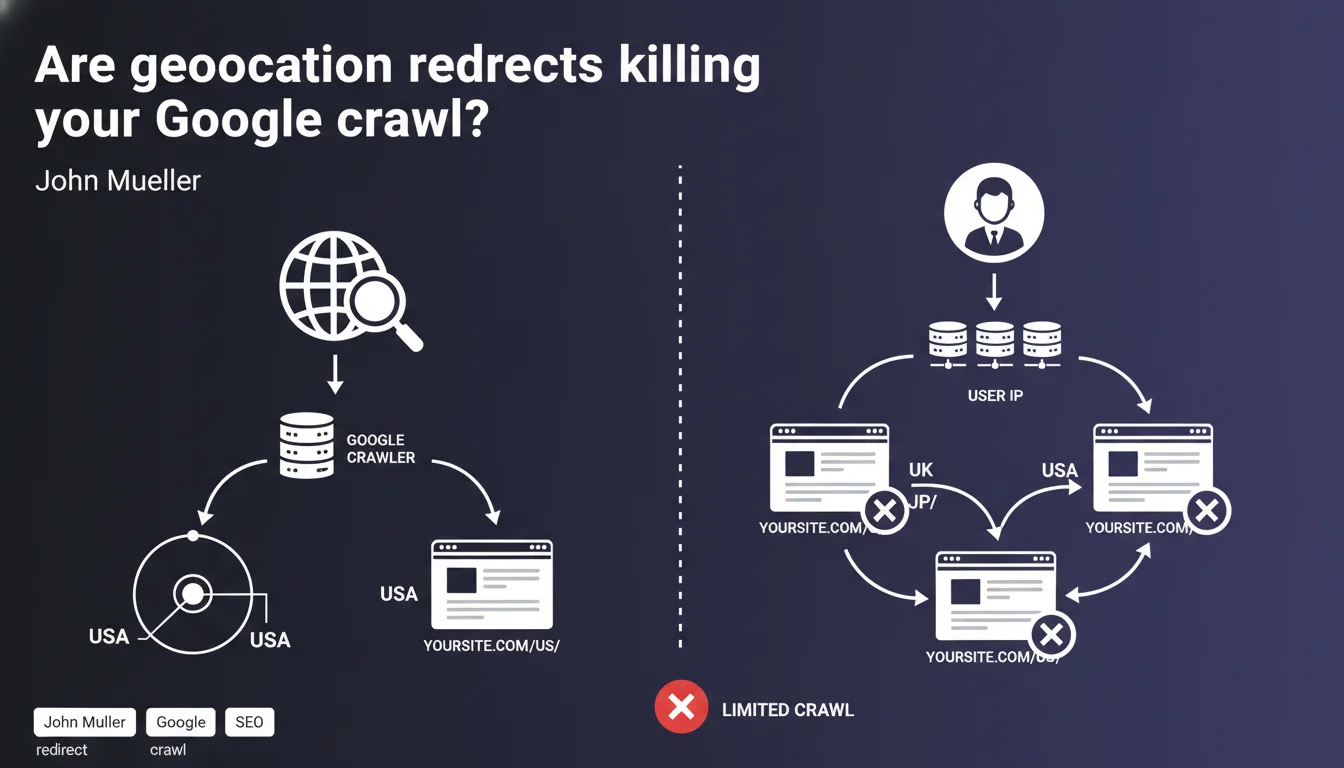
Google crawls from a single location (typically the US) and only sees one version of your site if other versions are automatically redirected by IP. Result: regional versions risk never being indexed if you rely solely on IP redirects to serve localized content.
What you need to understand
Why does Google only see one version of your site?
The Googlebot crawls primarily from US data centers. When a site detects the bot's IP and automatically redirects it to a regional version (for example .com to .fr), Google only sees this redirected version. Other language or regional variants remain invisible.
In practical terms? If your site.com automatically redirects to site.fr for French IPs, US Googlebot will never access site.de, site.es or site.it. These versions will be neither crawled nor indexed.
What's the difference from user-agent redirects?
Redirects based on user agent can theoretically target Googlebot specifically, but remain problematic. Google recommends not serving different content based on visitor identity — this is cloaking in some cases.
IP redirection poses a distinct problem: it doesn't specifically target bots, but mechanically prevents access to multiple site versions from the same geographic origin.
What are the recommended alternatives?
- Hreflang: signals Google about language/regional variants without automatically redirecting
- Manual selector: lets users choose their language/region via a dropdown menu
- Voluntary redirects: suggest a change ("You appear to be in France, would you like to visit site.fr?") rather than forcing a redirect
- Subdirectories or subdomains: structure /fr/, /de/, /es/ accessible from all geolocations
SEO Expert opinion
Is this technical limitation confirmed in the field?
Yes, and it's been documented for years. Sites with international presence that use automatic IP redirects regularly find that certain regional versions disappear from the index or never enter it at all. The problem particularly affects media content and e-commerce sites with distinct catalogs by region.
Let's be honest: this isn't a Google bug, it's a limitation inherent to how crawling works. Google can't guess that site.it exists if site.com systematically redirects it to site.fr whenever it detects a European IP.
Are there cases where IP redirect remains acceptable?
In theory, if all regional versions share exactly the same content (simple translation, no different catalog), the loss of indexation isn't critical — one version is enough. But this situation is rare in practice.
The real problem appears when each region has distinct content, products, or prices. There, losing the indexation of one version = losing organic traffic on that market. [To verify]: Google claims to crawl "occasionally" from other locations, but no frequency or guarantee is communicated.
Does hreflang really solve the problem?
Hreflang signals variants, but guarantees nothing if Google can't crawl them. If an IP redirect blocks access, hreflang is useless — you must first make URLs accessible from all geolocations.
In other words: hreflang is the signaling solution, but removing (or making optional) the IP redirect is the essential technical prerequisite.
Practical impact and recommendations
What should I do if my site already uses IP redirects?
First step: audit Search Console to identify which regional versions are absent from the index. Look at performance by country — if certain markets show zero impressions while a local version exists, that's a clear signal.
Next, two options: either you completely remove the automatic redirect and offer a manual selector, or you implement a non-blocking detection (suggest version change, don't force redirect).
How should I properly structure a multilingual/multi-regional site?
- Use subdirectories (/fr/, /de/, /es/) or subdomains (fr.site.com) rather than separate domains
- Implement hreflang on all pages with language/regional variants
- Make all versions accessible from any geolocation (no IP blocking)
- Add a visible language selector in the header to enable manual choice
- Verify in Search Console that Google indexes each regional version properly
What mistakes should I absolutely avoid?
Never combine IP redirect + hreflang thinking it compensates — it doesn't work. Don't assume Google will naturally crawl from multiple locations to discover your variants. And most importantly, don't ignore Search Console data: if a regional version shows zero organic traffic, it's rarely a demand problem.
❓ Frequently Asked Questions
Google crawle-t-il vraiment depuis une seule localisation ?
Puis-je utiliser une redirection IP uniquement pour les utilisateurs, et servir Googlebot différemment ?
Le hreflang fonctionne-t-il si les versions régionales sont bloquées par IP ?
Quelle structure URL choisir pour un site multilingue : sous-domaines ou sous-répertoires ?
Comment vérifier si mes versions régionales sont indexées ?
🎥 From the same video 10
Other SEO insights extracted from this same Google Search Central video · published on 25/04/2024
🎥 Watch the full video on YouTube →
💬 Comments (0)
Be the first to comment.