
Official statement
Other statements from this video 10 ▾
- □ Does Google really reduce SEO to just two main areas?
- □ Are there really any secrets to ranking first on Google?
- □ Does Google's SEO Starter Guide really contain all the essential techniques you need to rank higher?
- □ Why does Google recommend Search Console over Trends for SEO technical requirements?
- □ Is Google Trends really effective for identifying the right keywords?
- □ Can Google Trends really uncover your hidden SEO opportunities?
- □ Should you really publish your content before seasonal search peaks hit?
- □ Is geographic optimization the missing piece that's holding back your SEO results?
- □ Can Google Trends really accelerate your YouTube video strategy?
- □ Why do YouTube search trends differ so dramatically from traditional Google web search?
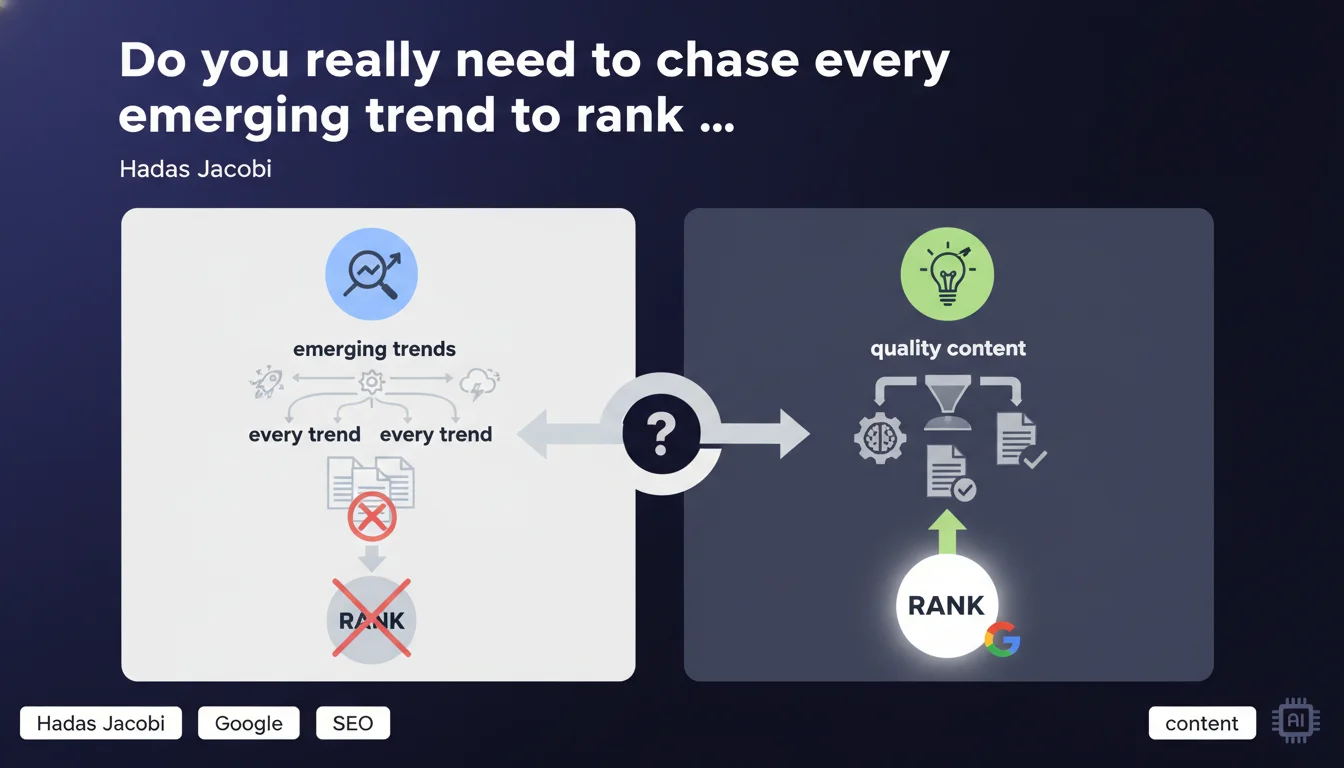
Google states that effective SEO requires constant monitoring of emerging trends and new search terms in your industry. The goal: produce quality content at the right time, when demand starts to pick up. But between theory and practice, timing and relevance remain the real challenges.
What you need to understand
What does Google mean by "staying aware of emerging trends"?
Google is suggesting here a proactive approach: identify emerging subjects and new search queries before they become saturated. The idea? Be present as soon as demand starts to structure itself, rather than arriving when the top 10 is already locked by established players.
Concretely, this involves regular industry monitoring — tracking forums, social media, Google Trends, keyword research tools to detect volume shifts. Not a new concept, but Google formalizes it as a pillar of modern SEO.
Why does Google specifically emphasize "search terms"?
Because semantics constantly evolve. A concept may have existed for years, but the vocabulary used by searchers changes — new expressions, anglicisms, acronyms. If you keep optimizing for terms losing popularity, you miss the boat.
Google values sites that understand these semantic shifts and adjust their content accordingly. It's a way to evaluate thematic freshness, not just publication date.
What does "high-quality content for users" mean?
Here, Google intentionally remains vague. "High quality" = depth, comprehensiveness, authority? Or simply quickly answering an emerging intent?
In the context of emerging trends, this can be interpreted as: producing useful and comprehensive content on a topic still underexplored, before competition intensifies. But the formula remains unclear.
- Active monitoring: watch for the emergence of new subjects and terms in your industry
- Editorial responsiveness: ability to publish relevant content quickly when a trend emerges
- Maintained quality: don't sacrifice depth for speed — balance is crucial
- Semantic understanding: follow the evolution of vocabulary used by your target audience
SEO Expert opinion
Is this statement consistent with real-world practices?
Yes and no. In ultra-competitive markets, arriving early on a trend can indeed give you an advantage — for a few weeks or months, before major players jump in. But in stable niches, this logic applies less.
The real problem: Google says nothing about thematic relevance. If your site has covered gardening for 10 years and you suddenly publish an article on an emerging tech trend just because volume is exploding, you probably won't rank. Sector authority matters as much as timing.
What nuances should we add?
Following trends doesn't mean jumping on everything that moves. You must distinguish between ephemeral micro-trends (buzz lasting a few days) and structural evolutions in your sector. Producing content on a topic that disappears in two weeks is wasted resources.
Second nuance: "high quality" is relative to the subject's maturity stage. On a nascent trend, an 800-word well-structured article may suffice. On an established topic, you need 3000 words, sources, visuals, depth. Google specifies nothing here. [To be verified]
In what cases doesn't this rule apply?
For high domain authority sites that rank through inertia, following trends is a bonus, not an obligation. Their existing content continues performing without constant adjustment.
For new small sites, it's different — targeting emerging trends can be a smart entry strategy, since competition is still weak. But without backlinks or history, even good timing guarantees nothing.
Practical impact and recommendations
What should you concretely do to apply this recommendation?
First, set up structured monitoring: Google Trends, keyword suggestion tools, specialized forums, Reddit, Twitter. The goal is to spot queries whose volume is starting to grow before they explode.
Next, define a reactive editorial calendar. You must be able to produce and publish content in days maximum when a trend emerges. This requires dedicated resources — writers, fast validation, no three-week approval tunnels.
What mistakes should you absolutely avoid?
Don't confuse speed with poor quality. Publishing shallow content just to be first on a trend is counterproductive. Google talks about "high quality" — a mediocre article won't rank long-term, even if it launches early.
Another trap: straying from your core topic. If a trend explodes but has no connection to your sector, forget it. You won't rank, and it blurs your site's thematic coherence.
How do you verify this strategy is working on your site?
Track impressions and clicks in Search Console on your recent trend-related content. If you rank quickly on emerging queries, that's a good sign. If your articles take months to generate traffic, your timing might be too late.
Also compare your average position on emerging vs established topics. If you rank better on new subjects, your monitoring strategy is working.
- Set up Google Trends alerts and monitor volume curves on your target keywords
- Identify 3-5 reliable industry monitoring sources (forums, specialized media, social networks)
- Implement an editorial process capable of publishing quality content in under 72 hours
- Prioritize trends aligned with your topic and current audience
- Avoid ephemeral subjects with no long-term potential — focus on structural evolutions
- Monitor performance in Search Console to validate ROI of this approach
❓ Frequently Asked Questions
Est-ce que suivre les tendances montantes suffit pour bien ranker ?
Comment identifier une tendance montante avant qu'il ne soit trop tard ?
Faut-il créer du contenu sur toutes les tendances émergentes ?
Quelle vitesse de publication est nécessaire pour capitaliser sur une tendance ?
Cette stratégie fonctionne-t-elle pour tous les types de sites ?
🎥 From the same video 10
Other SEO insights extracted from this same Google Search Central video · published on 25/09/2024
🎥 Watch the full video on YouTube →
💬 Comments (0)
Be the first to comment.