
Official statement
Other statements from this video 11 ▾
- □ Does Google really index your PDFs, or does it transform them first?
- □ Does content weight really vary based on its location in HTML versus PDF?
- □ Does Google really depend on Adobe to properly index your PDFs?
- □ Does Google really index source code files the same way as regular text content?
- □ Why do raw source code files fail to rank properly in Google search results?
- □ Should you really stop storing all your PDFs in a single /pdfs/ folder?
- □ Does Google Really Never Index a Single Image Without a Hosting Page?
- □ Does Google really filter out personal data before indexing your pages?
- □ Does your file extension (.html, .php, .txt) really impact Google SEO rankings?
- □ Does Google really index all your XML files?
- □ Can you really get JSON and plain text files indexed in Google search results without metadata?
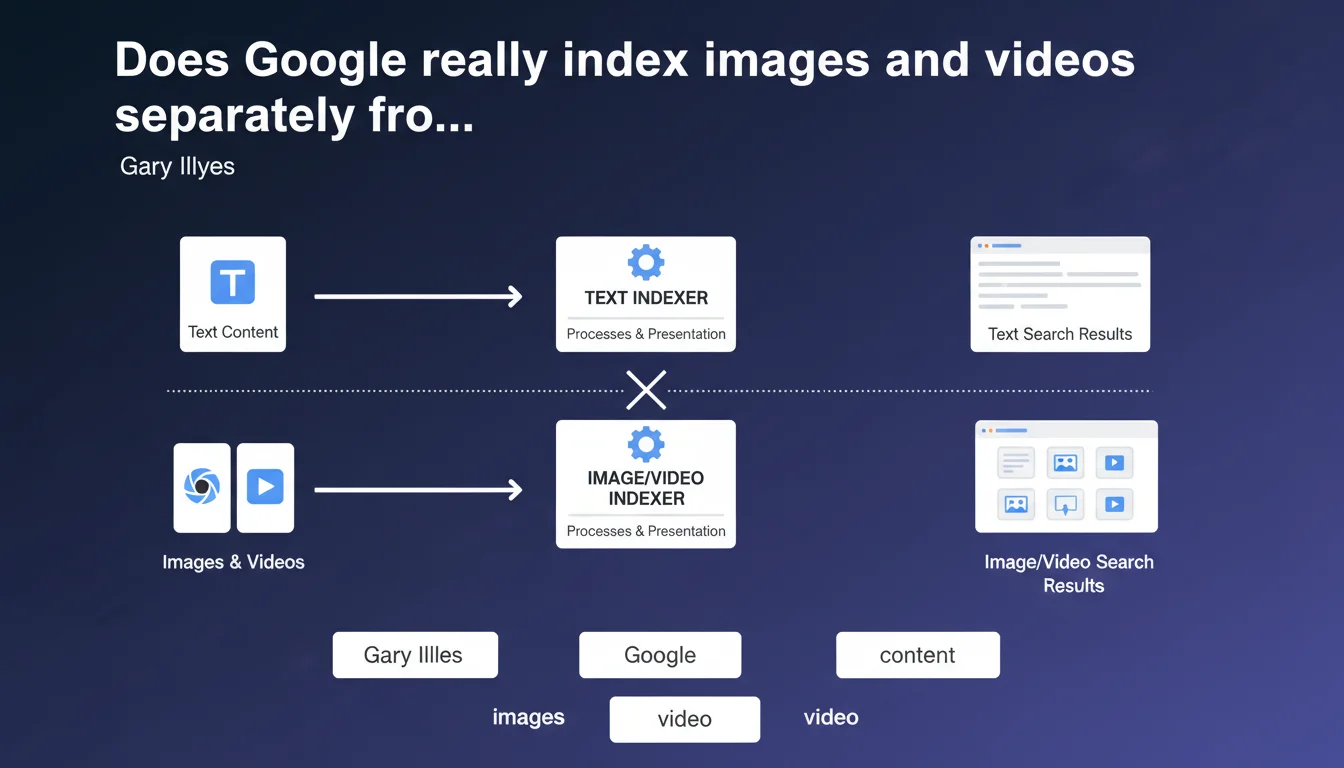
Google confirms that images and videos go through a completely distinct indexing system from textual content. Each type of media uses its own processes, evaluation criteria, and presentation modes in search results. In practice, optimizing for Google Images offers no guarantee of benefits for text ranking — and vice versa.
What you need to understand
What does this concretely mean for Google's architecture?
Google doesn't treat your site as a single entity. Each type of content passes through a specific indexing pipeline with its own rules, its own relevance signals, and its own ranking algorithms.
Your text goes through Caffeine (or its evolutions), your images through a visual indexer that analyzes pixels, EXIF metadata, and semantic context. Your videos? Yet another system entirely. Three parallel worlds within the same infrastructure.
Why does this technical distinction matter for SEO?
Because ranking factors don't automatically overlap. A powerful backlink to your page helps your textual content. But for your image to rank higher in Google Images, different signals matter: visual quality, dimensions, compression, filename relevance, descriptive alt attribute.
This separation explains why some pages ranking at position 1 in regular search never appear in Google Images for the same queries — and vice versa.
- Separate indexing: text, images, videos follow distinct paths
- Different ranking criteria: what boosts one doesn't necessarily help the other
- Independent result presentation: regular SERP ≠ Google Images ≠ Google Videos
- Potentially staggered crawling: an image can be indexed before or after the surrounding text
Has this separation always existed at Google?
Yes and no. Google Images has existed since the early 2000s, but indexing systems have evolved. Initially, visual indexing was rudimentary — essentially based on textual metadata (alt tags, titles, context).
Today, Google analyzes the pixels themselves thanks to computer vision. The image indexer understands visual content independently of accompanying text. It's an autonomous system, not just a metadata layer on top of the main index.
SEO Expert opinion
Does this statement change established SEO practices?
Honestly? No. Serious practitioners already knew this. But Gary Illyes officially confirms what field tests have shown for years: optimizing for Google Images and optimizing for regular search are two different disciplines.
The problem is that many sites still completely neglect visual optimization. They throw up 3MB images without relevant filenames, without worked-out alt attributes, without WebP compression. Then they wonder why they get no traffic from Google Images.
What nuances should be applied to this claim?
You need to distinguish between indexing and semantic context. Yes, the systems are separate. But Google still crosses signals.
Example: an image on a high-authority topical page — say, a medical article published by a recognized institution — will likely get a boost in Google Images thanks to the semantic context provided by surrounding text. The image indexer doesn't exist in isolation. It consumes signals from the broader ecosystem of the page.
When does this rule apply less strictly?
When Google mixes formats in a single SERP. Rich results (image carousels, pinned videos, People Also Search For with thumbnails) break the theoretical separation.
In these cases, the text indexer can pull in visual content from parallel indexes to enhance user experience. But that's still cross-presentation, not a merger of the indexing systems themselves.
Practical impact and recommendations
What concretely must you do to optimize each index?
For the text index, you know the drill: relevant content, clean HTML structure, internal linking, topical authority, quality backlinks. The fundamentals haven't changed.
For the image index, it's a different ballgame. Descriptive filenames (not "IMG_4527.jpg"), rich but natural alt attributes, WebP or AVIF format for compression, dimensions suited to display context, ImageObject structured data when relevant.
For the video index: text transcriptions, structured chapters, optimized thumbnails, VideoObject markup, hosting on platforms that Google crawls efficiently (YouTube obviously, but also Vimeo, Wistia, or natively with a video sitemap).
What mistakes must you absolutely avoid?
First classic mistake: believing that a page ranking well in text search will automatically boost its images to the top of Google Images. Nope. If your visuals are poorly optimized, they'll stay invisible even if your article is a hit.
Second mistake: neglecting media loading speed. A non-lazy-loaded video or non-responsive image tanks your Core Web Vitals — and there, the impact potentially crosses indexers since overall user experience degrades.
- Name each image file with a relevant description before uploading
- Write unique, descriptive alt attributes (not just the keyword repeated)
- Systematically compress (WebP, AVIF) without sacrificing visual quality
- Implement lazy loading for below-the-fold images
- Add ImageObject / VideoObject structured data when justified
- Create separate image AND video sitemaps if you have large volumes
- Check effective indexing via Google Search Console (Images and Videos tabs)
- Monitor organic traffic by channel (Web / Images / Videos) to spot missed opportunities
How do you verify that your visual content is properly indexed?
In Google Search Console, Performance tab — filter by search type. You'll see three options: Web, Image, Video. Analyze impressions and clicks separately for each channel.
If you're getting zero traffic from Google Images while your site contains hundreds of relevant visuals, that's a red flag. Either your images aren't being indexed (robots.txt blocking, poorly implemented lazy loading), or they're indexed but poorly optimized for ranking.
In summary: treat each content type as a distinct acquisition channel with its own optimization strategy. The days when optimizing text alone could capture all organic traffic are long gone — if they ever truly existed.
The complexity of these cross-optimization efforts, especially on large sites or technically constrained architectures, often justifies bringing in external expertise. A specialized SEO agency can conduct fine-grained audits of each indexer, identify missed opportunities, and deploy a coherent strategy across all organic channels without you having to juggle three parallel methodologies.
❓ Frequently Asked Questions
Un backlink vers ma page aide-t-il mes images à ranker dans Google Images ?
Dois-je créer des sitemaps séparés pour les images et vidéos ?
Google Images peut-il indexer une image même si la page texte ne l'est pas ?
Les Core Web Vitals impactent-ils le ranking dans Google Images ?
Faut-il optimiser différemment pour Google Discover et l'index textuel classique ?
🎥 From the same video 11
Other SEO insights extracted from this same Google Search Central video · published on 08/09/2022
🎥 Watch the full video on YouTube →
💬 Comments (0)
Be the first to comment.