
Official statement
Other statements from this video 14 ▾
- □ Do ccTLDs Really Give You a Geographic SEO Advantage?
- □ Does your domain extension really impact SEO rankings?
- □ Should you really avoid cheap domain extensions for your SEO?
- □ Why does Google treat certain ccTLDs the same way as generic domain extensions?
- □ Do .edu and .gov domains really provide an SEO advantage?
- □ Does your domain extension (TLD) really impact your search rankings?
- □ Does a .coffee or .tech domain really boost your search rankings?
- □ Should you always verify a domain's history before buying it?
- □ Why can't you detect manual actions before buying an expired domain?
- □ Do keywords in your domain name really matter for SEO rankings?
- □ Should you prioritize branding over exact keywords in your domain name?
- □ Does your choice between www and non-www really impact your search rankings?
- □ Is it time to ditch the m. subdomain for mobile?
- □ Should you really avoid publishing a 'Coming Soon' page on a new domain?
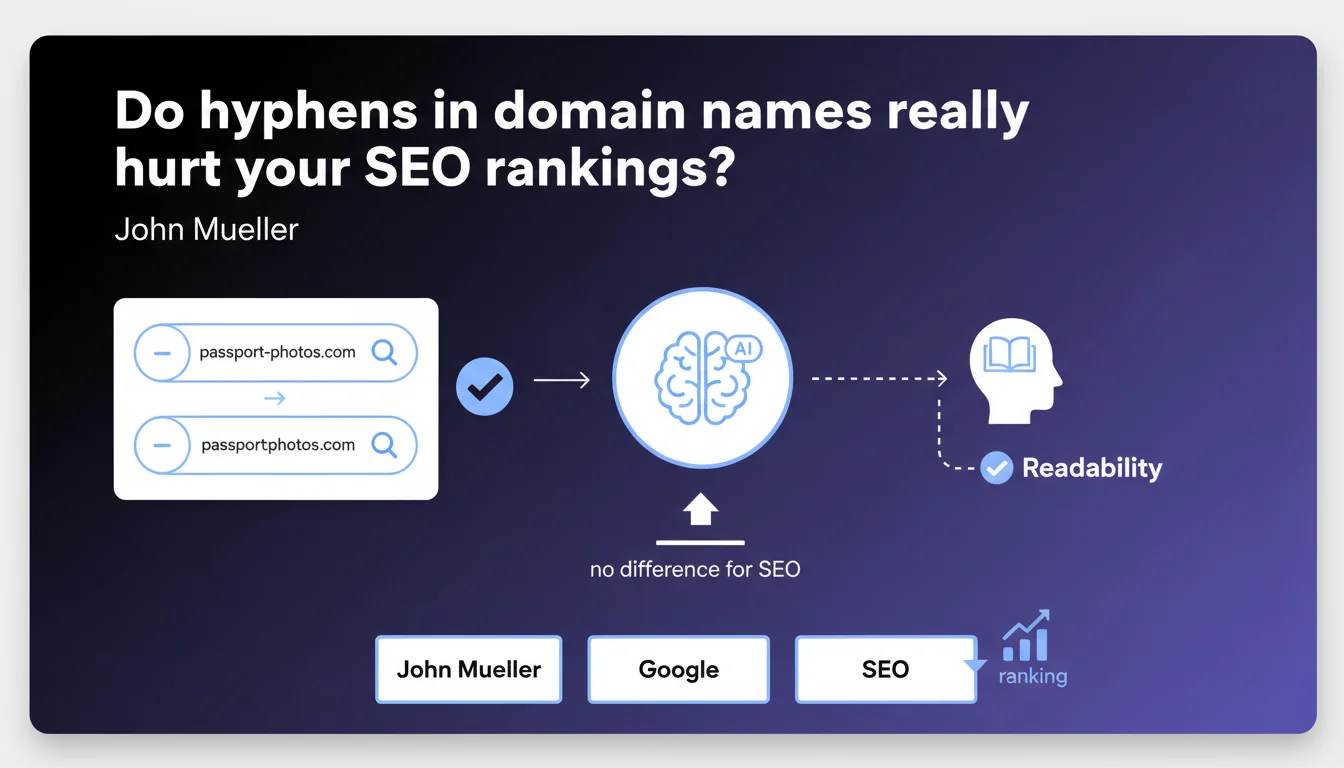
Google states that hyphens in a domain name (like passport-photos.com) have no SEO impact compared to a version without hyphens (passportphotos.com). The only difference lies in readability for the user. In other words: choose based on your preferences, not on hypothetical algorithmic optimization.
What you need to understand
The question of hyphens in domain names has come up repeatedly in SEO discussions for years. Some practitioners believe that hyphens help Google recognize keywords better, while others fear a low-quality signal associated with spammy domains.
Mueller is clear: no algorithmic difference whatsoever.
Does Google segment words better with hyphens?
No. Google's algorithms are sophisticated enough to segment words in a hyphen-free domain. Whether you write passportphotos.com or passport-photos.com, Google understands it's about "passport" and "photos".
The era when you had to mechanically facilitate the search engine's parsing is over. Semantic processing handles the job, hyphens or not.
Why do so many spammy domains use hyphens then?
Because quality domains without hyphens are already taken. Spammers fall back on hyphenated variants to quickly create dozens of satellite sites.
This historical correlation has created a negative perception — but it's not the hyphen that causes spam, it's just a symptom of limited availability for good domains.
Does user readability play an indirect role?
Yes, and that's where it gets interesting. If a hyphen improves domain memorability or reduces typing errors, it can influence direct traffic, word-of-mouth, and click-through rates on SERPs.
These behavioral signals can indirectly affect your visibility — but it's not a direct SEO factor tied to the hyphen itself.
- Hyphens don't influence Google's ranking algorithm
- Google segments words in hyphen-free domains with no technical difficulty
- The negative perception of hyphens comes from spam correlation, not algorithmic penalty
- The real impact is at the level of UX and user memorability
- Choose your domain based on your marketing criteria, not on imaginary SEO optimization
SEO Expert opinion
Is this statement consistent with real-world observations?
Completely. For years, we've observed hyphenated domains performing just as well as their non-hyphenated equivalents in competitive sectors. The idea that a hyphen is penalizing is a persistent myth with no empirical foundation.
What really matters: domain authority, content quality, backlinks, user experience. The hyphen is anecdotal compared to these levers.
What nuances should be added to this claim?
Mueller is talking about SEO in the strict sense — Google's algorithm. But a hyphenated domain can have indirect implications that need to be weighed.
Example: if your audience perceives hyphens as less professional, your click-through rate on SERPs can drop. If users mistype your URL, you lose direct traffic. These effects aren't algorithmic, but they impact your business results.
Another point: multi-hyphenated domains (like buy-cheap-shoes-online.com) send a human signal of spam, even if Google doesn't directly penalize them. Your credibility takes a hit.
Are there cases where this rule doesn't apply?
It applies everywhere. But — and this is crucial — it doesn't mean domain choice is neutral for your business.
If you're launching a brand, a brandable domain without hyphens will almost always be more memorable and stronger for building brand awareness. If you're targeting an exact-match keyword and only the hyphenated domain is available, take it without hesitation — you'll lose nothing on the SEO side.
Practical impact and recommendations
What should you do concretely if you're hesitating between two domain versions?
Forget SEO in this equation. Instead, ask yourself these questions: which domain will your customers remember best? Which one inspires more trust? Which one is easiest to say aloud?
If the non-hyphenated domain is taken and the hyphenated alternative remains clear and professional, take it without SEO guilt. If the hyphenated domain looks awkward or confusing, look for another option (different extension, different wording).
What mistakes should you avoid when choosing your domain?
Don't overload with hyphens. One hyphen is fine. Two or more and you slip into a perceived spam register, even if Google doesn't penalize you.
Avoid long-winded domains with hyphens that try to cram all your keywords. It's counterproductive for branding and complicates communication.
Don't change domains just to remove a hyphen if your current site is performing. Migration carries risks (temporary ranking loss, redirect errors) that don't justify a non-existent SEO gain.
How do you verify your domain strategy is solid?
Test memorability: tell someone your URL and see if they retype it correctly. If you have to spell it letter-by-letter or specify "with hyphen", that's a UX red flag.
Analyze your direct traffic: if many users type the wrong version (without hyphen when you have one), you're losing visitors. Secure the variants and redirect properly.
Audit your backlinks: check that sites linking to you use the correct URL. Link errors (with/without hyphen version) unnecessarily dilute your link juice.
- Choose your domain based on branding and UX criteria, not SEO
- A single, justified hyphen poses no algorithmic problems
- Avoid multi-hyphens that degrade quality perception
- Secure your domain variants (with/without hyphen) and redirect with 301s
- Don't migrate a performing domain just to remove a hyphen
- Test the memorability and ease of communication of your URL
- Monitor direct traffic to detect recurring typing errors
❓ Frequently Asked Questions
Un domaine avec tiret peut-il être pénalisé par Google ?
Les tirets aident-ils Google à mieux comprendre les mots-clés dans le domaine ?
Pourquoi tant de sites spam utilisent-ils des domaines avec tirets ?
Dois-je changer mon domaine pour retirer le tiret si mon site performe ?
Le tiret peut-il influencer indirectement mon référencement ?
🎥 From the same video 14
Other SEO insights extracted from this same Google Search Central video · published on 20/07/2023
🎥 Watch the full video on YouTube →
💬 Comments (0)
Be the first to comment.