
Official statement
Other statements from this video 12 ▾
- □ Should you trust PageSpeed Insights or Search Console to measure your site's speed?
- □ Does Google really index all of your website's content?
- □ Is Googlebot Really Ignoring Your JavaScript Links If You're Not Using <a> Tags?
- □ Does Google really reject the idea of a unified SEO score for ranking?
- □ Can you safely link to HTTP websites without hurting your SEO rankings?
- □ Does Google really expect you to write 'naturally' to rank well?
- □ Should you really delete your disavow file?
- □ Is implementing Schema markup through Google Tag Manager really holding back your SEO performance?
- □ Does blocking crawl with robots.txt actually prevent deindexation?
- □ Can you safely list the same URL in multiple sitemap files without harming your SEO?
- □ How can you index embedded iframe content without indexing the source page separately?
- □ Does a descriptive domain name really guarantee your ranking for that search query?
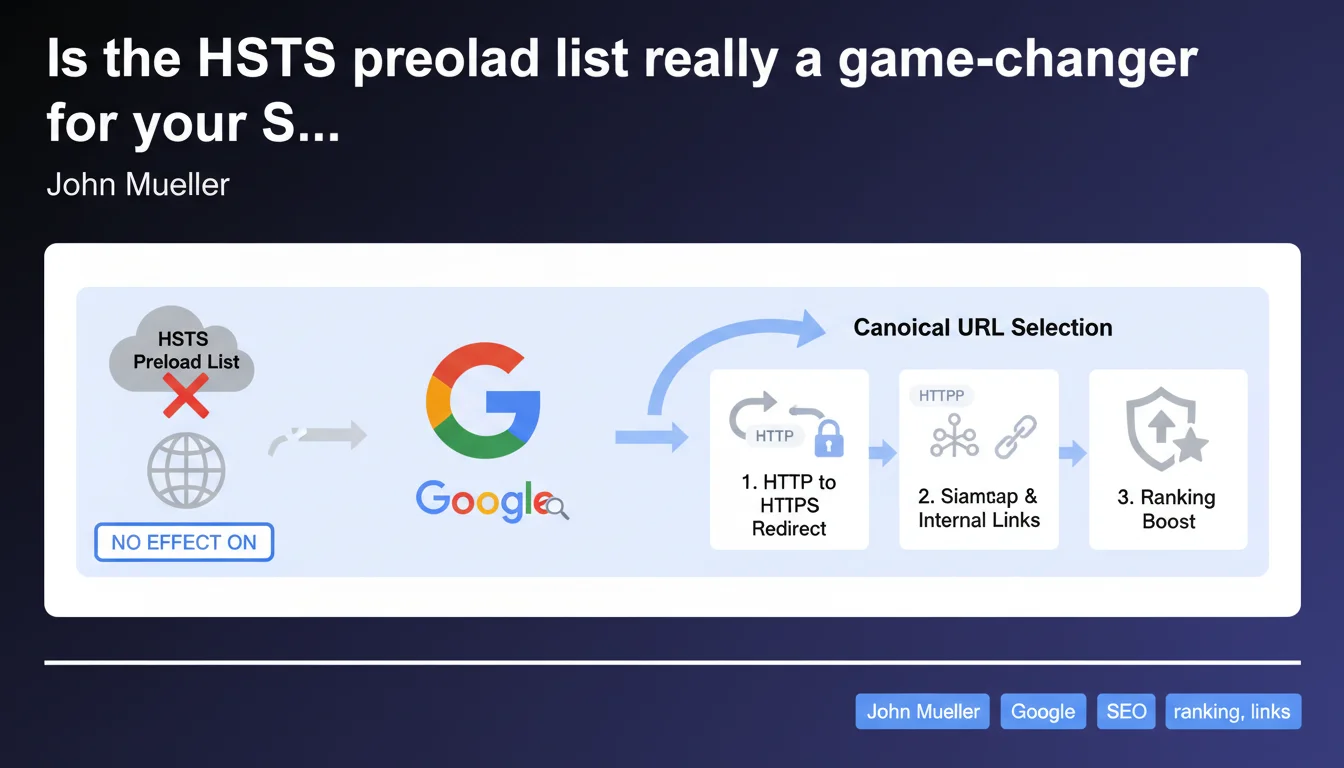
The HSTS preload list has no influence on Google's canonical URL selection. What actually matters: redirecting HTTP to HTTPS, confirming this preference via your sitemap and internal links. The HTTPS ranking boost is automatic once Google indexes the secure version.
What you need to understand
What is HSTS and why do SEO professionals talk about it?
HSTS (HTTP Strict Transport Security) is a security mechanism that forces browsers to exclusively use HTTPS for a given domain. The preload list is a list maintained by browsers that applies HSTS before a user's first visit.
Some professionals believe that being listed on this preload list could influence how Google handles canonical URLs. Mueller settles the debate: it's false. HSTS plays no role in Google's choice between HTTP and HTTPS as the reference URL.
What does Google actually do with HTTPS in terms of canonicalization?
Google selects the canonical URL based on direct signals: 301/302 redirects, canonical tags, sitemap structure, internal link consistency. If all these signals point to HTTPS, Google will index the HTTPS version.
HSTS and the preload list are browser-side mechanisms. Google doesn't need this list to understand that a site should be crawled and indexed over HTTPS — it deduces this from your server and CMS configurations.
Does the HTTPS ranking boost apply automatically?
Yes, once Google has switched to the HTTPS version as the canonical URL, the positive ranking signal activates without any additional action. No need for a preload list to benefit from it.
The nuance: this boost remains modest. It won't miraculously boost a poorly optimized site. It's one signal among hundreds, but it's a signal you get for free if the HTTPS migration is done correctly.
- HSTS and preload list: browser security, not a canonicalization factor for Google
- Decisive signals: redirects, sitemap, internal links to HTTPS
- HTTPS ranking boost: automatic once Google indexes the secure version
- Listing on the preload list doesn't accelerate or improve this process from an SEO perspective
SEO Expert opinion
Is this statement consistent with real-world observations?
Absolutely. We regularly observe sites that aren't on the preload list and that fully benefit from the HTTPS boost. Conversely, sites listed on this preload list can struggle with canonicalization if redirects or the sitemap are misconfigured.
The preload list is useful for strengthening user security — it prevents downgrade attacks to HTTP on first visit. But from an SEO perspective, it adds nothing more than a proper redirect configuration and canonical signals.
What nuances should be added to Mueller's statement?
Mueller emphasizes signal consistency: the sitemap and internal links must point to HTTPS. This is rarely a problem on modern CMS platforms, but on legacy or hybrid sites (mixed HTTP/HTTPS), it becomes a nightmare.
If your XML sitemap still contains HTTP URLs, or if your internal links massively point to HTTP despite a redirect in place, Google may hesitate or slow down the canonical switch. [To verify]: Google doesn't explicitly state how long this switch takes in case of contradictory signals — we observe delays of several weeks or even months on some large sites.
In what cases might this rule not apply?
On very old sites with massive backlink history pointing to HTTP, Google may temporarily maintain HTTP as canonical if redirects are absent or misconfigured. We've seen cases where an HTTPS sitemap was in place, but thousands of internal links still pointed to HTTP — result: fuzzy canonicalization for months.
Practical impact and recommendations
What should you do concretely to guarantee HTTPS canonicalization?
Forget the preload list as an SEO lever. Focus on three non-negotiable actions: implement permanent 301 redirects from HTTP to HTTPS, update your XML sitemap to contain only HTTPS URLs, verify and correct all internal links so they point to HTTPS.
On WordPress, Shopify, or other CMS platforms, this consistency is often automatic — but verify anyway. On custom or complex stacks (multilingual, multi-domain), a technical audit is necessary.
What mistakes should you avoid during an HTTPS migration?
Never leave HTTP accessible without a redirect. Some webmasters enable HTTPS but leave HTTP running in parallel "just in case" — guaranteed SEO disaster.
Don't rely solely on an SSL certificate and an HSTS header. Google doesn't crawl security headers to decide canonicalization — it follows redirects and reads the sitemap. HSTS protects your users, not your ranking.
How to verify that everything is in order?
- Test each important HTTP URL: it must redirect with a 301 to HTTPS (not 302, no redirect chains)
- Open your XML sitemap: no HTTP URLs should appear
- Crawl the site with Screaming Frog or equivalent: zero internal links to HTTP
- Check in Google Search Console that the declared canonical URL is indeed in HTTPS
- Wait a few weeks and monitor the evolution of indexing in GSC (coverage report)
HTTPS migration is a technical undertaking that demands rigor and consistency. Redirects, sitemap, internal links: these three pillars must be aligned. HSTS and the preload list strengthen user security, but don't replace proper SEO configuration.
On complex infrastructures or high-traffic sites, these optimizations can prove trickier than they appear — between involuntary redirect chains, fragmented sitemaps, and internal links inherited from successive migrations. In these cases, support from an SEO-specialized agency helps avoid costly mistakes and guarantees an HTTPS switch without ranking loss.
❓ Frequently Asked Questions
L'inscription sur la preload list améliore-t-elle mon référencement ?
Dois-je activer HSTS pour obtenir le bonus de classement HTTPS ?
Combien de temps prend le basculement vers HTTPS dans l'index Google ?
Google peut-il indexer HTTP et HTTPS en même temps ?
Que faire si mes URLs HTTP restent indexées malgré une migration HTTPS ?
🎥 From the same video 12
Other SEO insights extracted from this same Google Search Central video · published on 04/07/2022
🎥 Watch the full video on YouTube →
💬 Comments (0)
Be the first to comment.