
Official statement
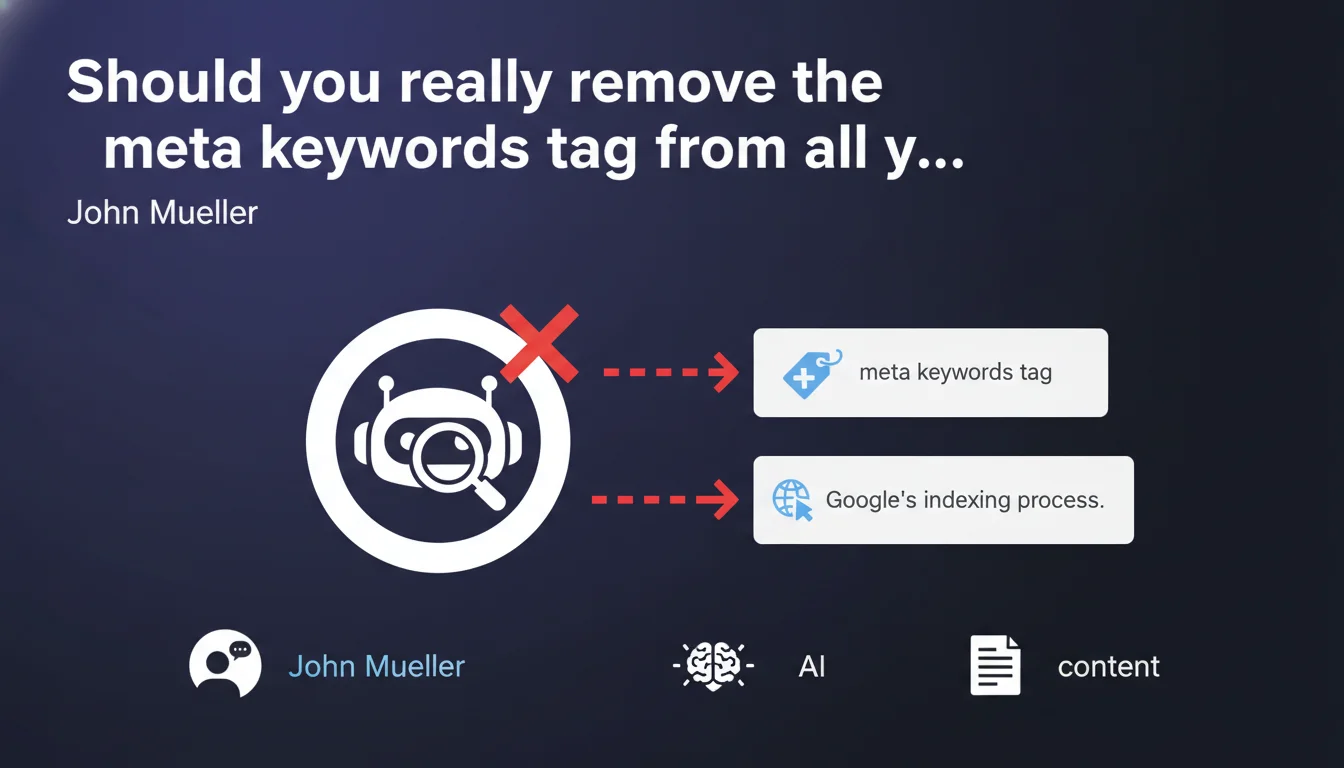
Google completely ignores the meta keywords tag — it has no impact on indexing or ranking. Googlebot doesn't even read its content. Keeping or removing this tag is now purely a technical choice with no direct SEO consequences.
What you need to understand
John Mueller confirms what many have suspected for years: the meta keywords tag is completely ignored by Googlebot. Not partially, not "sometimes" — completely.
This clarification puts an end to a recurring debate: some were still adding keywords to it "just in case," thinking that a weak signal was better than nothing.
Why did Google abandon this tag?
In the 1990s, the meta keywords tag was used to indicate a page's subject. But it was quickly massively spammed: webmasters would stuff hundreds of keywords into it with no relation to the actual page content.
Google therefore stopped using it as a relevance signal from the early 2000s onwards. Since then, the algorithm relies exclusively on analyzing visible content, titles, link anchors, and semantic context.
Is this tag dangerous for SEO?
No. It's simply useless. Googlebot completely skips over it during crawling — it weighs neither positively nor negatively in rankings.
The only risk concerns other search engines: Bing and Yandex have indicated in the past that abusive use could be interpreted as spam. But even there, the impact remains marginal.
- Google completely ignores the content of meta keywords
- This tag has no impact on indexing or ranking
- Keeping it doesn't hurt, but it serves absolutely no purpose
- Bing and Yandex could theoretically penalize abuse, but this is rare
- Time spent filling this tag is wasted time
SEO Expert opinion
Is this statement consistent with what we observe in the field?
Yes, completely. For at least 15 years, no correlation has ever been measured between the presence of this tag and organic performance on Google. A/B tests consistently show zero variation in traffic or rankings.
Some SEO tools continue to audit it by default, which maintains the confusion. But concretely, if you remove meta keywords tomorrow morning from 10,000 pages, you won't see any change in Search Console.
Why do some CMS platforms still include it by default?
Technical legacy. Many WordPress, Drupal, or Magento themes generated this tag 10 years ago and nobody bothered to clean up the code.
Some SEO plugins still offer it "for Bing" — a questionable argument, given that Bing itself declared in 2014 that it didn't use it as a relevance signal.
In what cases could this tag still be useful?
Practically none. A few internal company search engines or legacy document indexing tools might still use it — but that's marginal.
If your site feeds into a third-party system that consumes this metadata, keep it for integration reasons. Otherwise, it only inflates the HTML unnecessarily.
Practical impact and recommendations
What should you do concretely with this tag?
Three options are available to you. Remove it: this is the cleanest solution if you control the source code or CMS. It streamlines the HTML and prevents any future confusion.
Leave it in place: if it's generated automatically and modifying it requires disproportionate effort, it makes no difference. Google ignores it anyway.
Stop filling it manually: if your SEO workflow still includes this step, eliminate it immediately. This time should be reallocated to optimizations that actually matter.
What mistakes should you avoid following this clarification?
Don't fall into the opposite extreme: some SEO professionals tend to overreact to Google's statements and launch massive cleanup initiatives. If meta keywords is present on 50,000 pages and removing it requires a dev sprint, it's clearly not a priority.
Another trap: confusing meta keywords with other actually useful meta tags (description, robots, canonical). Make sure your technical team doesn't delete everything in one go.
How should you prioritize this project against other SEO optimizations?
Place it in low priority. If you have crawl budget issues, broken internal linking, duplicate content, or Core Web Vitals problems, fix those first.
Removing meta keywords is technical housekeeping — useful during a redesign or migration, but not urgent if the rest of your site is performing well.
- Audit your CMS to see if meta keywords is generated automatically
- Immediately stop any manual workflow for filling this tag
- Plan its removal during the next redesign or major technical update
- Reallocate the time saved to optimizing meta description or title tags
- Verify that your team clearly distinguishes meta keywords from other essential meta tags
- Don't launch a dev sprint dedicated solely to its removal if other critical SEO projects are waiting
❓ Frequently Asked Questions
Est-ce que supprimer la balise meta keywords va améliorer mon SEO ?
Bing utilise-t-il encore la balise meta keywords ?
Les CMS comme WordPress génèrent-ils encore cette balise par défaut ?
Si je la garde, est-ce que ça peut nuire à mon référencement ?
Dois-je prioriser la suppression de meta keywords sur mes autres chantiers SEO ?
🎥 From the same video 4
Other SEO insights extracted from this same Google Search Central video · published on 15/03/2022
🎥 Watch the full video on YouTube →
💬 Comments (0)
Be the first to comment.