
Official statement
Other statements from this video 5 ▾
- □ Does Google Trends really show you all search data, or just a fraction of the real picture?
- □ Why is Google filtering Google Trends data and how does it impact your SEO monitoring strategy?
- □ How can you leverage 20 years of Google Trends history to supercharge your SEO strategy?
- □ Does Google Trends really aggregate all keyword variants together, or does it treat them separately?
- □ Should you really prioritize topics over keywords when analyzing search trends?
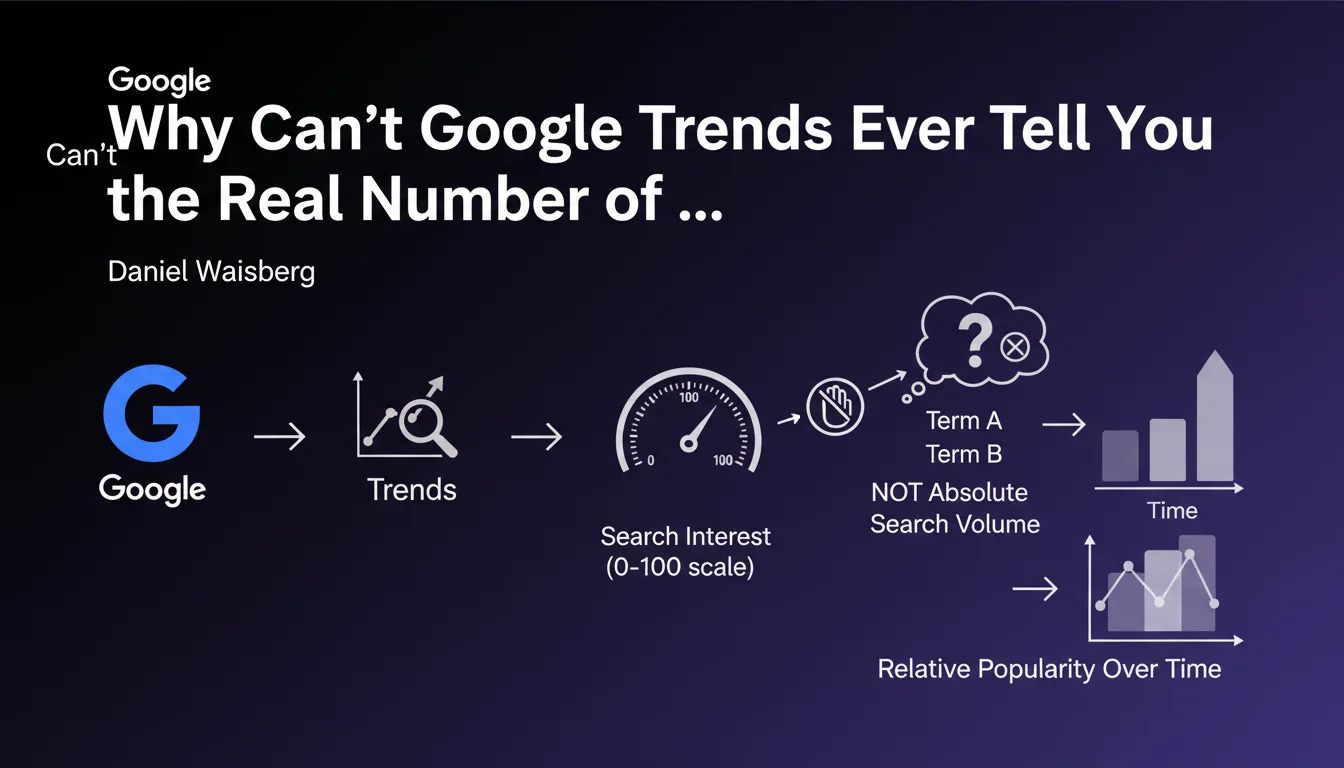
Google Trends normalizes its data on a 0-to-100 scale that reflects the relative popularity of a term, not its absolute search volume. In practical terms: you cannot extract real volumes from this tool, only compare trends and identify spikes in interest. This limitation requires cross-referencing with other sources to estimate potential traffic.
What you need to understand
What Does "Normalization" Really Mean in Google Trends?
Google Trends applies data normalization to bring all terms onto a common 0-to-100 scale. The 100 represents the peak interest point for the analyzed term during the selected period, not an absolute search volume.
This interest metric therefore compares a term's popularity with itself over time, or with other terms in the same query. Two keywords each showing a peak of 100 don't necessarily generate the same search volume — one might represent 10,000 monthly searches, the other 10 million.
Why Doesn't Google Provide Raw Volumes?
Google doesn't disclose absolute search volumes in Trends for obvious strategic reasons: protecting user data privacy and maintaining a competitive advantage. Only Google Ads Keyword Planner provides volume ranges, with their own share of inaccuracies.
This opacity forces SEO practitioners to cross-reference multiple sources: Keyword Planner, Semrush, Ahrefs, SE Ranking. None provides absolute truth, but cross-referencing allows you to approach a reliable estimate.
What Are the Real Use Cases of Google Trends for SEO?
Google Trends excels at identifying seasonal trends, spotting spikes in interest linked to news events, or comparing the relative popularity of keyword variants (singular/plural, synonyms). It also allows you to detect emerging opportunities before they appear in paid tools.
- Compare the popularity of multiple terms against each other over a given period
- Spot seasonal variations to plan an editorial calendar
- Identify emerging or rapidly declining queries
- Analyze geographic interest to target specific regions
- Never use Trends as the sole source to estimate potential traffic volume
SEO Expert opinion
Does This Statement Contradict Practices Observed in the Field?
No, this statement is consistent with what we've observed for years. Experienced SEO practitioners already know that Google Trends cannot replace a keyword research tool. It's a trend indicator, not a volumetry source.
The problem is that many beginners — or poorly configured automated tools — still try to extrapolate absolute volumes from Trends. They compare a peak of 100 with another at 50 and wrongly conclude that the first generates twice as much traffic. This is a classic interpretation error.
What Nuances Should Be Added to This Normalization?
Normalization varies depending on the filters applied. A term might show a score of 100 over a one-month period, but drop to 30 if you expand the analysis to five years. The temporal and geographic context dramatically changes the displayed values.
Another rarely mentioned point: Google Trends samples the data — it's not an exact reflection of 100% of queries. Low volumes are smoothed out or even masked. For niche queries with low volume, Trends may show "0" when there is actual non-negligible volume. [Verify] systematically with other tools.
In What Cases Does This Metric Become Misleading?
When comparing terms whose order of magnitude differs massively. If you pit "car insurance" against "car insurance for Tesla Model 3," Trends will normalize both, but one represents millions of monthly searches while the other represents a few hundred. The graph doesn't reflect this disproportion.
Practical impact and recommendations
How to Properly Leverage Google Trends in an SEO Strategy?
Use Trends as a strategic framing tool, not as a volumetry source. It serves to validate a trend, to decide between two keyword variants, to spot seasonalities. To estimate potential traffic, cross-reference with Keyword Planner, a paid third-party tool, and your own GSC data.
Concrete example: you're torn between "running shoes" and "sports running sneakers." Trends shows you the comparative trend and geographic distribution. Next, you validate volumes in Semrush or Ahrefs, then check ranking difficulty.
What Mistakes Should You Avoid with Google Trends?
Never treat a score of 100 as an absolute volume. Never compare terms without adjusting temporal and geographic filters. And above all, never base a business case solely on Trends — it's one indicator among many, never an absolute truth.
Another pitfall: interpreting a drop in the index as a decline in real traffic. Volume can remain stable, but if a competitor launches a massive campaign on a related term, your Trends index can mechanically drop due to normalization effect.
- Systematically cross-reference Trends with at least two other volumetry sources
- Use Trends to identify seasonalities and adjust your editorial calendar
- Compare only terms of similar magnitude to avoid bias
- Check for sampling: a "0" doesn't mean "no searches"
- Never extrapolate ROI or Ads budget from a Trends index
❓ Frequently Asked Questions
Peut-on convertir un score Google Trends en volume de recherches mensuelles ?
Pourquoi deux mots-clés affichent-ils tous les deux un pic à 100 alors qu'ils n'ont pas le même volume ?
Google Trends utilise-t-il 100 % des données de recherche ou un échantillon ?
Peut-on utiliser Google Trends pour prédire un trafic futur sur un mot-clé ?
Faut-il privilégier Google Trends ou Keyword Planner pour choisir des mots-clés ?
🎥 From the same video 5
Other SEO insights extracted from this same Google Search Central video · published on 31/07/2024
🎥 Watch the full video on YouTube →
💬 Comments (0)
Be the first to comment.