
Official statement
Other statements from this video 5 ▾
- □ Does Google Trends really show you all search data, or just a fraction of the real picture?
- □ Why is Google filtering Google Trends data and how does it impact your SEO monitoring strategy?
- □ Why Can't Google Trends Ever Tell You the Real Number of Keyword Searches?
- □ Does Google Trends really aggregate all keyword variants together, or does it treat them separately?
- □ Should you really prioritize topics over keywords when analyzing search trends?
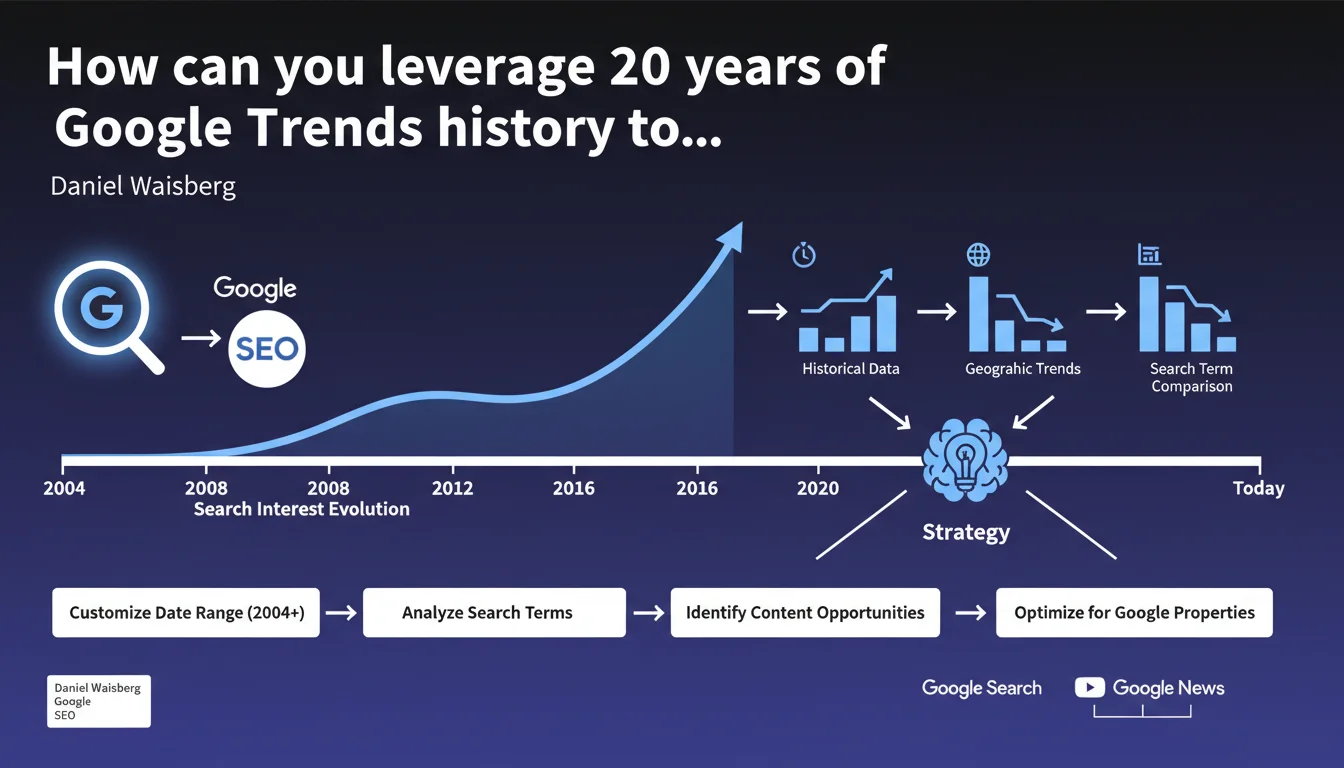
Google Trends allows you to go back to 2004 to analyze the evolution of search terms. This historical depth offers a unique perspective on long-term trends, recurring seasonality, and market shifts. For SEO professionals, it's a strategic lever that's often underutilized in demand analysis and content planning.
What you need to understand
What exactly does this time customization feature allow you to do?
Google Trends offers adjustable temporal granularity: you can analyze any period since 2004 up to today. In concrete terms, this means accessing two decades of behavioral data on user search queries.
This historical depth is far from trivial — it reveals patterns impossible to detect over short time windows. Seasonal cycles, underlying trends, sudden shifts (product launches, events, crises) become visible and quantifiable.
Why does this historical data change the game for an SEO professional?
Most SEO specialists use Google Trends to validate a specific intuition: "is this keyword trending right now?". That's useful, but limited. Looking back over 20 years allows you to contextualize: is the current rise truly exceptional or simply an annual seasonality pattern?
More strategically: you can anticipate future demand by identifying long-term cycles (demographic shifts, sector transformations, progressive obsolescence of certain terms). For example, the gradual transition from "car insurance" to "electric vehicle insurance" is visible in the curves.
Which Google properties are covered by this temporal analysis?
Google Trends covers several surfaces: Google Search, Google Images, Google News, Google Shopping, and YouTube. Each property has its own characteristics and audience. Analyzing a term's evolution on YouTube versus Search can reveal instructive shifts.
A concrete example: a term might stagnate in classic Search but explode on YouTube — a sign of a shift in consumption format (move from text to video). These insights directly guide your content strategy.
- Historical depth: exploitable data since 2004, representing 20 years of hindsight
- Geographic and temporal granularity: regional comparisons, fine-grained seasonality
- Multi-property coverage: Search, Images, News, Shopping, YouTube
- Relative data: note that Google Trends normalizes (0-100 scale), these are not raw volumes
- Macro context: allows you to distinguish weak signals from occasional noise
SEO Expert opinion
Is this feature actually being leveraged by SEO professionals?
Let's be honest: no, it's largely underutilized. Most SEO audits focus on the last 12-24 months. Going back a decade requires heavier analysis effort, and paid tools (SEMrush, Ahrefs) don't offer this depth. Result: Google Trends remains a blind spot.
Yet clients funding editorial strategies over 2-3 years would directly benefit from this long-term view. The problem? The lack of standardized methodology to transform this data into actionable recommendations. You need to cross Trends with actual volume data (Google Keyword Planner, Search Console) to avoid false leads.
What biases should you keep in mind with this historical data?
Google Trends normalizes. A score of 100 doesn't mean the same thing in 2004 versus today. The absolute volume of searches has exploded over 20 years — a relative decline can mask absolute growth. Conversely, a term that's "rising" might simply be declining slower than overall search traffic.
Another critical bias: the evolution of search intent. In 2005, "iPhone" returned... nothing. In 2008, it was a niche product. Today, it's a generic term. Comparing curves directly without contextualizing semantic shifts leads to false conclusions. [To verify] on each insight: has the intent behind the keyword changed?
In which cases does this historical depth become truly strategic?
This is where it gets powerful: long-cycle markets (real estate, finance, healthcare, education). Underlying trends unfold over 5-10 years, not 6 months. A site positioned on "mortgage" needs to understand that search peaks follow economic cycles — and anticipate downturns.
Another underestimated use case: indirect competitive analysis. If a historical competitor has capitalized on a term now in decline (visible on Trends), you know they're probably vulnerable. Conversely, a newer site well-positioned on an upward curve for 15 years likely has a structural advantage difficult to overcome.
Practical impact and recommendations
How do you integrate this historical depth into your SEO workflow?
First step: identify your long-cycle topics. List your strategic keywords and analyze them over 10-15 years. Spot seasonality patterns (obvious or hidden), sudden shifts, underlying trends. Export CSV data to cross-reference with your own analytics.
Concretely, build thematic maturity matrices: terms in structural growth (editorial priority), stable terms (maintenance), declining terms (divest or pivot). This mapping guides your content planning over 18-24 months, not just the next quarter.
What mistakes should you avoid when exploiting this data?
Classic error: confusing correlation with causation. A curve rising since 2010 guarantees nothing about the next 5 years. Markets saturate, technologies replace other technologies. Always cross-validate with external market data (industry reports, demographic studies).
Another trap: overweighting micro-variations. Over a 20-year scale, a 3-month spike might seem negligible — but if it aligns with a recurring event (industry conference, legislative reform), it deserves attention. Zoom in on key periods to avoid missing them.
How do you validate that your interpretation is reliable?
Simple rule: test your hypotheses on sub-periods. If you identify seasonality over 15 years, verify it repeats annually, not by chance. Compare multiple related terms — if they follow similar patterns, the signal is solid.
And crucially: reconcile Trends with your internal data. If Google Trends shows decline on a term where your organic traffic is climbing, either you're gaining voice share (good) or your measurement is skewed (problem). Reconcile both sources before any strategic decision.
- Export Google Trends CSV data to cross-reference with Google Keyword Planner and Search Console
- Map your thematic landscape into 3 categories: growth, stability, decline
- Identify recurring seasonal cycles (minimum 5+ consecutive years)
- Spot historical breakpoints and investigate their causes (products, regulations, events)
- Compare multiple Google properties (Search versus YouTube) to detect format migrations
- Validate each insight with external market data (industry studies, demographics)
- Integrate this analysis into your quarterly and annual content planning
Google Trends offers rare historical depth — 20 years of behavioral data — but leveraging it requires methodology and rigor. The true value: anticipating long-term shifts, not overreacting to weekly fluctuations.
This strategic analysis can quickly become time-intensive and require advanced data interpretation skills. If your team lacks resources or expertise, engaging a specialized SEO agency allows you to structure this approach, avoid interpretation bias, and transform these insights into an actionable roadmap without diverting your teams from their core mission.
❓ Frequently Asked Questions
Google Trends donne-t-il accès aux volumes de recherche réels ?
Peut-on comparer plusieurs termes de recherche sur 20 ans ?
Les données avant 2004 sont-elles accessibles quelque part ?
Comment distinguer une vraie tendance de fond d'un bruit ponctuel ?
Google Trends est-il fiable pour les niches avec peu de volume ?
🎥 From the same video 5
Other SEO insights extracted from this same Google Search Central video · published on 31/07/2024
🎥 Watch the full video on YouTube →
💬 Comments (0)
Be the first to comment.