
Official statement
Other statements from this video 5 ▾
- □ Does Google Trends really show you all search data, or just a fraction of the real picture?
- □ Why is Google filtering Google Trends data and how does it impact your SEO monitoring strategy?
- □ Why Can't Google Trends Ever Tell You the Real Number of Keyword Searches?
- □ How can you leverage 20 years of Google Trends history to supercharge your SEO strategy?
- □ Does Google Trends really aggregate all keyword variants together, or does it treat them separately?
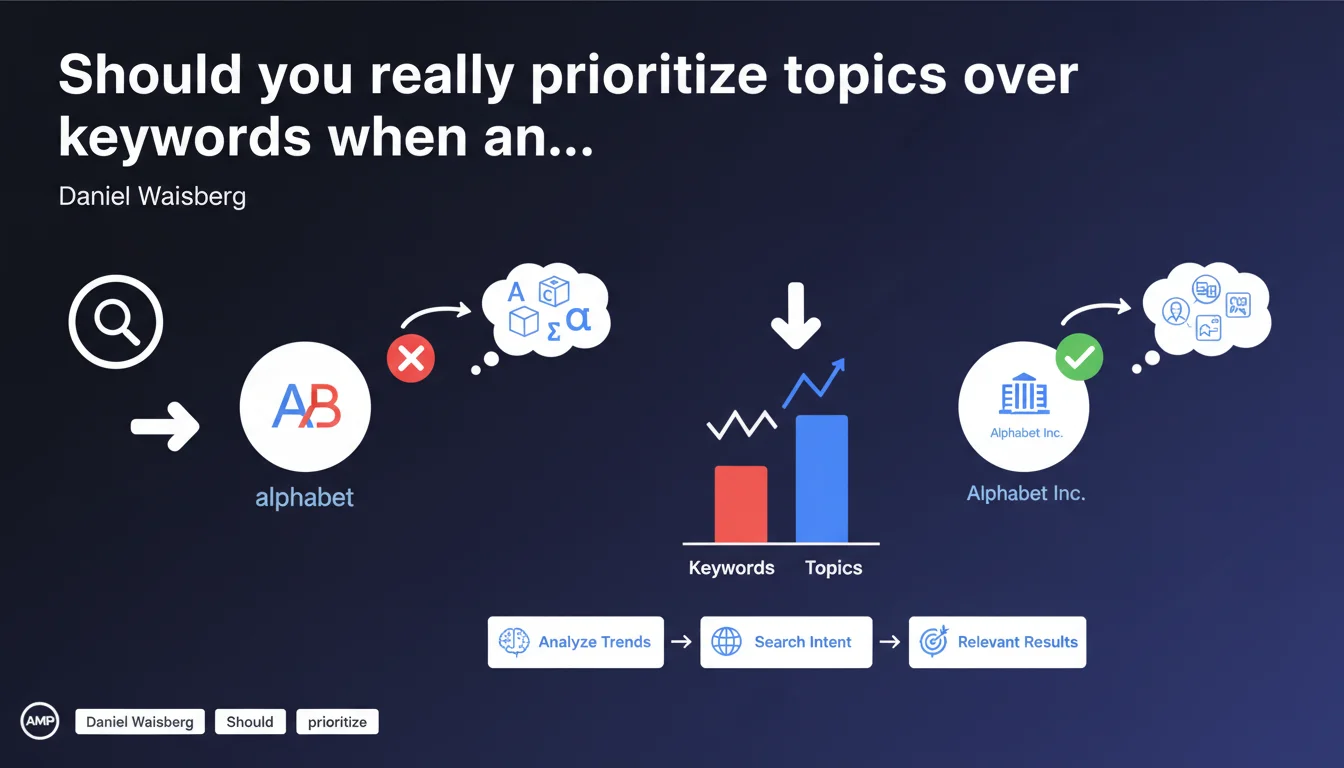
Google recommends using topics rather than simple terms when analyzing trends to avoid semantic ambiguities. A term like 'alphabet' can refer to multiple search intentions, whereas the topic 'Alphabet Inc.' precisely targets the company. This distinction is crucial for correctly interpreting performance data and avoiding analytical errors.
What you need to understand
What's the difference between a term and a topic in Google Trends?
A search term is a simple string of characters — Google analyzes it literally. 'Alphabet' can refer to the order of letters, Google's parent company, or an educational toy brand.
A topic is a semantic entity identified in the Knowledge Graph. When you select 'Alphabet Inc.' as a topic, Google automatically filters queries that actually concern the company — whether people search 'Alphabet', 'Google parent company', or 'GOOGL stock'.
Why is this recommendation coming out now?
Because too many SEO analysts are drawing wrong conclusions based on polluted data. You're tracking 'Amazon' to assess interest in e-commerce? You're also including the Amazon rainforest and the river.
Google is pushing topics so that SEO professionals stop confusing search volumes with actual intentions. It's consistent with their entity-based approach over the years.
In what context does this distinction become critical?
Anywhere homonymy skews your analysis. Brands sharing a common name (Apple, Orange, Amazon), technical acronyms (SEO = search engine optimization OR service engine oil), polysemous terms (python, java, swift).
Concretely? If you're evaluating a market opportunity or justifying an SEO budget with Google Trends, a targeting error can lead you to overestimate — or underestimate — the potential of an entire sector.
- Simple terms = raw data, including all possible meanings of a word
- Topics = entities filtered by the Knowledge Graph, targeting a precise semantic intention
- Lexical ambiguity can completely skew a trends or search volume analysis
- This recommendation applies mainly in Google Trends; Search Console and Analytics remain based on literal queries
SEO Expert opinion
Is this recommendation really new?
No. Google has offered topics in Trends since 2012. What's changing is that they're now formalizing it as an official best practice — probably because they're seeing too many business decisions based on flawed analyses.
But let's be honest: in real life, most SEO tools still work on literal keywords. Semrush, Ahrefs, Yooda — they all track character strings, not semantic entities. This recommendation creates a gap between what Google recommends and what our tools measure.
Where are the limits of this approach?
Topics work well for structured entities — brands, personalities, places, established concepts in the Knowledge Graph. But for long-tail queries or emerging niches, Google doesn't always have a defined entity.
Concrete example: you're launching an innovative product. It doesn't yet exist as a topic in the Knowledge Graph. You're forced to track raw terms — and thus live with the ambiguity. [To verify]: we don't know how quickly Google creates new entities for emerging concepts.
Does this distinction actually affect ranking?
This is where it gets interesting. Google doesn't say you should optimize for topics rather than keywords — it's only talking about data analysis.
But if their engine truly understands entities better than literal terms (which all patents have confirmed since BERT), then your content should probably target semantic intentions rather than stuff keyword density. What Waisberg doesn't say is whether this logic also applies to ranking — and on that point, we're in pure interpretation territory.
Practical impact and recommendations
How do you identify if a term risks creating ambiguity?
Type your keyword into Google. If the SERP mixes multiple intentions (e-commerce + info + local + disparate images), you have a homonymy problem.
Next, test in Google Trends: search the term, then see if Google suggests multiple associated topics. If so, explicitly select the one that matches your actual intention. Compare the curves — they'll often be radically different.
What do you do if your niche doesn't have a defined topic?
You're stuck with raw terms. In that case, cross-reference multiple sources to validate your hypotheses: Google Trends + Search Console + analytics + third-party tools.
Look at associated queries in Search Console — they reveal the actual intentions driving traffic. If you notice a gap between your intention and visitors' intentions, that's lexical ambiguity affecting you without you knowing it.
Should you adapt your content strategy accordingly?
It depends. If you're dealing with a brand or concept with high ambiguity, you need to overcontextualize your content to clarify intention from the very first lines.
Conversely, if you're targeting an ambiguous term to capture multiple intentions (intermediate content strategy), then lexical fuzziness can work in your favor — but accept that your engagement metrics will be mediocre.
- Check in Google Trends whether your strategic terms have multiple competing meanings
- Prioritize topics over simple terms when analyzing trends and volumes
- Cross-reference Search Console with Trends to identify gaps between intended and actual traffic
- Adapt titles, meta descriptions, and H1s to disambiguate intention from the SERP
- Document your entity vs. keyword choices in your editorial strategy to prevent drift
❓ Frequently Asked Questions
Est-ce que cibler des sujets améliore directement mon ranking dans Google ?
Comment savoir si mon mot-clé principal souffre d'ambiguïté sémantique ?
Les outils SEO classiques (Semrush, Ahrefs) gèrent-ils les sujets ou seulement les mots-clés ?
Que faire si mon secteur est trop niche pour avoir des sujets définis dans le Knowledge Graph ?
Cette distinction terme/sujet s'applique-t-elle aussi dans Search Console ?
🎥 From the same video 5
Other SEO insights extracted from this same Google Search Central video · published on 31/07/2024
🎥 Watch the full video on YouTube →
💬 Comments (0)
Be the first to comment.