
Official statement
Other statements from this video 5 ▾
- □ Does Google Trends really show you all search data, or just a fraction of the real picture?
- □ Why is Google filtering Google Trends data and how does it impact your SEO monitoring strategy?
- □ Why Can't Google Trends Ever Tell You the Real Number of Keyword Searches?
- □ How can you leverage 20 years of Google Trends history to supercharge your SEO strategy?
- □ Should you really prioritize topics over keywords when analyzing search trends?
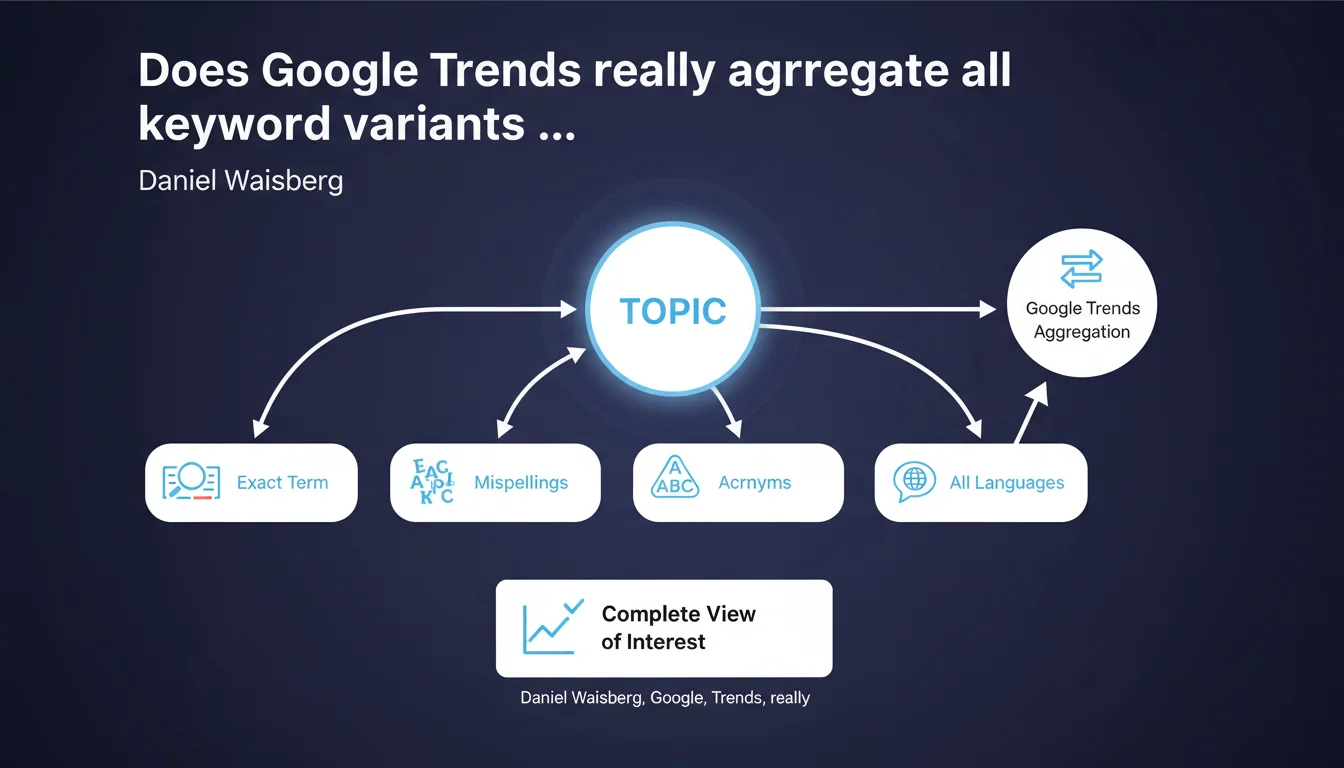
Topics in Google Trends automatically aggregate the exact term, common misspellings, acronyms, and all language variants related to the same entity. This approach allows you to assess overall interest in a concept without being limited by spelling or language—useful for sizing the true potential of a topic beyond query variations.
What you need to understand
What does "topic" actually mean in Google Trends?
A topic in Google Trends is not just a simple text query. It's a semantic entity that automatically groups all the different ways people express the same concept: correct spelling, common misspellings, acronyms, translations in different languages.
In practice? If you select "Paris Saint-Germain" as a topic, Google Trends compiles data from "PSG," "Paris SG," "paris saint germain" (with or without hyphens), "paris saint-german" (misspelling), and even equivalents in other languages. You get a consolidated view of interest in this entity, regardless of how users spell it.
How does this distinction differ from "search terms"?
Google Trends offers two analysis modes: search terms (exact queries, case and spelling sensitive) and topics (normalized entities).
When you enter "macbook pro" as a term, you only get searches containing exactly that string. If you choose "MacBook Pro" as a topic, you capture "mackbook pro," "mac book pro," "macbookpro," and more. The audience difference can be substantial—and often underestimated.
Why does this matter for SEO?
Because it affects how you evaluate the search potential of a topic. If you base your analysis only on exact terms, you miss a significant portion of volume—especially for topics with frequent spelling variations or popular acronyms.
It also impacts your content strategy: should you target an exact term, or create content around the broader entity by naturally covering variants? The distinction between "optimizing for a query" and "covering a topic" takes on real meaning here.
- Topics aggregate exact terms, misspellings, acronyms, and language variants
- This provides a consolidated view of interest in an entity, without fragmentation by spelling
- Google Trends distinguishes search terms (literal) from topics (normalized entities)
- This aggregation can reveal actual volume far higher than exact-query analysis suggests
- Understanding this distinction changes how you evaluate the SEO potential of your content
SEO Expert opinion
Does this approach reflect how Google Search handles queries?
Yes and no. Google Search does use semantic understanding to link variants of the same entity—which is why it serves consistent results for "paris saint germain" and "PSG" without requiring webmasters to stuff their pages with every variant.
But Trends and Search are two separate systems. What Trends groups under a "topic" doesn't necessarily correspond to what Search treats as strictly equivalent for ranking purposes. We regularly observe different SERPs for variants that Trends would nonetheless group under the same topic. [To verify] case by case with actual searches.
Do misspellings still have SEO impact?
Less and less. Google is remarkably effective at automatically correcting common misspellings and serving the same results as for correct spelling. In most cases, specifically targeting both "macbook" and "mackbook" in your content adds nothing.
Two notable exceptions: misspellings so common they've become terms in their own right (e.g., "gogle" is not treated as "google"), and markets with uneven language education where Google has less training data. In these contexts, covering variants can still help—but it's marginal.
Does multilingual aggregation cause analysis problems?
It can distort your interpretation if you're not careful. A topic in Trends can mix searches in French, English, German, and so on—useful for assessing global interest in an international entity, but misleading if you want to size a local opportunity.
Always filter Trends by geographic region and check whether the topic you're analyzing has multilingual implications. A spike in "Paris" searches could come from French users searching "Paris SG" or Americans planning a trip. The intent context is radically different.
Practical impact and recommendations
How do you use this distinction to size an SEO market?
Start by analyzing the topic in Google Trends to get the overall interest volume. Then compare it with exact-term search volumes in Google Keyword Planner or your preferred tool.
If there's a significant gap, it means a substantial portion of traffic comes through non-literal variants—misspellings, acronyms, or alternative wordings. Your content should cover the entity as a whole, not just the exact keyword.
Should you include spelling variants in your content?
No, not artificially. Google is sophisticated enough to understand that "macbook" and "mackbook" refer to the same thing—you don't need to write "macbook, also spelled mackbook" in your text.
However, legitimate acronyms deserve natural mentions: "Paris Saint-Germain (PSG) won the..." This helps both Google and readers make the connection—without forcing it.
What mistakes should you avoid when analyzing Trends?
Don't confuse Trends volume with search volume. Trends gives you a relative trend, not an absolute query count. A peak of 100 in Trends might represent 10,000 searches in January and 50,000 in June—the scale is normalized.
Second pitfall: analyzing a multilingual topic without filtering by region. You might think a topic is exploding in France when the spike actually comes from another market included in the language aggregation.
- Always filter Google Trends by relevant geographic region before analyzing a topic
- Compare Trends volume (topic) with Keyword Planner volume (exact terms) to identify important variants
- Don't stuff your content with misspellings—Google corrects them automatically
- Mention legitimate acronyms and variants naturally in your body text
- Check whether the topic you're analyzing has multilingual implications that could skew interpretation
- Use Trends to size overall interest, but cross-reference other sources for absolute volumes
❓ Frequently Asked Questions
Dois-je créer des pages séparées pour chaque variante orthographique d'un mot-clé ?
Comment savoir si un pic dans Google Trends vient de mon marché ou d'un autre pays ?
Les acronymes doivent-ils figurer dans les balises title et meta description ?
Google Trends et Keyword Planner donnent-ils les mêmes volumes ?
Peut-on utiliser cette agrégation pour identifier des sujets émergents ?
🎥 From the same video 5
Other SEO insights extracted from this same Google Search Central video · published on 31/07/2024
🎥 Watch the full video on YouTube →
💬 Comments (0)
Be the first to comment.