
Official statement
Other statements from this video 8 ▾
- □ Le JavaScript ralentit-il réellement l'indexation de votre site ?
- □ Faut-il vraiment abandonner JavaScript pour le SSR en SEO ?
- □ Pourquoi la configuration JavaScript de votre site est-elle un point de contrôle critique pour Google ?
- □ Faut-il vraiment choisir SSR ou CSR selon le type de site ?
- □ Faut-il vraiment maîtriser Chrome DevTools pour faire du SEO technique ?
- □ Faut-il vraiment maîtriser le fonctionnement des navigateurs pour faire du SEO technique ?
- □ Faut-il vraiment se fier uniquement à la documentation officielle de Google ?
- □ Pourquoi le trafic ne devrait-il jamais être votre seule métrique SEO ?
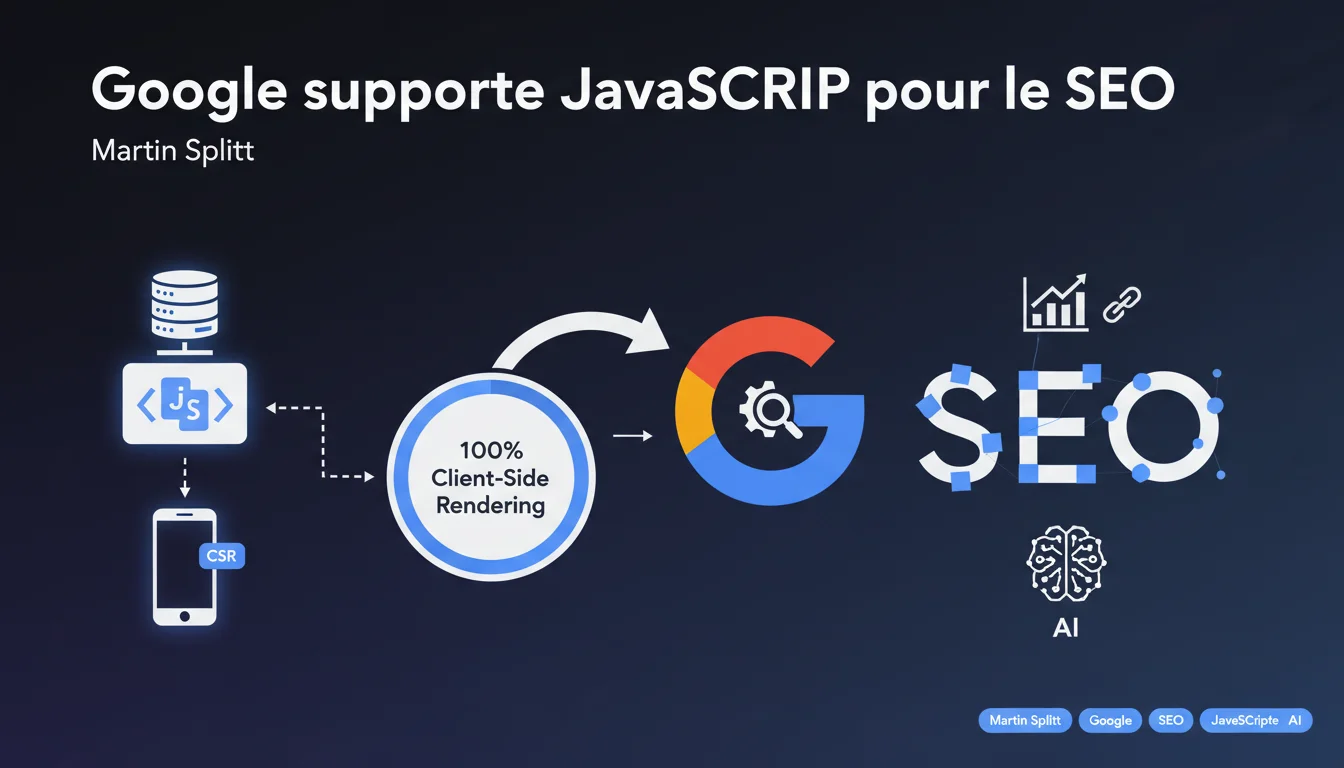
Google claims to process and index JavaScript sites, including pure client-side rendering. Officially confirmed by Martin Splitt. The big question is whether this support equals optimal treatment — spoiler alert: it does not.
What you need to understand
Why is this announcement strategic for Google?<\/h3>
Google has long been accused of poorly handling client-side JavaScript<\/strong>. This official statement aims to reassure developers and SEOs: yes, Googlebot can execute JS, and yes, you can build a 100% CSR<\/strong> site without being blacklisted.<\/p> But "capable of" doesn't mean "performs as well as static HTML." Google can process your React SPA, but with delays, hiccups, and a crawl budget that is significantly more strained compared to server rendering.<\/p> In CSR<\/strong>, the initial HTML is empty — just a shell. The content is injected by JavaScript afterward, on the browser side. Therefore, Googlebot must wait for the script to execute, which introduces a render delay<\/strong> that can be quite significant.<\/p> This delay can prevent Googlebot from seeing the content on the first pass. If the bot does not return quickly enough, your page remains orphaned in the index with partial or empty content.<\/p>What is client-side rendering and why does it complicate SEO?<\/h3>
What should we take away from this official statement?<\/h3>
SEO Expert opinion
Is this statement consistent with observed practices in the field?<\/h3>
Yes and no. Technically, Google can<\/strong> crawl and index JavaScript — this is observable on millions of React, Vue, or Angular sites. The issue is the latency<\/strong>.<\/p> In practice, 100% CSR sites often suffer from indexed pages with no content, catastrophic Core Web Vitals<\/strong>, and a wasted crawl budget. Google can execute your JS, but it doesn't always do so at the right time or in a thorough manner. [To be verified]<\/strong> on your own projects with regular crawling.<\/p> Splitt emphasizes the "support," but never details the render delays<\/strong> or failure cases. A CSR site can take several days to be properly indexed, while an SSR site will be crawled in a matter of hours.<\/p> Another point he avoids: heavy JavaScript<\/strong> (bundles of several MB, execution errors, timeouts) brings Googlebot to its knees. If your code fails on the client side, Google will see a blank page — and no alert will notify you.<\/p> If your site relies on dynamically generated content<\/strong> after user interaction (aggressive lazy loading, infinite scroll, content behind a click), Googlebot may never see it. The bot does not interact like a human.<\/p> Similarly, if your JS resources are blocked by robots.txt<\/strong> or your CDN returns 403/503 errors, rendering fails silently. Google will index only an empty shell.<\/p>What nuances is Martin Splitt deliberately omitting?<\/h3>
In what cases does this rule not apply?<\/h3>
Practical impact and recommendations
What should you actually do if your site is in CSR?<\/h3>
First, audit what Googlebot actually sees<\/strong>. Use the URL inspection tool in Search Console and compare the raw HTML to the rendered HTML. If the content only appears after executing JS, you are in risky territory.<\/p> Next, reduce the Time to Interactive (TTI)<\/strong> and the Largest Contentful Paint (LCP)<\/strong>. A slow CSR site becomes a nightmare for Googlebot, which may abandon rendering before completion. Optimize your bundles, defer non-critical JS, and use code splitting.<\/p> Never block your JS/CSS files in robots.txt — it's a guaranteed death for your rendering. Google needs these resources to execute your code.<\/p> Avoid soft 404s<\/strong> as well: if your SPA displays an error page via JS but returns an HTTP 200 code, Google will index an empty page without realizing it is broken. Manage server-side errors with the correct HTTP codes (404, 410, 503).<\/p> Finally, do not rely solely on CSR for a critical site. If your business depends on SEO, invest in SSR, SSG, or hybrid rendering<\/strong> (Next.js, Nuxt, etc.). This is non-negotiable for e-commerce or media.<\/p>What mistakes should you absolutely avoid with JavaScript and SEO?<\/h3>
How can you verify that your JavaScript site is properly indexed?<\/h3>
❓ Frequently Asked Questions
Est-ce que Googlebot exécute JavaScript comme un navigateur moderne ?
Faut-il absolument migrer vers du SSR si mon site est en CSR ?
Les frameworks comme React ou Vue posent-ils problème pour le SEO ?
Comment savoir si Googlebot voit bien mon contenu JavaScript ?
Le lazy loading de contenu est-il compatible avec Googlebot ?
🎥 From the same video 8
Other SEO insights extracted from this same Google Search Central video · published on 29/12/2021
🎥 Watch the full video on YouTube →Related statements
Get real-time analysis of the latest Google SEO declarations
Be the first to know every time a new official Google statement drops — with full expert analysis.
💬 Comments (0)
Be the first to comment.