
Official statement
Other statements from this video 8 ▾
- □ Google supporte-t-il vraiment JavaScript pour le SEO ou est-ce un leurre ?
- □ Le JavaScript ralentit-il réellement l'indexation de votre site ?
- □ Faut-il vraiment abandonner JavaScript pour le SSR en SEO ?
- □ Pourquoi la configuration JavaScript de votre site est-elle un point de contrôle critique pour Google ?
- □ Faut-il vraiment choisir SSR ou CSR selon le type de site ?
- □ Faut-il vraiment maîtriser Chrome DevTools pour faire du SEO technique ?
- □ Faut-il vraiment maîtriser le fonctionnement des navigateurs pour faire du SEO technique ?
- □ Pourquoi le trafic ne devrait-il jamais être votre seule métrique SEO ?
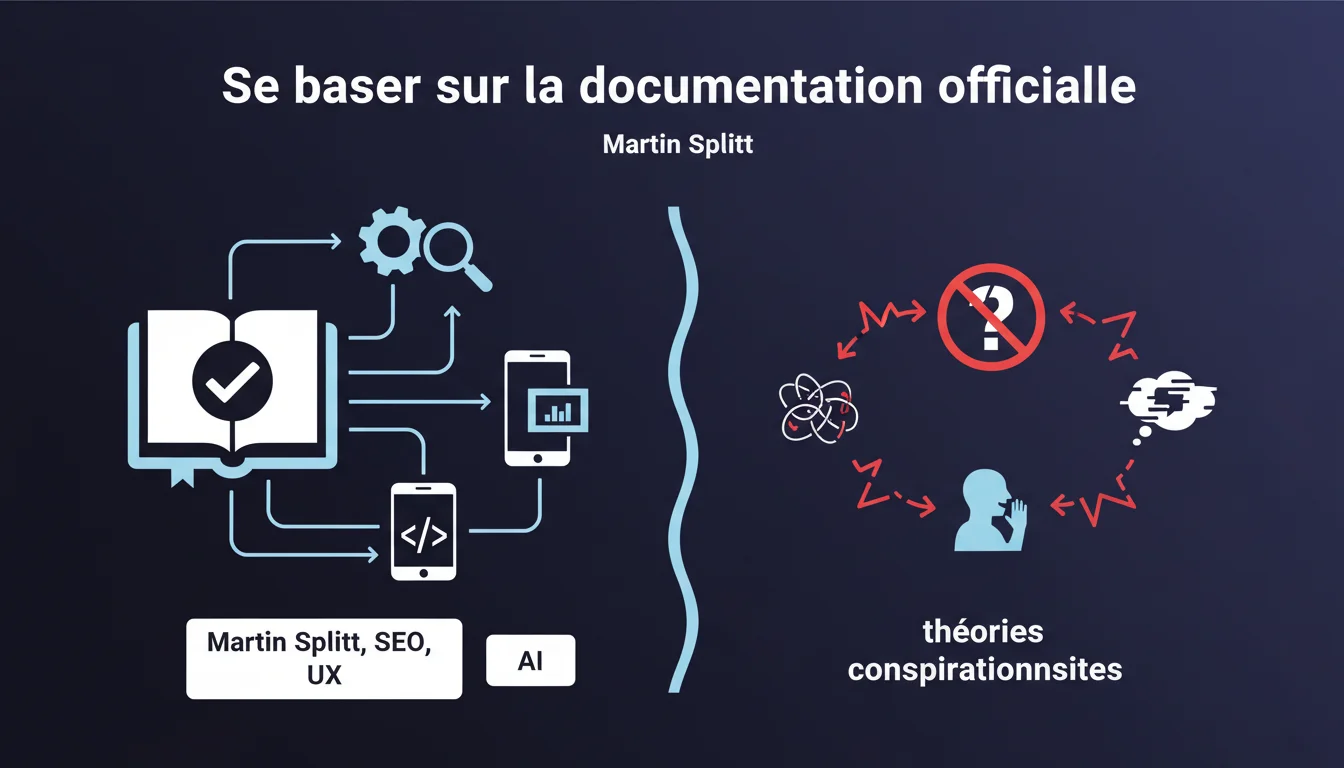
Martin Splitt recommends always prioritizing Google's official documentation over unverified theories circulating in the SEO industry. The goal: to avoid misunderstandings between developers and SEO professionals, especially when rumors contradict documented facts. A piece of advice that seems sensible, yet raises the question of the actual completeness of this documentation.
What you need to understand
Why does Google emphasize its official documentation?
This statement from Martin Splitt aims to refocus professionals on a reliable source instead of industry gossip. Developers, in particular, can be confused by contradictory SEO claims circulating on forums or social media.
Google seeks to reduce friction between technical teams and SEO. When a developer hears "Google doesn’t index JavaScript" while the documentation has stated otherwise for years, it creates unnecessary blockers on projects.
What do we really mean by 'official documentation'?
It primarily consists of Google Search Central (formerly Webmaster Central), developer guides, and official announcements on the Google Search Central blog. These resources are maintained by Google's product teams.
However, a gray area exists: what about statements from Googlers on Twitter, conference talks, or responses in SEO hangouts? Technically, these are not official documents, but they come from internal sources.
Does this recommendation really change SEO practices?
On paper, any serious professional should already be consulting the official documentation. The problem: this documentation is sometimes incomplete, vague, or outdated. It does not cover all the use cases encountered in the field.
This very documentation gap has given rise to alternative theories. Some are indeed mythical, while others are working hypotheses based on repeated observations that find no explanation in the official docs.
- Systematically prioritize Google Search Central documentation for technical decisions
- Correlate with public statements from Googlers when the documentation is insufficient
- Document discrepancies observed between official theory and practical experience
- Distinguish baseless myths from undocumented empirical hypotheses
- Train development teams on official resources to align knowledge
SEO Expert opinion
Is this statement really applicable to all cases?
Let’s be honest: Google's official documentation is largely insufficient for covering the real complexity of SEO in production. It addresses general cases well but remains silent on many specific situations.
Take a concrete example. The official documentation on crawl budget is extremely limited. Yet, on sites with millions of pages, crawl prioritization issues are a daily occurrence. Practitioners have had to develop their own methodologies due to the lack of detailed guidance.
[To be verified]: Google regularly claims that certain signals "are not ranking factors," without clarifying if they have any indirect impact or are completely ignored. This imprecision leaves the door open for interpretations.
What about observations that contradict the documentation?
That's where it gets tricky. Dozens of SEO A/B tests regularly show results that do not match the official claims. Either the tests are poorly conducted (possible), or the documentation simplifies a more nuanced reality (likely).
The "urban legends" Google denounces sometimes include practices that empirically work, even if they are not documented. Systematically dismissing any non-official approach is to miss out on part of the ground-level innovation.
How to distinguish a real conspiracy theory from a legitimate working hypothesis?
An SEO conspiracy theory: attributes hidden intentions to Google without proof, resists counterexamples, relies on isolated anecdotes. Typical example: "Google systematically favors its own services" without quantitative analysis.
A legitimate hypothesis: starts from repeated observations, is tested methodically, and accepts to be disproven by the data. Example: finding that adding structured data improves CTR in certain verticals, even if it’s not a direct ranking factor.
The fundamental difference: the scientific approach. Serious pros document their tests, share their methodology, and accept that their conclusions can be challenged. This is very different from unfounded claims on Twitter.
Practical impact and recommendations
What should you concretely do with this recommendation?
The first step: audit the processes of your team or organization. What sources are used to make SEO decisions? If they rely mostly on third-party blog posts or YouTube videos rather than the official documentation, there’s a methodological issue.
Next, create a document repository. List the relevant Google Search Central resources for each type of decision: technical structure, content, mobile, Core Web Vitals, etc. This becomes the primary source of truth before any implementation.
But—and this is crucial—this repository must also document gray areas. When the official documentation is silent or insufficient, note it explicitly. This is where internal testing and field feedback become necessary.
How to train development teams on this approach?
Developers need reliable and technical sources. Google Search Central offers developer guides with code examples and explanations on the technical workings of the engine.
Organize joint training sessions between dev/SEO around the official documentation. The goal: to speak the same language and eliminate urban legends that block projects. A developer who understands how Googlebot renders JavaScript won’t raise unnecessary objections.
Set up a validation process: every major SEO recommendation must be backed by either official documentation or a documented internal test. No more "I read somewhere that".
What mistakes to avoid in applying this principle?
The most common mistake: dismissing any practice that is not explicitly validated by Google. That’s dogmatism that stifles innovation. The official documentation defines the guardrails, not the alpha and omega of advanced SEO.
Another trap: ignoring the rapid evolutions of the algorithm. The official documentation often lags behind real deployments. Official announcements on the blog or interventions from Googlers sometimes give hints before the complete documentation update.
- Systematically check if an SEO claim has its source in the Google Search Central documentation
- Create an internal document repository listing official resources by theme
- Train development teams on the official developer guides
- Explicitly document areas not covered by the official documentation
- Implement a rigorous testing process for undocumented hypotheses
- Clearly distinguish official facts, tested hypotheses, and speculation
- Maintain vigilance on official announcements from the Google Search Central blog
Relying on official documentation is a common-sense principle that should guide any structuring SEO decision. However, the reality of the job requires complementing this foundation with a rigorous empirical approach in areas that Google does not document in detail.
The optimal balance: scrupulously respect official guidelines on fundamental technical aspects while methodically testing advanced optimizations that are not explicitly covered. These optimizations can become complex to implement alone, especially when they involve advanced technical infrastructures. In such situations, the assistance of a specialized SEO agency can provide the necessary expertise to navigate between documented compliance and tested innovation.
❓ Frequently Asked Questions
La documentation officielle de Google couvre-t-elle vraiment tous les aspects du SEO ?
Dois-je ignorer toutes les informations SEO qui ne viennent pas de Google ?
Comment réagir quand mes observations terrain contredisent la documentation officielle ?
Les déclarations de Googlers sur Twitter ou en conférence sont-elles considérées comme officielles ?
Que faire quand la documentation officielle est datée ou incomplète sur un sujet précis ?
🎥 From the same video 8
Other SEO insights extracted from this same Google Search Central video · published on 29/12/2021
🎥 Watch the full video on YouTube →
💬 Comments (0)
Be the first to comment.