
Official statement
Other statements from this video 8 ▾
- □ Why does Google deliberately choose not to aim for 100% reliability in Search?
- □ Is Google really checking user experience beyond HTTP status codes?
- □ How is Google detecting incidents before you even know they exist?
- □ Does Google really deprioritize certain traffic during extreme peaks without affecting your SEO?
- □ Why does Google treat some search queries as less expensive than others?
- □ Does Google really steal indexing resources to stabilize its search engine during outages?
- □ Does Google really stabilize rankings with emergency mitigations before deploying permanent fixes?
- □ Why does Google suddenly shut down data centers when something goes wrong?
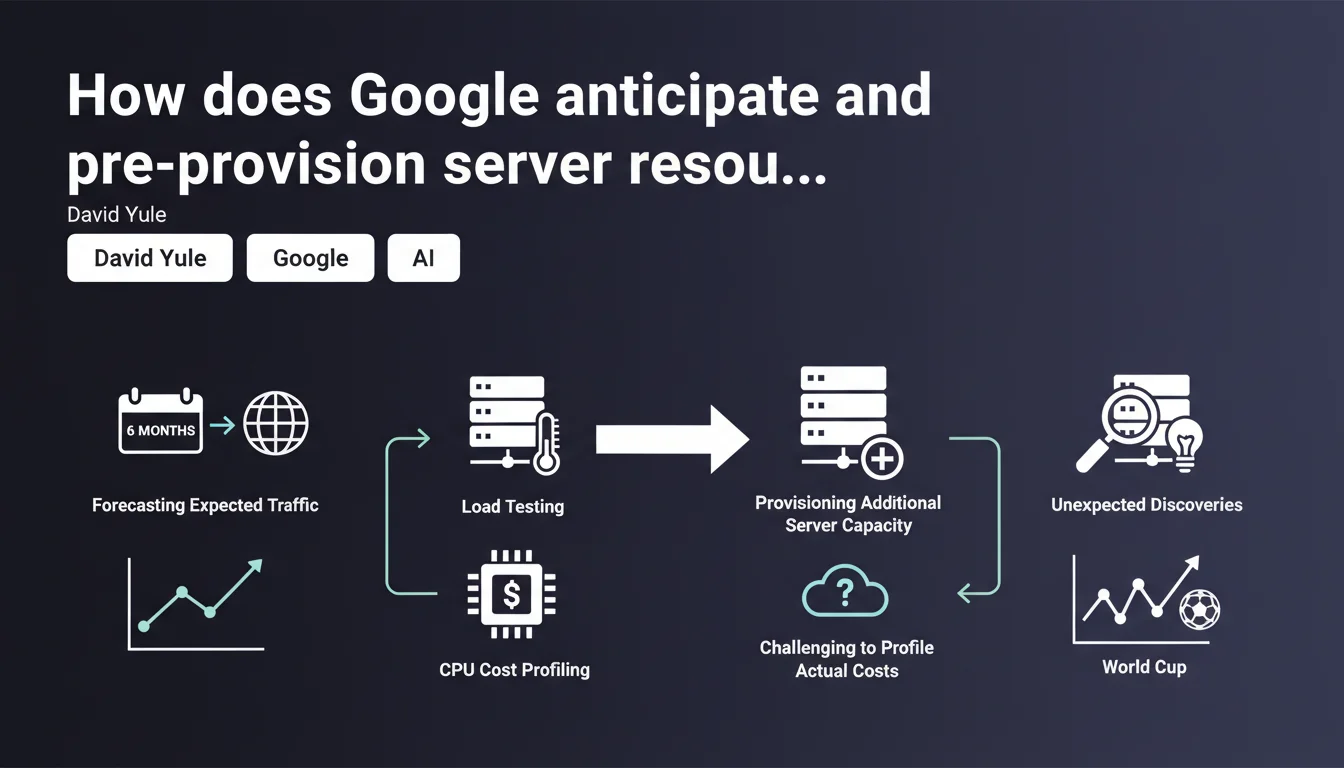
Google plans 6 months in advance for server capacity provisioning ahead of major events like the World Cup: forecasting expected traffic, load testing, CPU cost profiling, and provisioning additional capacity. Despite this anticipation, real-world cost profiling before the event remains difficult and can hold surprises.
What you need to understand
David Yule's statement reveals the operational backstage of Google. It concerns how the search engine prepares its technical infrastructure to handle foreseeable traffic spikes.
For an SEO practitioner, this information sheds light on a rarely discussed angle: Google's capacity to absorb exceptional query volumes without service degradation.
Why does Google plan 6 months in advance?
Events like the World Cup generate massive and concentrated traffic spikes. Google must ensure that its index servers, crawl infrastructure, and rendering engines can handle these volumes without latency or errors.
Forecasting expected traffic allows for proper resource sizing. Load testing simulates real-world conditions to identify bottlenecks before they occur in production.
What exactly is CPU cost profiling?
CPU cost profiling measures how much computational power is consumed by each type of query. Google seeks to anticipate which types of pages or searches will place the heaviest demand on its servers.
Yule admits that this profiling remains difficult to conduct before the actual event. In other words: even with 6 months of preparation, Google cannot predict everything and sometimes discovers surprises in production.
What are the key takeaways?
- Google plans server resources 6 months in advance for major foreseeable events
- The process includes: traffic forecasting, load testing, CPU profiling, and additional capacity provisioning
- Cost profiling before the actual event remains difficult and imperfect
- Google can still encounter operational surprises under real-world conditions
- This planning applies to foreseeable events — not unpredictable spikes or daily baseline traffic
SEO Expert opinion
Does this statement change anything for an SEO practitioner?
Let's be honest: not directly. This statement concerns Google's infrastructure engineering, not ranking signals or SEO best practices.
However, it does confirm a rarely discussed point: Google is hyper-prepared for major events. If your site experiences increased crawl activity during a worldwide event, that's no accident — it's planned.
Are there indirect implications for crawl budget?
Possibly. If Google provisions additional server capacity for foreseeable events, it's logical that it would crawl more intensively sites related to those events during that period.
Concretely: a sports website might observe an increase in allocated crawl budget during the World Cup. But Yule doesn't state this explicitly — it's an extrapolation. [Requires verification]
What should we make of the admission about operational surprises?
This is probably the most interesting point. Even with 6 months of preparation, Google admits that real CPU cost profiling remains difficult.
This means certain types of queries or pages can tax Google's servers far more than anticipated. For an e-commerce site with millions of facets or a media outlet with ultra-dynamic pages, this raises a question: could your page structure become an unexpected "CPU cost" for Google?
Practical impact and recommendations
What should you do concretely if your site depends on major events?
If your business is tied to foreseeable events — sports, elections, festivals, product launches — anticipate your infrastructure's traffic spikes. Google provisions its servers 6 months in advance. You should do the same.
Verify that your server, CDN, and cache can handle 5 to 10 times your baseline traffic. Load-test your response times. A slow site or one that crashes during a traffic spike not only loses visitors but also loses quality signals for Google.
How can you optimize your site to reduce CPU costs on Google's side?
Yule mentions that CPU cost profiling can hold surprises. While this statement doesn't directly concern rankings, a site that strains Google's servers too much can be crawled less efficiently.
A few ways to reduce your theoretical "CPU cost":
- Avoid infinite facets or unnecessary URL parameters that generate near-identical pages
- Consolidate your page variations (pagination, filters, sorting) with clear canonicals
- Use your robots.txt file to block URLs without SEO value (admin, cart, internal search results)
- Optimize your server response times (TTFB): a fast server reduces time Googlebot spends on each page
- Simplify your client-side JavaScript: heavy JS increases rendering cost for Google
What mistakes should you avoid?
Don't confuse Google's resource provisioning with crawl budget. Google may have more server capacity during an event, but that doesn't mean it will crawl every page of your site.
Don't bank on an "automatic SEO boost" during a major event either. If your content is relevant, it may benefit from a surge in user demand — but that's not Google pushing your site, that's your audience pulling it.
In summary: This statement doesn't change SEO fundamentals, but it reminds us that Google plans resources at scale. If your site depends on major events, align your technical infrastructure with this logic. Prepare your servers, optimize your response times, and eliminate unnecessary technical overhead.
These optimizations — particularly crawl efficiency audits, server sizing, and traffic spike forecasting — can be complex to orchestrate alone. If you need personalized support preparing your site for major events in your sector, partnering with a specialized SEO agency can save you time and help you avoid costly mistakes.
❓ Frequently Asked Questions
Google augmente-t-il le crawl budget des sites pendant les événements majeurs ?
Un site techniquement lourd peut-il être pénalisé à cause des coûts CPU ?
Quels types d'événements Google considère-t-il comme prévisibles ?
Faut-il adapter sa stratégie SEO 6 mois avant un événement majeur ?
Cette déclaration concerne-t-elle aussi les pics de trafic imprévisibles ?
🎥 From the same video 8
Other SEO insights extracted from this same Google Search Central video · published on 03/10/2024
🎥 Watch the full video on YouTube →
💬 Comments (0)
Be the first to comment.