
Official statement
Other statements from this video 7 ▾
- □ Is Google's Ecommerce Essentials series really changing how you approach technical SEO?
- □ Will Google's new video report in Search Console be a game-changer for video SEO?
- □ How can you survive a Google Core Update without losing all your traffic?
- □ Should you really stop using Google's URL parameter management tool in Search Console?
- □ Are sitemap extension tags still worth your time and effort?
- □ Should you connect Search Console to Data Studio to boost your SEO performance?
- □ How is Google really evolving its anti-spam tactics to stay ahead of manipulators?
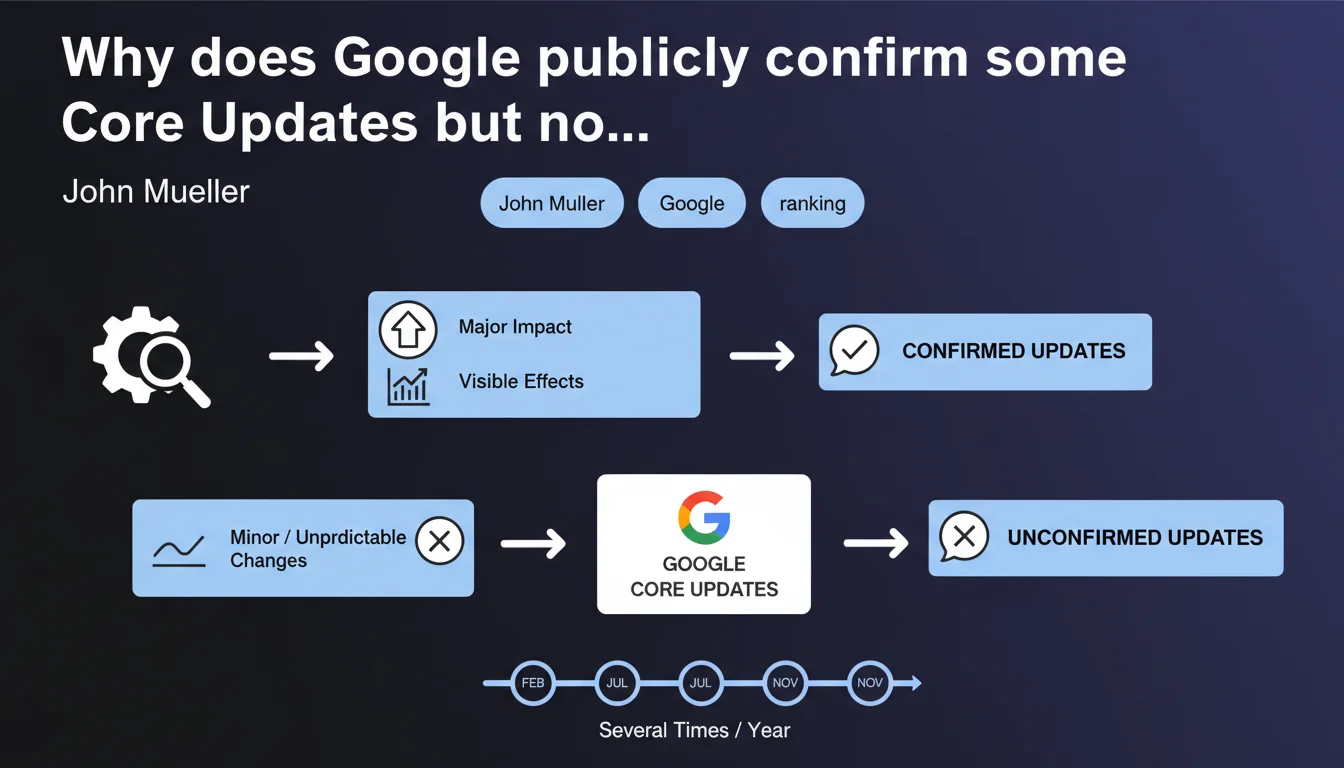
Google deploys several Core Updates each year and publicly confirms major updates that generate visible ranking impacts. This official confirmation serves to alert webmasters to significant fluctuations ahead, but raises the question: are all Core Updates really announced?
What you need to understand
Does Google really announce all of its Core Updates?
Mueller's statement clarifies that Google confirms major updates because they produce visible effects. The word "major" is crucial here — it implies that there are smaller Core Updates that don't receive official communication.
In practice, Google began systematically confirming its Core Updates starting in March 2018, after years of silence that fueled speculation and paranoia in the SEO community. This relative transparency allows professionals to distinguish normal fluctuations from genuine algorithmic shifts.
What is the actual frequency of these updates?
Mueller mentions "several times per year," which remains deliberately vague. In practice, Google typically deploys 3 to 4 confirmed Core Updates annually, spaced roughly 3 to 4 months apart. But between these major waves, the algorithm evolves daily with minor adjustments that fly under the radar.
This cadence theoretically allows sites penalized during a Core Update to correct themselves and recover during the next one. Theoretically. Because in reality, recovery often takes several cycles — sometimes 6 to 12 months.
Why does this official confirmation change the game?
Before this confirmation policy, every traffic fluctuation triggered an avalanche of conspiracy theories. Today, when Google announces a Core Update via its @searchliaison account, at least you know your position changes aren't a figment of your imagination.
But — and this is where it gets tricky — this confirmation often arrives during or after deployment, not before. Which severely limits your ability to anticipate.
- Official frequency: 3-4 confirmed Core Updates per year, plus daily unannnounced adjustments
- Confirmation delay: Generally communicated at the time of deployment, sometimes with 24-48 hour lag
- Deployment duration: Approximately 1 to 2 weeks for a Core Update to be fully deployed
- Official communication: Via Twitter/X account @searchliaison and Search Central Blog
- Limited transparency: Google never reveals the exact criteria modified during a Core Update
SEO Expert opinion
Is this confirmation policy really useful for SEO practitioners?
Let's be honest: knowing a Core Update is underway doesn't fundamentally change your strategy if you're working properly. Google's official advice remains invariably the same — "create quality content for your users" — which doesn't help anyone concretely.
The main value of this confirmation? It allows you to justify traffic variations to your clients without looking like you're making excuses. "It's a Core Update" sounds better than "I don't know why your rankings dropped".
Do we actually observe multiple major updates per year?
The statement "several times per year" matches field observations. But the designation of "major" is subjective. A Core Update can be major for certain niches and completely imperceptible for others.
I've seen e-commerce sites lose 40% of traffic on a Core Update while SaaS sites in the same vertical didn't move a pixel. [To verify]: Google never provides sector-specific data on the actual impact of each Core Update, making it impossible to objectively assess what constitutes a "significant" impact.
In what cases does this confirmation rule not apply?
Google does not systematically confirm Product Reviews Updates, spam adjustments, or modifications targeted at specific niches. There are also "phantom updates" — massive fluctuations observed by the community but never officially acknowledged.
Moreover, the term "Core Update" has become a convenient catchall. Google can very well deploy substantial algorithm modifications without using this label — such as adjustments related to generative AI integrated into SERPs, which radically transform visibility without technically being "Core Updates".
Practical impact and recommendations
What should you do concretely when Google announces a Core Update?
First instinct: don't panic and don't take action for 2 weeks. Full deployment takes time, and your positions will likely fluctuate daily. Waiting for stabilization prevents you from making hasty decisions based on incomplete data.
During this deployment period, intensify your monitoring. Compare pages that are rising with those that are falling — look for patterns. Are your long-form contents losing to more concise content? Are your commercial pages being replaced by informational content?
How to analyze the impact on your site after a Core Update?
Segment your analysis by content type, not just by URL. Core Updates rarely target isolated pages — they re-evaluate entire content categories or quality patterns.
Use Search Console to identify queries that lost impressions. Cross-reference with your Analytics data to see if conversion rate evolved proportionally to traffic. Sometimes losing 20% of low-quality traffic improves your business performance.
What mistakes should you avoid after noticing a drop?
The classic mistake: massively rewriting your content in a panic. Google explicitly discouraged this approach. If your content was relevant before the update, the problem is probably not in the text itself but in the overall quality signals your site emits.
Another common mistake: over-optimizing your pages by adding keywords or artificially extending content. Core Updates evaluate overall relevance and authority, not word count.
- Wait 10-14 days after the announcement before taking major action to allow the update to stabilize
- Monitor daily rankings on your strategic keywords with a reliable third-party tool
- Compare winning vs losing content to identify privileged algorithmic patterns
- Audit your site's E-E-A-T signals: demonstrated expertise, cited sources, identified authors
- Verify the thematic consistency of your backlinks and disavow toxic links if necessary
- Analyze real user experience: load time, Core Web Vitals, bounce rate
- Never substantially modify your content without a clear hypothesis based on data
- Document every change you make precisely to measure its impact during the next Core Update
❓ Frequently Asked Questions
Combien de temps faut-il pour qu'un Core Update soit complètement déployé ?
Si mon site perd des positions lors d'un Core Update, peut-il récupérer au suivant ?
Google annonce-t-il tous les changements d'algorithme ou seulement les Core Updates ?
Dois-je modifier mes contenus immédiatement après un Core Update qui m'a pénalisé ?
Où Google communique-t-il officiellement ses Core Updates ?
🎥 From the same video 7
Other SEO insights extracted from this same Google Search Central video · published on 23/06/2022
🎥 Watch the full video on YouTube →
💬 Comments (0)
Be the first to comment.