
Official statement
Other statements from this video 7 ▾
- □ Comment la série Ecommerce Essentials de Google révolutionne-t-elle l'approche technique du SEO ?
- □ Le nouveau rapport vidéo Search Console va-t-il changer la donne pour le SEO vidéo ?
- □ Pourquoi Google confirme-t-il publiquement certaines Core Updates et pas d'autres ?
- □ Faut-il vraiment arrêter d'utiliser l'outil de gestion des paramètres d'URL dans Search Console ?
- □ Faut-il encore s'embêter avec les balises d'extension de sitemap ?
- □ Faut-il connecter Search Console à Data Studio pour optimiser ses performances SEO ?
- □ Comment Google a-t-il réellement adapté sa lutte anti-spam ces dernières années ?
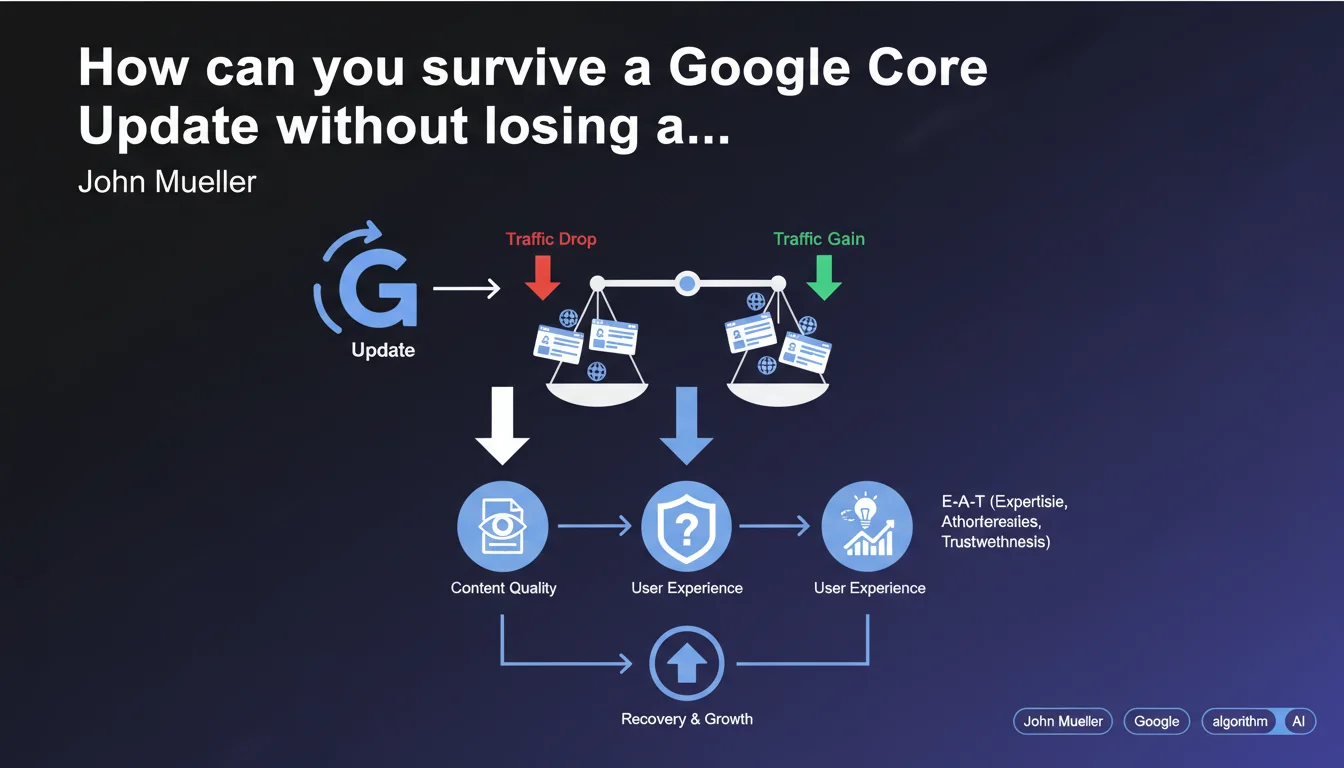
Google regularly deploys Core Updates that impact the core of its ranking algorithms. These updates can cause significant traffic variations, both up and down. Don't panic: it's not a penalty, but a global re-evaluation of your content's relevance.
What you need to understand
The May Core Update is part of a regular cycle of major updates that Google deploys several times a year. Unlike targeted updates (Panda, Penguin, etc.), these Core Updates affect all ranking systems.
The announcement is typically sparse: Google confirms the rollout and reminds users that fluctuations are normal. Nothing more.
What does a Core Update actually change?
A Core Update modifies the way Google evaluates the overall quality of a site. This is not a spam correction or a penalty, but a recalibration of relevance criteria.
Google adjusts its algorithms to better reward content that addresses search intent, demonstrates real expertise, and delivers a solid user experience. If your site loses traffic, it's not necessarily because it's bad — it's perhaps because others have become more relevant in the algorithm's eyes.
Why do some sites gain while others lose?
Core Updates don't target specific sites. They re-evaluate the entire indexed web according to evolving quality criteria. If a competitor significantly improves their content, you can lose rankings even if you haven't done anything wrong.
Sites that gain are generally those that have invested in in-depth, updated, well-structured content aligned with users' real needs. Those that lose often have shallow, duplicated content, or content that no longer meets Google's current standards.
- Core Update ≠ penalty: no manual action, just an algorithmic re-evaluation.
- Fluctuations can be significant and sudden, with traffic variations of 20% to 50% or more.
- Google recommends focusing on content quality, not on one-off technical optimizations.
- Rollout typically takes 1 to 2 weeks, with effects stabilizing afterward.
- There's no "quick fix": adjustments must be structural.
SEO Expert opinion
Is this statement consistent with what we observe on the ground?
Yes, broadly speaking. Core Updates do indeed cause notable — sometimes spectacular — movement in the SERPs. Sites displaying clear expertise and content depth tend to resist better or progress.
But here's the catch: Google remains vague about what exactly constitutes that "quality." The famous E-E-A-T guidelines are a framework, not a recipe. [To be verified]: the actual impact of certain signals (freshness, article length, semantic depth) varies enormously depending on the niche. What works in health doesn't necessarily work in finance or e-commerce.
What nuances should we add to this announcement?
Google says "focus on quality," but never specifies what that means operationally. The reality is that each Core Update seems to weight different factors differently: sometimes domain authority matters more, sometimes freshness does, sometimes semantic structure does.
Another point: Core Updates are not isolated. They often overlap with other algorithmic adjustments in progress (Helpful Content, Product Reviews, etc.). It's hard to know which update causes which variation. Analysis tools show correlations, rarely clear causality. The alert box
In what cases does this logic not apply?
Core Updates primarily affect content-heavy sites. If you're a transactional site with little editorial content (marketplace type, SaaS, etc.), the impact will often be lower — unless your product pages or landing pages are weak.
Also, certain niche sites with strong brand authority seem relatively immune. Google increasingly favors recognized brands, which can create positive inertia. A new site, even with excellent content, will take longer to climb after a Core Update than an established site with years of history.
Practical impact and recommendations
What should you do concretely after a Core Update?
First, wait for the rollout to complete. Fluctuations can last 1 to 2 weeks. Don't panic at the first sign of a drop — it can stabilize or even correct itself naturally.
Next, precisely identify the impacted pages. Use Search Console to spot URLs that have lost impressions or clicks. Compare with your direct competitors: what content ranks them better? What do they have that you don't?
- Analyze losing pages: content depth, structure, freshness, relevance to search intent.
- Audit your E-E-A-T signals: who writes your content? Are they credentialed (author bio, references, sources)?
- Check technical quality: loading time, mobile-first, user experience. A Core Update doesn't target these aspects, but they can amplify or mitigate impact.
- Compare with competitors who are advancing: article length, semantic richness, title structure, media used.
- Rewrite or enrich weak content, but don't touch what's still performing well.
What mistakes should you avoid at all costs?
Don't rewrite your entire site in a panic. Many SEOs panic and massively modify their content, which can worsen the situation by creating new inconsistencies or diluting relevance.
Also, don't focus solely on keywords. A Core Update doesn't reward keyword density, but perceived content value. Adding 500 words of filler serves no purpose.
- Don't delete content without analyzing its role in internal linking and overall architecture.
- Don't blindly copy what competitors do — what works for them won't necessarily work for you.
- Don't neglect regular updates: content that hasn't been refreshed in several years is often penalized.
How can you verify your site is on the right track?
Monitor the evolution of your rankings and traffic over 4 to 6 weeks after the rollout ends. Progressive recovery is a good sign. Stagnation or continued decline requires a fundamental overhaul.
Use tracking tools (SEMrush, Ahrefs, Google Analytics) to identify trends by page type, by topic, by query. Core Updates often have segmented impacts: some content categories may gain while others lose.
Recovering after a Core Update takes time, analysis, and structural adjustments. If your internal resources are limited or you lack visibility into what levers to activate, support from a specialized SEO agency can speed up diagnosis and implementation of necessary corrections. External expertise often helps identify blind spots and avoid costly mistakes.
❓ Frequently Asked Questions
Une Core Update est-elle une pénalité ?
Combien de temps faut-il pour récupérer après une Core Update ?
Faut-il attendre la prochaine Core Update pour voir des résultats ?
Google publie-t-il une liste de critères pour réussir une Core Update ?
Les backlinks jouent-ils un rôle dans les Core Updates ?
🎥 From the same video 7
Other SEO insights extracted from this same Google Search Central video · published on 23/06/2022
🎥 Watch the full video on YouTube →
💬 Comments (0)
Be the first to comment.