
Official statement
Other statements from this video 7 ▾
- □ Comment la série Ecommerce Essentials de Google révolutionne-t-elle l'approche technique du SEO ?
- □ Le nouveau rapport vidéo Search Console va-t-il changer la donne pour le SEO vidéo ?
- □ Comment survivre à une Core Update de Google sans perdre tout son trafic ?
- □ Pourquoi Google confirme-t-il publiquement certaines Core Updates et pas d'autres ?
- □ Faut-il vraiment arrêter d'utiliser l'outil de gestion des paramètres d'URL dans Search Console ?
- □ Faut-il connecter Search Console à Data Studio pour optimiser ses performances SEO ?
- □ Comment Google a-t-il réellement adapté sa lutte anti-spam ces dernières années ?
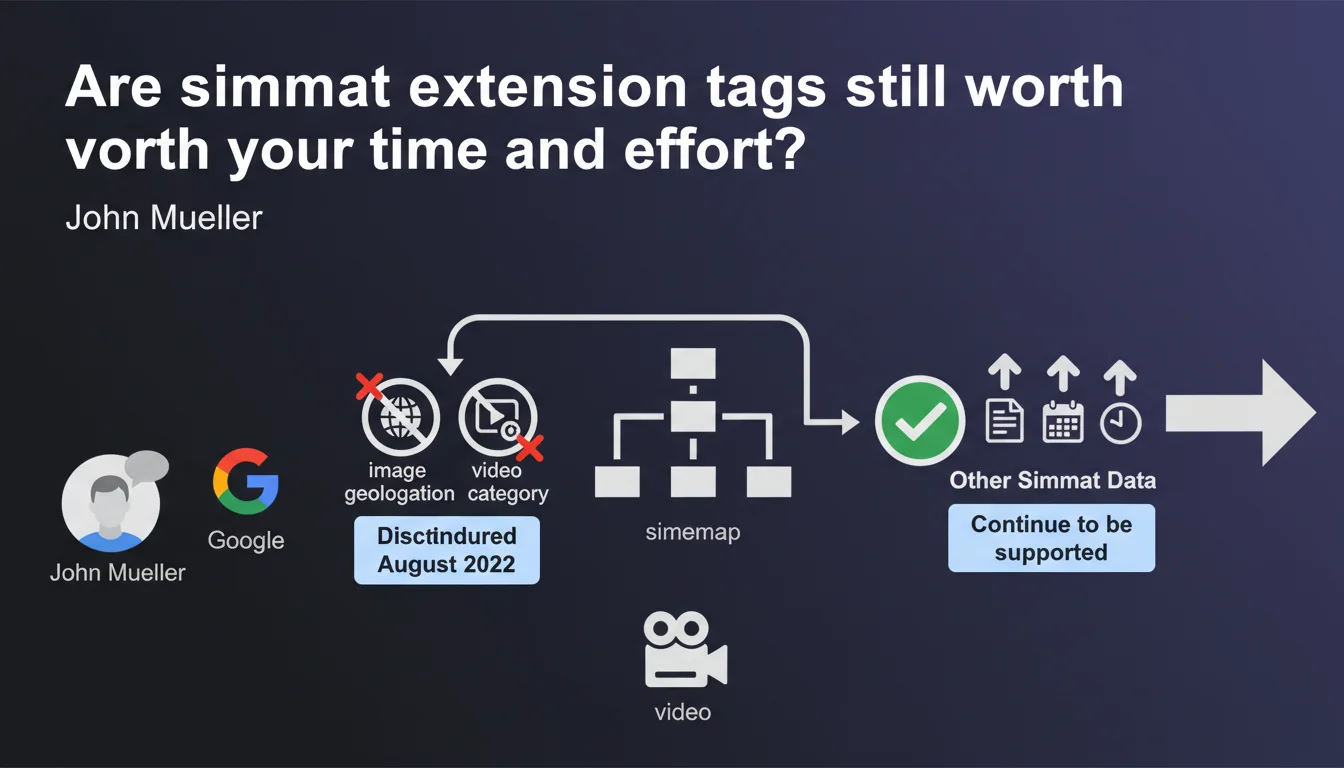
Google discontinued several sitemap extension tags, including image geolocation and video category. In practical terms, this means these metadata are no longer useful in your XML files. Other sitemap data remains valid and continues to be crawled normally.
What you need to understand
Which extension tags were exactly abandoned?
Google stopped using image geolocation and video category in sitemaps. These tags theoretically allowed you to indicate the geographic location of a photo or categorize a video according to its content.
The announcement remains vague about the exhaustive list of affected tags. John Mueller mentions "several" tags without naming them all, which leaves some uncertainty about what is still actually being used.
Why is Google abandoning these tags now?
The official reason? Google says nothing. We can assume that this data provided no real added value to the indexing process or that nobody was using them correctly.
More likely: their visual and video understanding algorithms are now sophisticated enough to extract this information directly from content, without needing declarative metadata.
Do sitemaps remain relevant despite this?
Yes, absolutely. Standard sitemap data (URLs, lastmod, priority, changefreq) continue to be supported. Image and video sitemaps remain functional, just without these specific extension tags.
The sitemap remains an essential communication tool between your site and Googlebot, especially for large sites with deep content or pages that are difficult to discover through natural crawling.
- Image geolocation and video category tags: abandoned, no need to maintain them
- Standard, image, video sitemaps: still supported and recommended
- Other extension tags: uncertain status, Google did not provide an exhaustive list
- Impact on indexation: none if you weren't using these specific tags
SEO Expert opinion
Does this announcement reflect Google's lack of interest in enriched sitemaps?
Not really. It's rather a sign that Google is refining its use of structured data. The abandoned tags were redundant with what their algorithms automatically extract.
However, it shows that Google doesn't hesitate to deprecate standards they themselves pushed a few years ago. For SEO professionals who spent time implementing these tags — it was wasted effort.
Should we clean up our sitemaps of these obsolete tags?
Technically, no. Google simply ignores them. They don't penalize your crawl budget or indexation. [To verify]: some SEO professionals report that unknown or obsolete tags can generate warnings in Search Console.
For the sake of technical cleanliness, it's worth removing them if you're redesigning your sitemaps. But it's clearly not an urgent priority.
Which extension tags actually remain exploited?
This is the big gray area of this announcement. John Mueller doesn't provide the complete list of still-supported tags. We know that standard tags (title, description, thumbnail for videos) continue to work.
For the rest, we're flying blind. Typical Google: an announcement that only partially answers the question and leaves practitioners to experiment to understand what still works.
Practical impact and recommendations
What needs to be modified in your current sitemaps?
If you're using the image geolocation or video category tags, you can remove them. It's not blocking to leave them, but it's better to simplify your XML files for easier maintenance.
For e-commerce or media sites with lots of images and videos, verify that your sitemaps still respect the basic tags: video/image URL, title, description, thumbnail. These are the ones that really matter.
How do you verify that your sitemaps are properly interpreted?
Head to Search Console, Sitemaps section. Check that there are no reported errors, especially warnings about unrecognized tags.
For videos, the Enhancements > Videos section tells you if Google detects and indexes your video content correctly. If your videos are listed, that means your sitemap is doing its job, extension tags or not.
- Identify whether you're using image geolocation or video category tags in your current sitemaps
- Remove them during your next sitemap update (or leave them, they don't cause harm)
- Ensure that essential tags (URL, title, description, thumbnail) are still present
- Monitor Search Console to detect any warnings about unrecognized tags
- For large sites, document the extension tags you still use and test their impact
❓ Frequently Asked Questions
Les balises de sitemap vidéo sont-elles toutes obsolètes ?
Faut-il supprimer immédiatement ces balises de mes sitemaps ?
Cette annonce impacte-t-elle l'indexation de mes images et vidéos ?
Comment savoir quelles balises d'extension fonctionnent encore ?
Les sitemaps restent-ils importants pour le SEO après cette annonce ?
🎥 From the same video 7
Other SEO insights extracted from this same Google Search Central video · published on 23/06/2022
🎥 Watch the full video on YouTube →
💬 Comments (0)
Be the first to comment.