
Official statement
Other statements from this video 11 ▾
- □ How can you leverage massive Search Console data exports to BigQuery to transform your SEO strategy?
- □ Does Google really reward content quality regardless of how it's produced?
- □ Is automation really considered spam by Google when it's used to boost rankings?
- □ Is using AI to generate SEO content spam or a legitimate opportunity?
- □ Does Google really treat AI-generated content the same as human-written content in rankings?
- □ Does Google really expect you to justify who, how, and why for every piece of content you create?
- □ Is Google's Status Dashboard Really a Game-Changer for SEO Professionals?
- □ Why is Google making Experience a core ranking factor alongside Expertise, Authority, and Trustworthiness?
- □ Why did Google just release an official gallery of search visual elements?
- □ Why is Google publishing a specific guide on links for web designers?
- □ Is Google's product review system expanding globally? Here's what's changing for your website and why it matters
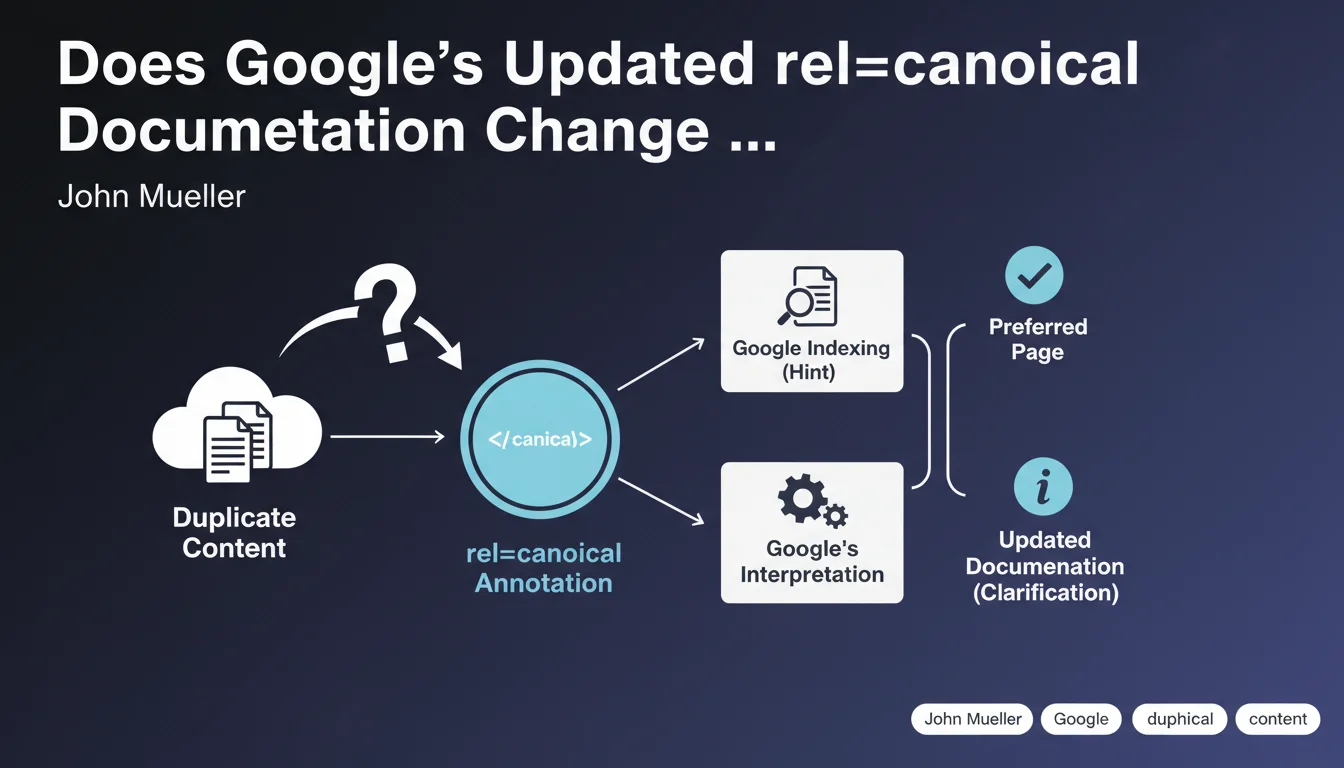
Google has refreshed its documentation on rel=canonical to clarify that this tag remains an advisory signal, not an absolute directive. The update reminds SEO practitioners that search engines retain the final decision-making authority on which page to canonicalize. In practical terms: your annotations are considered, but Google can override them if its own algorithms detect inconsistencies.
What you need to understand
What Exactly Does This Documentation Update Mean?
Google has revised its official resources concerning the rel=canonical attribute, a mechanism that webmasters use to signal which version of a page should be prioritized during indexing. This update does not introduce new technical behaviors — it clarifies Google's position on the status of this tag.
Unlike certain robots directives that are imperative, the canonical remains one signal among many. Google interprets it as a strong suggestion, but retains its algorithmic free will. If the engine detects inconsistencies (for example a canonical pointing to a 404 page, or to radically different content), it will discard your annotation.
How Does This Clarification Change Things for SEO Practitioners?
Most SEO experts already know that Google does not always blindly follow declared canonicals. But this official reframing settles a recurring debate: should rel=canonical be considered a mandatory instruction or a recommendation? Google's answer is now crystal clear — it's a recommendation.
This positioning also explains why, in certain audits, you observe that Google indexes a different URL than the one you specified. Rather than crying foul, you should seek the contradictory signals that prompted the algorithm to ignore your choice.
What Are the Typical Cases Where Google Ignores the Canonical?
Several scenarios trigger this behavior. A missing self-referential canonical on the master page can create doubt. Massive internal linking toward a non-canonical variant sends a strong contradictory signal. An hreflang tag that points to a different URL creates structural ambiguity.
Temporary 302 redirects to an alternative version, combined with a canonical pointing to the original, also generate confusion. Google often prioritizes overall signal consistency rather than an isolated tag.
- The canonical is a strong but non-binding signal — Google has the final say
- Inconsistencies between canonical, internal linking, and redirects weaken the signal
- A canonical pointing to an inaccessible page or radically different content will be ignored
- The documentation settles the « suggestion vs. directive » debate — it's officially a suggestion
- Google's algorithms cross-reference multiple signals before deciding on the final canonical page
SEO Expert opinion
Is This Clarification Consistent with Real-World Observations?
Yes, unsurprisingly so. Experienced practitioners have observed for years that Google does not always respect declared canonicals. This update simply documents an established algorithmic behavior. No technical revolution here — just a formalization that prevents misunderstandings.
That said, the lack of precise criteria on when and why Google decides to ignore a canonical remains frustrating. The documentation does not detail the thresholds or combinations of contradictory signals that tip the decision. [To be verified] in each context via Search Console and server logs.
What Nuances Should Be Added to This Statement?
First point — if your technical structure is coherent, Google follows the canonical in the vast majority of cases. Don't fall into the opposite trap: « since it's optional, why bother doing anything. » A well-implemented canonical remains one of the most reliable signals for guiding indexation.
Second nuance: the update does not explicitly mention cross-domain variants. Yet in migrations or multi-domain consolidations, the cross-domain canonical is followed even less systematically. Google often favors 301 redirects in these scenarios. Proceed with caution, therefore, if you're counting solely on rel=canonical to manage a site merger.
In What Cases Does This Rule Create Problems?
E-commerce platforms with parametric filters generate thousands of nearly identical URLs. A poorly configured canonical could theoretically be ignored if internal linking creates too many links to filtered variants. Result: index explosion and crawl budget dilution.
Another pitfall — multilingual sites that juggle between hreflang and canonical. If both mechanisms point to different URLs, Google decides according to its own logic. Not always in your favor. Consistency between these two attributes is not optional — it's a structural requirement.
Practical impact and recommendations
What Must You Concretely Verify on Your Site?
Start with Search Console. In the « Coverage » section, identify « Excluded » pages with the status « Other page with appropriate canonical tag. » If strategic URLs appear here when they should be indexed, this signals a misdirected canonical or conflicting signals.
Next, cross-reference with your server logs. Identify pages that Googlebot crawls heavily despite a canonical pointing elsewhere. This reveals either contradictory internal linking or algorithmic distrust of your tag. In either case, correction is needed.
What Mistakes Must You Avoid at All Costs?
Never chain canonicals — page A with canonical to B, which itself has a canonical to C. Google may follow one step, rarely two. The canonical should always point directly to the master version, with no intermediary.
Also avoid a canonical pointing to a page that itself redirects via 301 or 302. You create a loop of confused signals. If a page must redirect, remove it from the canonical equation. And most importantly: never point a canonical to a URL blocked by robots.txt or protected by meta robots noindex — Google will outright reject this annotation.
How Can You Ensure Your Canonicals Are Followed?
Use the URL Inspection tool in Search Console. For each critical page, verify that « User-declared canonical URL » matches « Google-selected canonical URL. » If the two diverge, investigate: analyze internal linking, redirects, any contradictory hreflang tags.
Automate detection through regular crawls (Screaming Frog, Oncrawl, Botify). Set up alerts for discrepancies between declared and detected canonical. On large e-commerce inventories or content-heavy sites, this ongoing monitoring is essential.
- Search Console audit: check excluded pages due to canonical
- Cross-reference with server logs to detect suspicious crawls
- Ensure no canonical points to a redirected or blocked page
- Eliminate any chains of canonicals (A → B → C)
- Verify canonical / hreflang consistency on multilingual sites
- Use URL Inspection to validate that Google is following your annotations
- Automate monitoring through scheduled crawls and alerts
❓ Frequently Asked Questions
Google est-il obligé de suivre le canonical que j'ai déclaré ?
Pourquoi Google indexe-t-il une URL différente de mon canonical ?
Peut-on utiliser un canonical cross-domain lors d'une migration ?
Comment savoir si Google a ignoré mon canonical ?
Faut-il mettre un canonical auto-référentiel sur chaque page maître ?
🎥 From the same video 11
Other SEO insights extracted from this same Google Search Central video · published on 18/04/2023
🎥 Watch the full video on YouTube →
💬 Comments (0)
Be the first to comment.