
Official statement
Other statements from this video 8 ▾
- □ Does Search Console Insights really only show Google Search traffic?
- □ What truly counts as a click in Search Console?
- □ What exactly is a query in Search Console, and why is Google clarifying its definition now?
- □ Should you really analyze your SEO performance over 28 days in Search Console?
- □ How is Google's Search Console now automatically grouping your search queries into semantic clusters?
- □ What is Google's actual definition of a brand query in Search Console?
- □ Is tracking brand searches the hidden metric that's sabotaging your entire SEO strategy?
- □ Are you really maximizing all the traffic breakdown data hidden in Search Console?
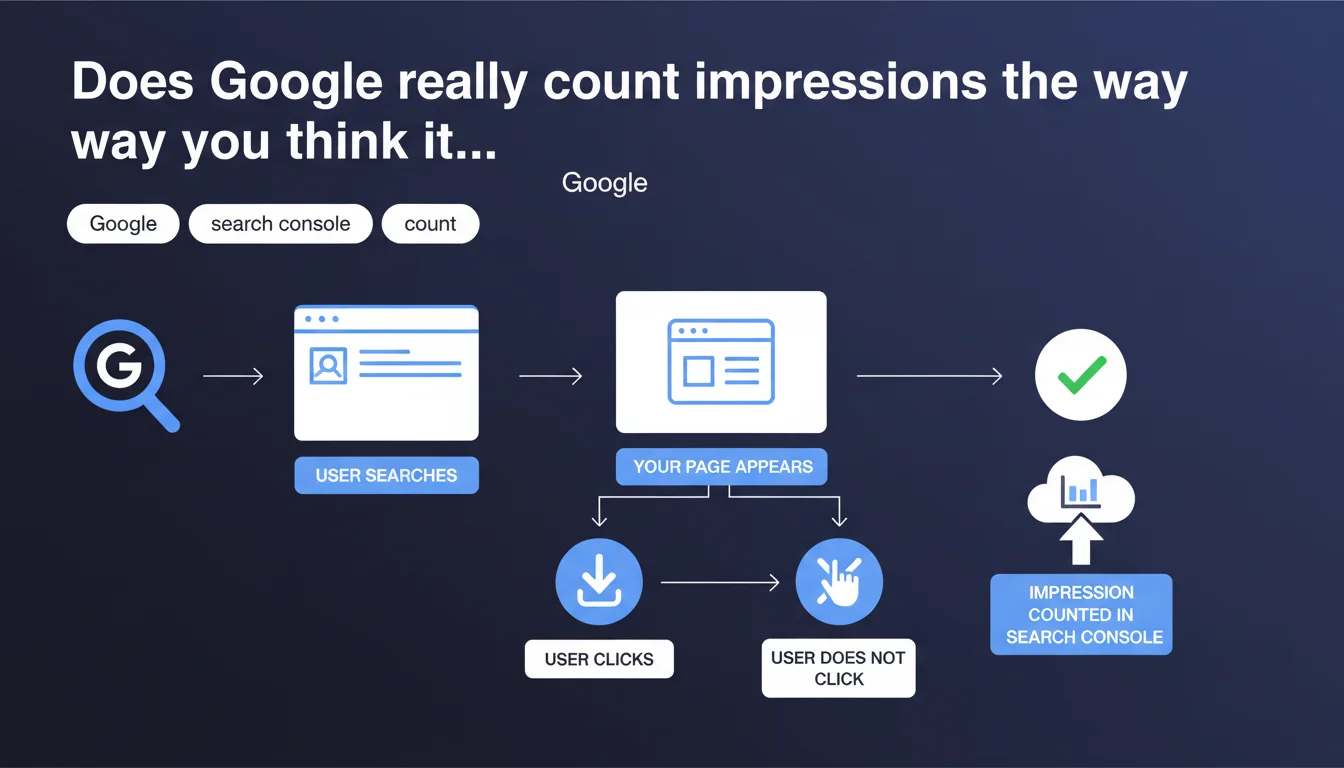
Google counts an impression as soon as a link to your website appears in search results, even if the user never scrolls down to see it. This official definition confirms that technical visibility takes priority over actual on-screen visibility. For SEO practitioners, this means your impression metrics don't necessarily reflect the real exposure of your content.
What you need to understand
Does Google count links that aren't visible on screen?
The official definition talks about a user who sees a link, which seems straightforward. Except in practice, Search Console counts an impression even if your result is at position 50 and the user never scrolled that far down.
The nuance is important — Google considers a link potentially visible as soon as it's part of the loaded results page, not that it actually appeared in the user's viewport. This is a crucial technical distinction for interpreting your data.
Why does this definition create problems for analysis?
Because it creates a gap between technical impression and actual impression. A result at position 18 generates an impression even if 95% of users never go past position 10.
Your click-through rates (CTR) end up mechanically diluted. A 2% CTR at position 15 might seem catastrophic, when in reality, among users who actually saw your link, the rate might be 15%.
What exactly triggers an impression?
As soon as the SERP containing your link is generated and displayed on the server side, the impression is counted. Regardless of whether the user leaves the page immediately, whether the result is at the bottom of the page, or even in some cases if it hasn't fully loaded yet.
SERP features (featured snippets, People Also Ask, carousels) complicate the picture even more. A result pushed to position 8 by three PAA blocks generates an impression, but its real visibility is that of a position 15-20.
- One impression = presence in the generated SERP, not on-screen visibility
- Average CTR by position is skewed by this technical/actual gap
- SERP features create a delta between stated position and visual position
- Rapid abandonment of the SERP still counts as an impression for all loaded results
SEO Expert opinion
Does this definition match what we observe in the data?
Yes, and that's exactly what explains certain apparent inconsistencies in Search Console. I've seen websites with a 0.8% CTR at average position 12 — mathematically impossible if only real impressions were counted.
The problem becomes even more visible on high-volume queries where Google displays enriched SERPs. You're ranked 3rd, but visually you appear after a featured snippet, three ads, and a local pack. Your CTR collapses, but Search Console still says position 3.
What are the consequences for interpreting performance?
The CTR benchmarks by position you find everywhere should be taken with enormous caution. They aggregate data where position 5 might mean truly the 5th visible link, or 11th after features.
Let's be honest — comparing your CTR at position 4 to the median CTR position 4 across your industry often makes no sense. It all depends on the SERP structure for your main queries. A clean SERP vs. a SERP packed with features are two completely different scenarios.
Could Google refine this metric in the future?
Technically, Google knows perfectly well what appears in the viewport. Chrome Lighthouse already measures Largest Contentful Paint and other real visibility metrics.
But don't expect a change. This impression definition serves Google's interests — it inflates impression volumes, which improves Search Console's coverage appearance and justifies the ad ecosystem. And that's where it pinches: a more precise metric would reveal the true impact of SERP features on organic visibility.
Practical impact and recommendations
How do you analyze your performance with this definition in mind?
Stop looking at global CTR. Filter by exact position (not average) and cross-reference with manual SERP analysis. Identify your queries with abnormally low CTR for their position, then check the SERP: are there features pushing your result out of the viewport?
Use tools like SISTRIX or SEMrush to map SERP features across your keywords. A position 3 result with zero features above it should generate 15-25% CTR. Same position with snippet + PAA + ads? 3-5% becomes normal.
Should you adjust your organic acquisition KPIs?
Absolutely. Don't set CTR targets based on generic benchmarks. Build your own baselines by SERP type.
Segment your queries: clean SERPs / SERPs with light features / saturated SERPs. Track CTR evolution within each segment. A global CTR decline might just be Google adding features, not a degradation of your titles.
Focus your meta descriptions and title optimization efforts on queries where you actually have visibility — typically positions 1-5 on uncluttered SERPs. The rest is statistical noise.
What levers can you pull to offset this effect?
Target position zero (featured snippets) rather than traditional position 1. Same effort challenge, but you capture attention before everything else. Structure your content with clear answers to common questions.
Invest in rich snippets and structured data. If you can't avoid features, you might as well be one. FAQ schema, HowTo schema, Product schema — anything that gets you featured in an enriched block rather than as an anonymous blue link.
- Map SERP features across your top 100 traffic-generating queries
- Segment your Search Console data by SERP type (clean/cluttered)
- Establish internal CTR benchmarks by SERP segment
- Prioritize optimizing queries where you have real visibility (top 5, clean SERPs)
- Implement structured data to capture enriched positions
- Monitor SERP feature evolution monthly — Google adds them constantly
🎥 From the same video 8
Other SEO insights extracted from this same Google Search Central video · published on 02/12/2025
🎥 Watch the full video on YouTube →
💬 Comments (0)
Be the first to comment.