
Official statement
Other statements from this video 8 ▾
- □ Does Google really prefer subdomains or subdirectories for SEO? Here's what actually matters
- □ Will backlinks really lose their importance in SEO?
- □ Does Google really detect link schemes 100% algorithmically without manual intervention?
- □ Should you really limit the Organization schema to just your homepage?
- □ Are structured content templates really a game-changer for SEO performance?
- □ Does Google really refuse to index your templated content, and why should you care?
- □ Should your alt attributes describe the image's context on the page, not just what's visually shown?
- □ Are differentiated H1 tags the secret to indexing your pages with similar templates?
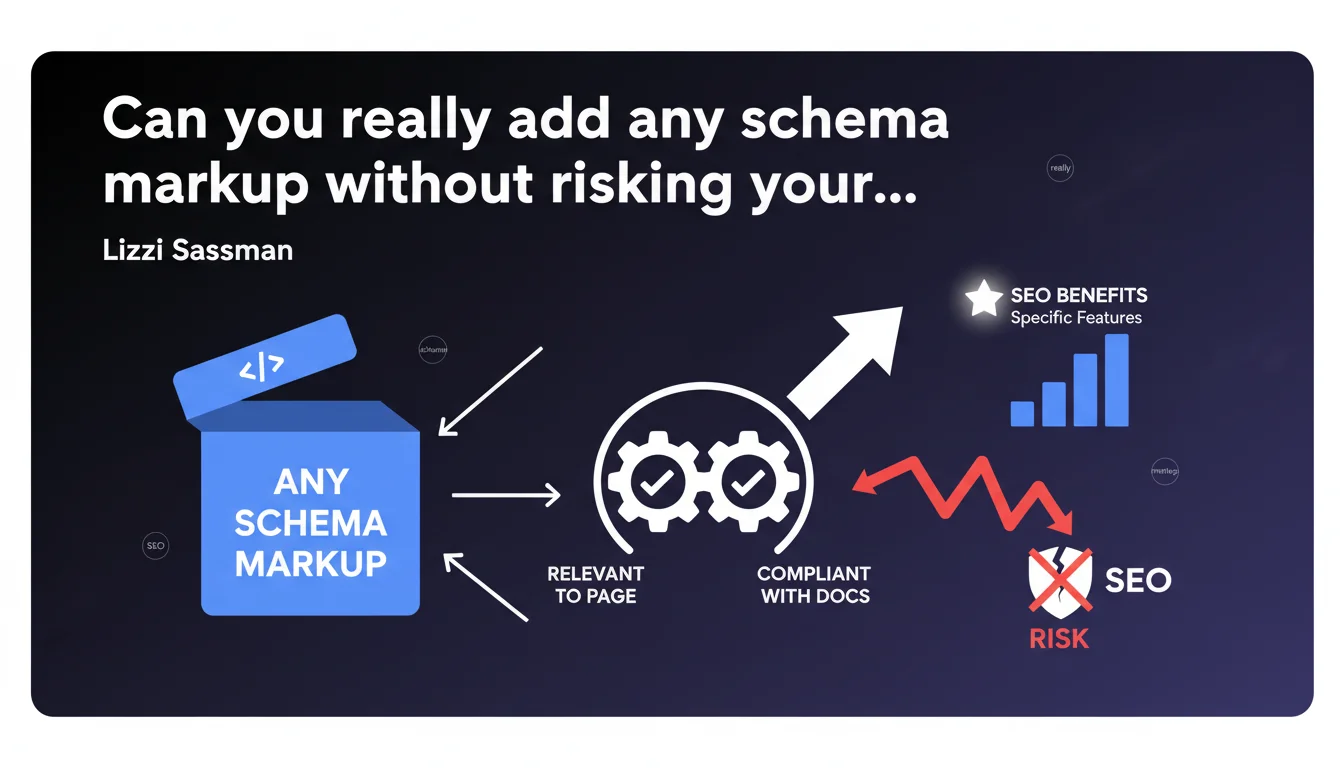
Google allows you to add all types of schema markup on your pages — there are no technical restrictions. The only constraint is contextual relevance and compliance with official documentation if you're targeting enriched features in the SERPs. In short, overloading a page with off-topic schemas won't break anything, but it won't help you either.
What you need to understand
What does this "complete freedom" really mean in practice?
Lizzi Sassman asserts that no technical filter prevents adding any type of schema markup to a web page. You can theoretically throw LocalBusiness, Recipe, and Event schemas on the same URL without triggering an algorithmic penalty.
But — and this is where it gets tricky — this technical freedom doesn't mean Google will exploit that markup. If the schema isn't relevant to the visible content, it will simply be ignored. No sanctions, no rewards.
Why does Google insist on relevance and compliance?
Enriched features (rich snippets, product cards, collapsible FAQs) only activate if the schema meets two criteria: correspondence with the actual page content AND strict adherence to Schema.org documentation plus Google guidelines.
A Recipe schema on an e-commerce product page? Technically possible. But zero chance of getting the recipe rich snippet — and risk of credibility loss if a manual review catches it.
What's the difference between "adding" and "benefiting"?
Google clearly distinguishes between the act of adding code (allowed without limits) and exploiting that code (conditional on relevance). It's a crucial distinction many SEO practitioners overlook.
Concretely: you can technically pollute your HTML with 15 different schema types. Google will crawl them, possibly validate them, but won't act on any of them if the context doesn't fit.
- Complete technical freedom: no schema type is blocked from being added
- Exploitation is conditional: only relevant and compliant schemas trigger features
- No penalty for overloading: adding off-topic schema doesn't hurt, but serves no purpose
- Strict compliance required: for rich snippets, mandatory adherence to official documentation
SEO Expert opinion
Is this statement consistent with real-world observations?
Yes, but with a caveat. Across thousands of audits, I've rarely seen Google penalize a site for off-topic schema. However, cases of rich snippet deindexing following abuse (fake FAQs, fraudulent reviews) are well documented.
The nuance? Google doesn't penalize the addition; it penalizes manipulation. If your LocalBusiness schema on a blog page is just poorly placed (integration error), nothing happens. If it's an attempt at keyword stuffing to grab SERP features, that's where it breaks.
What observed practices contradict this apparent flexibility?
Manual actions for schema spam definitely exist. Google has been very clear about abusive FAQs, fake reviews, and manipulated prices. So "complete freedom" doesn't mean "total impunity."
And let's be honest: [To verify] — Google publishes no metrics on the rejection rate of out-of-context schemas. We know they're ignored, but the indirect impact (wasted crawl time, degraded quality signal) remains undocumented.
In what cases does this rule not really apply?
YMYL sectors (healthcare, finance) face stricter scrutiny. A poorly executed or misleading MedicalWebPage schema can trigger manual review, even without clear "spam." Reputational risk pushes Google to be less lenient.
Practical impact and recommendations
What should you do concretely to optimize your schema markup?
Start with a relevance audit: each schema must correspond to visible and verifiable content on the page. No Recipe if no recipe is displayed, no Event if no event is detailed.
Next, validate technical compliance with the Rich Results Test and Schema Markup Validator. These tools catch structural errors but don't judge contextual relevance — that's your job.
- Map each content type to a single, appropriate schema
- Remove orphaned or out-of-context schemas from poorly configured templates
- Test rich snippet eligibility via Search Console (Enhancements report)
- Monitor SERP positions before/after to measure real impact
- Document markup choices to facilitate maintenance and future audits
What mistakes should you absolutely avoid?
Don't duplicate identical schemas across different pages without adapting the content. Google detects industry patterns and can demote duplicate rich snippets.
Also avoid schema stuffing in hopes of multiplying chances of appearing. One page = one primary schema. Secondary schemas (Breadcrumb, Organization) are OK, but stay consistent.
How do you verify your site stays compliant long-term?
Implement a quarterly audit routine: extract schemas via crawl, compare with actual content, check Search Console alerts. CMS templates evolve, plugins update — parasitic schemas can appear without your knowledge.
Also integrate an automated check into your CI/CD if you're in an advanced technical environment. Some tools can validate schema compliance on every deployment.
❓ Frequently Asked Questions
Puis-je ajouter plusieurs types de schema sur une même page sans risque ?
Google pénalise-t-il un schema hors-sujet ou le ignore-t-il simplement ?
Comment savoir si mon schema est éligible aux rich snippets ?
Faut-il privilégier JSON-LD ou les microdonnées pour le schema ?
Un schema mal configuré peut-il nuire au crawl ou à l'indexation ?
🎥 From the same video 8
Other SEO insights extracted from this same Google Search Central video · published on 03/11/2022
🎥 Watch the full video on YouTube →
💬 Comments (0)
Be the first to comment.