
Official statement
Other statements from this video 8 ▾
- □ Does Google really prefer subdomains or subdirectories for SEO? Here's what actually matters
- □ Does Google really detect link schemes 100% algorithmically without manual intervention?
- □ Should you really limit the Organization schema to just your homepage?
- □ Can you really add any schema markup without risking your SEO performance?
- □ Are structured content templates really a game-changer for SEO performance?
- □ Does Google really refuse to index your templated content, and why should you care?
- □ Should your alt attributes describe the image's context on the page, not just what's visually shown?
- □ Are differentiated H1 tags the secret to indexing your pages with similar templates?
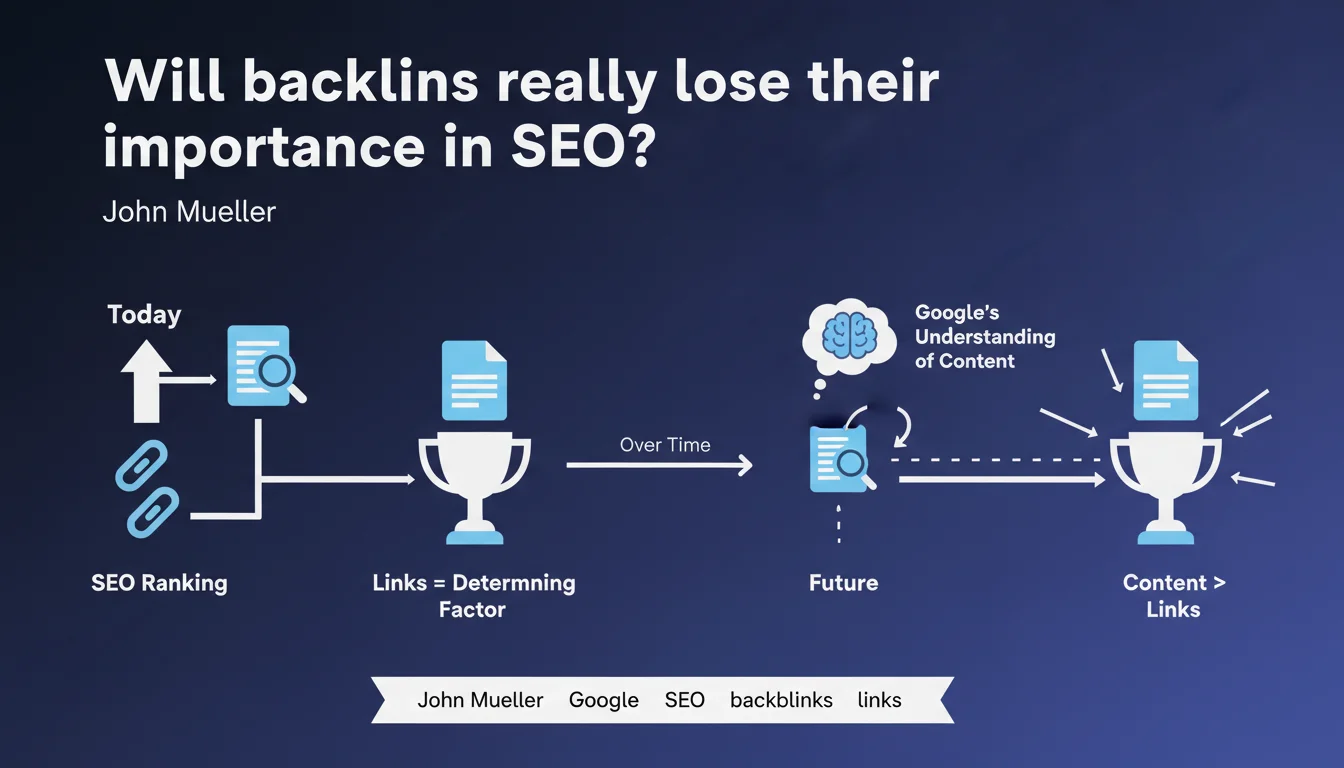
Google announces that the weight of backlinks will gradually decrease in favor of better contextual understanding of content. Links will remain useful for page discovery, but will no longer be the determining ranking factor they currently are. A major transition that redefines SEO priorities.
What you need to understand
What does Google's statement really say?
John Mueller claims that Google's algorithm is evolving toward less dependence on backlinks as a ranking signal. The goal: rely more on semantic and contextual understanding of content.
Links will retain their role in discovering and crawling pages — nothing new there. But their weight in calculating positioning would be expected to decrease as AI and natural language processing improve.
Why does Google want to reduce the weight of backlinks?
Because external links are manipulable at scale. Link networks, PBNs, massive exchanges, link buying — Google knows it, everyone knows it. By relying more on the intrinsic quality of content and its context, Google seeks to make its algorithm harder to trick.
The rise of BERT, MUM, and language models now makes it possible to analyze the relevance of content without relying solely on external votes. Google wants to value what a page actually delivers, not just how many sites point to it.
What are the concrete implications for SEO?
If this evolution is confirmed, content quality will become even more central. Topical authority, depth, originality, user signals — everything that demonstrates that a page really answers an intent.
This doesn't mean backlinks become useless overnight. They remain a signal, especially for new sites or content. But their relative ROI could decrease against other levers: user experience, E-E-A-T, semantic structuring.
- Backlinks remain important for discovery and crawling of new pages
- Their weight as a ranking factor is announced to be gradually declining
- Google is betting on AI to better understand content without depending on links
- On-page and contextual signals are gaining relative importance
- This transition is gradual, not a sudden shift
SEO Expert opinion
Is this statement consistent with what we observe in the field?
Yes and no. In certain verticals — notably news, health, finance — we already observe that sites with fewer backlinks but strong topical authority and expert content rank better. Helpful Content updates point in this direction.
But let's be honest: on ultra-competitive queries, backlinks still carry enormous weight. Try ranking for "car insurance" or "mortgage" without a solid link profile — spoiler: it won't work. [To verify] that this evolution is as rapid as Mueller suggests.
What nuances should be added to this announcement?
First nuance: Mueller doesn't say when or at what pace. "Gradually" can mean 2 years or 10 years. Without a timeline or metrics, it's impossible to calibrate this evolution. It's strategic messaging, not technical documentation.
Second nuance: not all links are equal. A contextual backlink from an authoritative site in your niche remains a powerful authority signal. What loses weight is probably weak, generic, or bulk-purchased links. Google is refining its ability to distinguish quality from quantity.
Third point — and this is the most important: this statement could be a communication strategy to discourage black hat practices. Saying "links matter less" might prompt some to reduce their link-building budgets, making Google's job easier.
In what cases does this rule not apply?
For new sites or content, backlinks remain crucial for discovery and accelerating indexation. Without incoming links, Google may take weeks to crawl certain deep pages.
In ultra-competitive niches (finance, legal, insurance, real estate), the link profile remains a major differentiator. As long as competitors invest heavily in link building, it's hard to compensate with content alone.
Practical impact and recommendations
What should you do concretely right now?
Rebalance your SEO investments. If 80% of your budget goes to link building and 20% to content, now's the time to reconsider the split. Invest more in expertise, thematic depth, and on-page optimization.
Develop your topical authority: cover your subject in depth, create interconnected content hubs, demonstrate your expertise. Google increasingly values sites that truly master their domain.
Optimize user signals: time on page, bounce rate, SERP returns. If your content holds attention and satisfies intent, it's a powerful signal that Google captures better and better.
What mistakes should you avoid in this context?
Don't throw your link-building strategy out the window. Backlinks remain useful, especially quality links from authoritative sites in your field. What becomes less profitable is bulk purchasing of mediocre links.
Don't fall into the "content for content's sake" trap. Quantity without expertise or depth is worthless. Better 10 excellent articles than 100 average ones.
Avoid neglecting technical aspects: crawlability, speed, Core Web Vitals, data structuring. If Google better understands content, you need to make its job easier with a technically sound site.
How to adjust your SEO strategy during this transition?
Audit your current backlink profile. Identify toxic or low-quality links that could lose even more value. Focus on acquiring natural editorial links.
Invest in content marketing: original studies, exclusive data, in-depth analyses. The type of content that naturally generates citations and shares without needing to solicit links.
Strengthen your E-E-A-T signals: author bios, detailed biographies, academic or professional references, transparency on sources. Google wants to know who writes and why that person is legitimate.
- Rebalance budget between link building and expert content creation
- Develop a topical authority strategy on your niche
- Audit and clean up your existing backlink profile
- Prioritize natural editorial links over bulk purchasing
- Optimize user signals (engagement, time on page, satisfaction)
- Strengthen E-E-A-T signals (expertise, authority, transparency)
- Improve technical aspects (crawl, speed, structuring)
- Produce original, in-depth content rather than generic volume
❓ Frequently Asked Questions
Les backlinks deviennent-ils totalement inutiles en SEO ?
Faut-il arrêter toute stratégie de netlinking ?
Comment Google peut-il évaluer la qualité d'un contenu sans les backlinks ?
Cette évolution concerne-t-elle tous les types de sites ?
Sur quoi investir si on réduit le budget netlinking ?
🎥 From the same video 8
Other SEO insights extracted from this same Google Search Central video · published on 03/11/2022
🎥 Watch the full video on YouTube →
💬 Comments (0)
Be the first to comment.