
Official statement
Other statements from this video 8 ▾
- □ Sous-domaines vs sous-répertoires : Google a-t-il vraiment une préférence ?
- □ Les backlinks vont-ils vraiment perdre de l'importance en SEO ?
- □ Google détecte-t-il vraiment les link schemes de manière 100% algorithmique ?
- □ Peut-on vraiment ajouter n'importe quel schema sans risque pour son SEO ?
- □ Les templates de contenu structurés sont-ils vraiment un atout pour le référencement ?
- □ Pourquoi Google refuse-t-il d'indexer votre contenu généré par templates ?
- □ Pourquoi l'attribut alt doit-il décrire le contexte de l'image et pas seulement l'image elle-même ?
- □ Les H1 différenciés sont-ils la clé pour indexer vos pages à template similaire ?
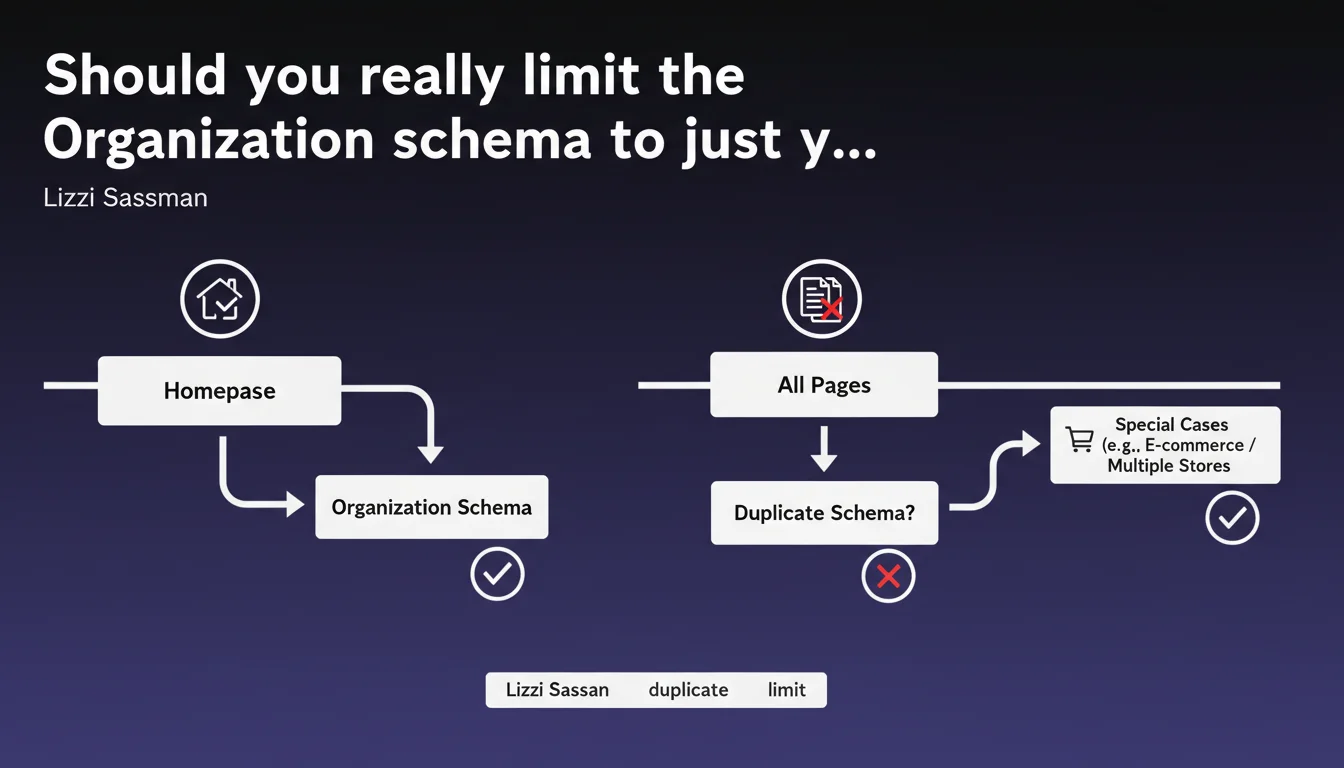
Google confirms that the Organization schema should appear exclusively on your homepage. Duplicating this markup across all pages is unnecessary and can actually create confusion for search engines. Only certain e-commerce platforms hosting multiple distinct entities are exempt from this rule.
What you need to understand
Why should you limit the Organization schema to the homepage?
The Organization schema serves to identify a single entity — your business, your brand, your organization. Google only needs this information once to map out your site.
Multiplying this markup on every page creates unnecessary redundancy. Worse, it can generate conflicting signals if the data varies from page to page. Google prioritizes consistency: one site = one organization = one single anchor point.
What actually changes in terms of crawling?
Nothing fundamental. Robots still explore all your pages. The difference is that Google consolidates identity information from a single clearly defined location: your homepage.
This approach simplifies the processing of structured entities. The search engine doesn't have to compare or merge 50 instances of the same schema scattered everywhere. It retrieves the info, validates it, and moves on.
In what exceptional cases can you break this rule?
Multi-store e-commerce platforms represent the main use case. If your site hosts multiple independent sellers — each with their own identity, logo, contact details — each store can legitimately claim its own Organization schema.
But be careful: this is not about regional variations of the same brand. We're talking about legally distinct entities using the same technical infrastructure.
- The Organization schema identifies a single entity per site
- Systematic duplication across all pages is counterproductive
- Only the homepage should carry this markup in 95% of cases
- Exception: platforms hosting multiple independent organizations
- Data consistency trumps quantity
SEO Expert opinion
Is this recommendation consistent with what we observe in the field?
Absolutely. Many sites still duplicate the Organization schema out of habit — often because a WordPress plugin injects it automatically everywhere. Result: no measurable benefit, just noise in your source code.
Field audits show that Google simply ignores redundant instances. It takes the first valid version it finds — usually the one on the homepage — and disregards the others. Duplication won't boost your visibility in the Knowledge Graph.
What nuances should be added to this statement?
Lizzi Sassman remains vague on one point: what happens if your homepage isn't indexable? [To verify] but logically, if your root returns a 404 or noindex, Google never accesses your Organization schema.
Another gray area: multilingual sites with multiple domains (example.fr, example.de). Technically, each domain has its own homepage — so each language version should carry the schema. But are these always the same organization or distinct local entities? The answer depends on your legal structure.
Can you really rely on this recommendation long-term?
Yes, because it's based on a stable principle: one site = one entity. Unlike Core Web Vitals recommendations that evolve every six months, structured data logic remains consistent over the years.
Google has every incentive for webmasters to simplify their markup. Less redundancy = fewer conflicts = better Knowledge Graph reliability. This directive aligns with the direction of things.
Practical impact and recommendations
What should you prioritize checking on your site?
First step: audit your pages to identify where the Organization schema currently appears. Use Google's structured data testing tool or scrape your templates with Screaming Frog by filtering for "application/ld+json".
If the markup appears on all your product pages, categories, or articles, you need to clean it up. Keep only the instance on the homepage. Also verify that the information (name, logo, social networks) matches your current identity.
How do you fix excessive Organization schema duplication?
In most cases, the problem comes from a misconfigured SEO plugin. Yoast, Rank Math, SEOPress — they all offer options to limit the Organization schema to the homepage. Disable global injection.
If your site is custom or uses a headless framework, modify your templates directly. Add a logical condition: the JSON-LD script only displays if is_front_page() or equivalent returns true.
What mistakes must you absolutely avoid?
Don't remove the Organization schema under the guise of simplification. You need to have one — just in the right place. Complete absence of this markup deprives Google of essential information for building your entity in the Knowledge Graph.
Also avoid creating inconsistent local variations. If your brand is called "Acme Corp" on the French homepage and "Acme GmbH" on the German version, Google might create two distinct entities instead of one with regional variations.
- Audit the current location of the Organization schema on your site
- Remove all instances except the one on your homepage
- Verify that the data (name, logo, sameAs) is up-to-date and complete
- Test the validity of your markup with Google's dedicated tool
- Disable automatic global injection in your SEO plugins
- Document the exception if you manage a multi-store platform
❓ Frequently Asked Questions
Dois-je supprimer le schema Organization de mes pages produits ?
Que faire si mon site héberge plusieurs marques sous le même domaine ?
Le schema Organization impacte-t-il mon positionnement dans les SERP ?
Faut-il un schema Organization différent pour chaque version linguistique ?
Que se passe-t-il si je laisse le schema sur toutes les pages ?
🎥 From the same video 8
Other SEO insights extracted from this same Google Search Central video · published on 03/11/2022
🎥 Watch the full video on YouTube →
💬 Comments (0)
Be the first to comment.