
Official statement
Other statements from this video 8 ▾
- □ Sous-domaines vs sous-répertoires : Google a-t-il vraiment une préférence ?
- □ Les backlinks vont-ils vraiment perdre de l'importance en SEO ?
- □ Google détecte-t-il vraiment les link schemes de manière 100% algorithmique ?
- □ Faut-il vraiment placer le schema Organization uniquement sur la page d'accueil ?
- □ Peut-on vraiment ajouter n'importe quel schema sans risque pour son SEO ?
- □ Les templates de contenu structurés sont-ils vraiment un atout pour le référencement ?
- □ Pourquoi Google refuse-t-il d'indexer votre contenu généré par templates ?
- □ Les H1 différenciés sont-ils la clé pour indexer vos pages à template similaire ?
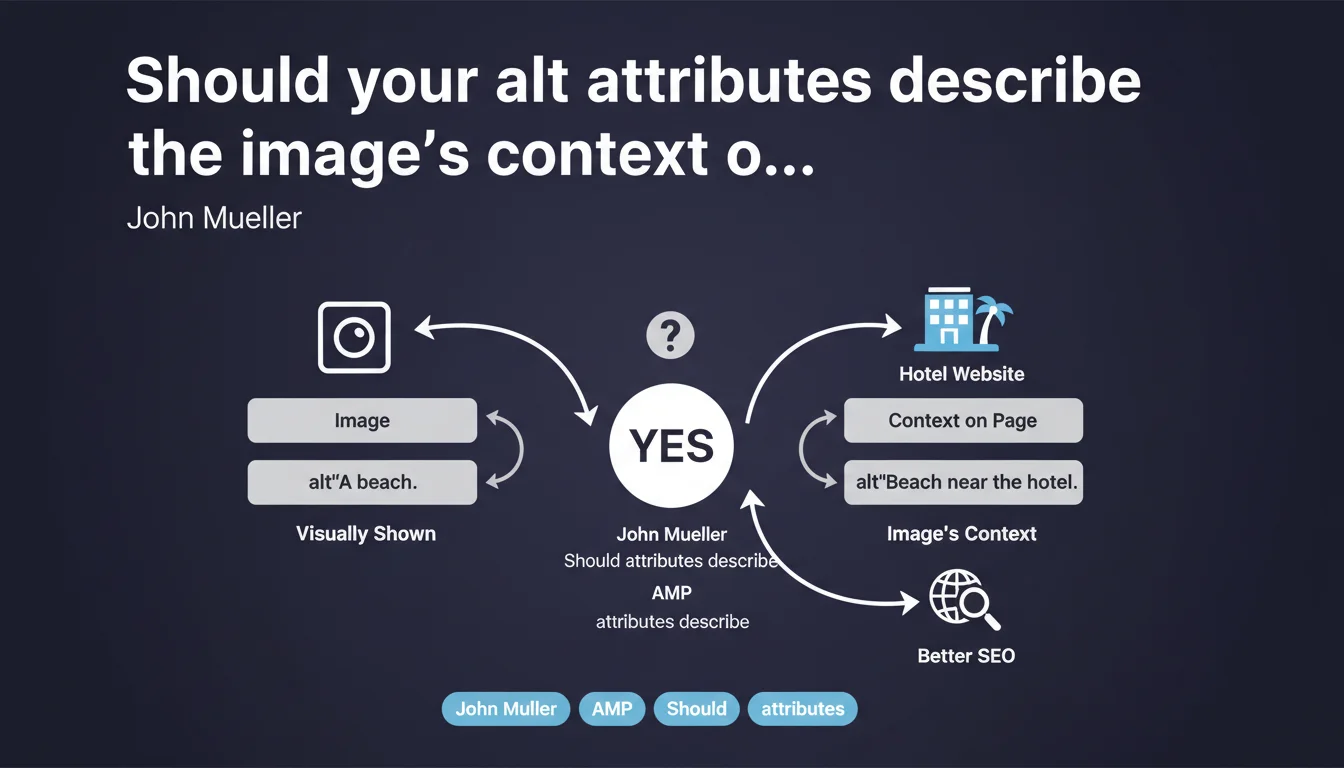
Google recommends enriching the alt attribute by specifying the image's context on the page, not just its raw description. For a beach photo on a hotel website, it's better to write "private beach 200m from the hotel" than simply "white sand beach". This approach improves semantic relevance and accessibility.
What you need to understand
What's the difference between describing an image and contextualizing it?
Most webmasters apply the basic rule: describe what you see visually. A sunset photo becomes "sunset over the sea". Technically correct, but incomplete.
Google asks you to go further by anchoring the image in its editorial environment. If this photo illustrates an article about the best photography spots in Bali, the alt should mention Bali. If it sells a hotel room with a sea view, specify "view from the deluxe room".
Why does this contextual precision matter for SEO?
Search engines exploit the alt attribute for three reasons: accessibility (screen readers), image indexing, and most importantly semantic reinforcement of the page. A contextualized alt creates bridges between the image and the surrounding text content.
Concretely, Google analyzes the coherence between the alt, adjacent text, page title, and search intent. A properly contextualized image strengthens thematic relevance signals — especially on queries with high transactional potential.
Does this recommendation apply to all types of images?
No, and that's where nuance comes in. Purely decorative images can keep an empty alt (alt=""). Technical diagrams, infographics, or screenshots require precise descriptions but not necessarily contextual ones if they're self-contained.
However, for product images, ambient photos, editorial visuals — anything that serves the commercial or informational argument of the page — context becomes essential.
- Describing the image alone: minimal approach, often insufficient for high-stakes SEO pages
- Contextualizing the image: specify its role on the page, its relationship with the offer or content
- Decorative images: empty alt acceptable if they add nothing to the message
- Semantic coherence: the alt should dialogue with surrounding text, not exist in isolation
- User intent: think about what someone searching for this image via Google Images is looking for
SEO Expert opinion
Does this directive match real-world observations?
Yes, and it aligns with what we've observed for years on well-ranked sites. Generic alts like "photo123.jpg" or "product image" serve absolutely no purpose. Over-optimized alts stuffed with keywords ("paris hotel cheap downtown eiffel tower") are counterproductive.
Sites that perform well in image SEO already apply this logic: description + context + added value. For example, a fashion e-commerce that writes "floral dress worn by model spring 2023 collection" rather than "floral dress" gains visibility on Google Images for long-tail queries.
What are the gray areas of this recommendation?
Google doesn't specify how far to push contextualization. Should you mention the brand? The exact model? Geographic location? The answer depends on search intent and page type. [To verify]: no official data on optimal length for a contextual alt.
Another gray area: images used on multiple pages with different contexts. Technically, the alt should vary, but in practice, few CMS platforms allow this granularity without workarounds. Centralized asset managers (DAM) pose a real implementation challenge.
Does this approach work across all sectors?
The benefit varies enormously by vertical. In e-commerce, real estate, tourism, travel — sectors where Google Images drives qualified traffic — it's a major lever. For a corporate B2B blog with 3 generic stock photos, the impact remains marginal.
Let's be honest: if your organic traffic from Google Images represents less than 2% of your visits, optimizing contextual alts probably isn't your number one priority. Focus on initiatives with higher ROI.
Practical impact and recommendations
How do you write an effective contextual alt attribute?
Ask yourself three questions before writing: What do you see? (visual description), Where does this image appear? (page context), Why is it there? (function in the argument). Synthesizing these three answers produces a relevant alt.
Practical example: a hotel room photo. Weak alt: "room". Correct alt: "double room with king-size bed". Contextual alt: "double room with sea view at Hotel du Cap Antibes". This last one integrates the establishment and its geographic positioning — exactly what users are searching for.
What implementation mistakes must you avoid at all costs?
First mistake: duplicating the alt across all product variants. If you sell a chair in 5 colors, each image should have its specific alt ("Scandinavian wooden natural chair", "Scandinavian black lacquered chair", etc.). Google may consider duplicates as soft spam.
Second mistake: confusing alt with image title attribute. The title attribute (the hover tooltip) can be more descriptive or marketing-focused. The alt remains factual and accessible. Don't fill them with the same copy-pasted text.
Third mistake: blindly automating via file name. "IMG_20231015_142305.jpg" converted to alt automatically is SEO suicide. If you have 10,000 products, invest in a structured naming system or dynamic alt templates based on product attributes.
How do you audit and fix existing alt attributes at scale?
Crawl your site with Screaming Frog or Oncrawl, export the image list with their alts. Filter by patterns: empty alts, duplicate alts, alt = filename, alts too short (<5 characters), alts too long (>100 characters).
To prioritize corrections, cross-reference with Google Search Console: identify pages generating impressions via Google Images. Those are your quick wins. Start there rather than trying to fix everything at once.
- Audit all existing alts via a complete technical crawl
- Identify images with high traffic potential (GSC, Google Images)
- Write alts of 10-15 words maximum integrating description + context
- Avoid alt duplication between product variants or similar pages
- Implement dynamic templates for new content
- Train editorial and e-commerce teams on best practices
- Monitor Google Images traffic evolution post-optimization
❓ Frequently Asked Questions
Quelle est la longueur idéale d'un attribut alt ?
Faut-il modifier les alt des images déjà indexées ?
Peut-on automatiser la rédaction des alt contextuels ?
Les alt impactent-ils le référencement des pages texte ou seulement Google Images ?
Que faire pour les images décoratives sans valeur informative ?
🎥 From the same video 8
Other SEO insights extracted from this same Google Search Central video · published on 03/11/2022
🎥 Watch the full video on YouTube →
💬 Comments (0)
Be the first to comment.