
Official statement
Other statements from this video 8 ▾
- □ Les backlinks vont-ils vraiment perdre de l'importance en SEO ?
- □ Google détecte-t-il vraiment les link schemes de manière 100% algorithmique ?
- □ Faut-il vraiment placer le schema Organization uniquement sur la page d'accueil ?
- □ Peut-on vraiment ajouter n'importe quel schema sans risque pour son SEO ?
- □ Les templates de contenu structurés sont-ils vraiment un atout pour le référencement ?
- □ Pourquoi Google refuse-t-il d'indexer votre contenu généré par templates ?
- □ Pourquoi l'attribut alt doit-il décrire le contexte de l'image et pas seulement l'image elle-même ?
- □ Les H1 différenciés sont-ils la clé pour indexer vos pages à template similaire ?
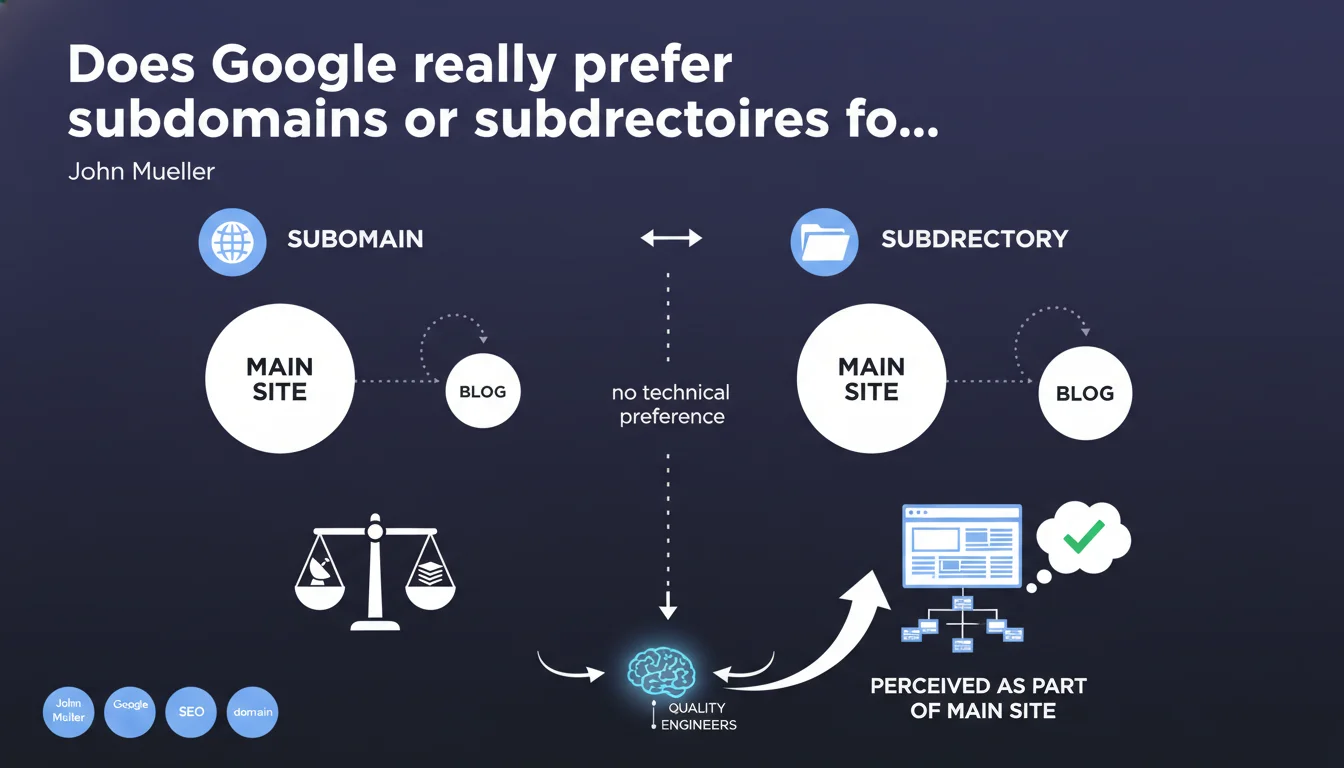
Google claims to have no technical preference between subdomains and subdirectories. However, Mueller acknowledges that subdirectories benefit from a stronger perception of belonging to the main site. This subtle distinction changes everything for your SEO strategy.
What you need to understand
Why does this question keep coming up in the SEO community?
URL structure has been a recurring debate for years. SEO practitioners want to know if placing content on blog.example.com or example.com/blog/ affects rankings. The stakes are real: determining whether the authority of the main domain transfers differently depending on the architecture chosen.
Mueller settles the debate on the surface: technically, Google treats both structures the same way. Quality engineers don't have a preference coded into the algorithm. But this answer hides a more complex reality.
What does Mueller really mean by this "perception" he mentions?
This is where it gets tricky. Mueller specifies that subdirectories are often perceived as being more part of the main site. Perceived by whom? By Google? By users? By quality assessment algorithms?
This vague wording suggests that even if there's technically no difference, in practice, trust and authority signals flow differently. A subdirectory naturally benefits from the history, backlinks, and reputation of the root domain.
What are the key takeaways from this statement?
- No technical penalty for using subdomains or subdirectories
- Subdirectories inherit authority more naturally from the main domain
- Google acknowledges a difference in perception, even if the algorithm remains neutral
- Your choice should be based on your business and organizational context, not on an absolute SEO constraint
- Trust and authority signals propagate differently depending on the structure
SEO Expert opinion
Is this statement consistent with real-world observations?
Let's be honest: field experience partially contradicts this official position. Thousands of tests show that launching new content on a subdirectory of an established domain produces faster results than a brand-new subdomain. Authority transmission isn't identical — [To be verified] by Google's own admission, which speaks of "perception."
The real question is: why does this perception exist if the algorithm is neutral? Either Google is communicating poorly about real mechanisms, or there are indirect factors (crawl budget, internal PageRank distribution, trust signals) that create this observable difference.
In what cases do subdomains remain a viable option?
Despite the implicit preference for subdirectories, subdomains retain their relevance in certain contexts. If you manage geographically distinct sites, separate technical platforms, or differentiated brands under the same corporate group, separation makes sense.
The problem arises when you use a subdomain for convenience or CMS constraints, without strategic consideration. In this case, you start at a disadvantage: the subdomain must build its own authority, even if the main domain has solid authority.
What nuance should we add to this official position?
Mueller says "do what you want," but this freedom hides a reality: not all choices are equal in SEO effectiveness. If your goal is to quickly capitalize on the existing authority of a domain, the subdirectory is objectively superior.
Google's statement remains technically accurate — no direct penalty — but it avoids the optimization question. Between "technically possible" and "strategically optimal," there's a gap that Mueller doesn't bridge here.
Practical impact and recommendations
What should you actually do based on your situation?
For a new content project (blog, e-commerce section, resources) on an established domain, systematically prioritize the subdirectory. You immediately benefit from accumulated authority, existing crawl budget, and trust associated with the domain.
If you already have high-performing content on a subdomain, don't migrate reflexively. Evaluate the cost-benefit: migration carries risks (temporary ranking loss, poorly managed redirects) and is only justified if the expected authority gain substantially outweighs them.
For truly distinct entities — different brands, autonomous geographic zones, incompatible technical platforms — the subdomain remains legitimate. The key is that this separation reflects business reality, not mere technical convenience.
What mistakes should you avoid when choosing a structure?
- Don't choose a subdomain just because your CMS or hosting provider suggests it by default
- Avoid multiplying subdomains without clear strategy — each one dilutes overall authority
- Never migrate structure without comprehensive 301 redirect plan and GSC monitoring
- Don't underestimate the time needed for a subdomain to build its own authority
- Avoid incoherent hybrid choices (some content on subdomains, others on subdirectories without logic)
How can you verify your current structure is optimal?
Analyze your authority metrics (Domain Rating, Trust Flow) between main domain and subdomains. If the gap is significant, you're potentially losing SEO juice. Also examine your crawl rate in Google Search Console: a subdomain often receives less crawl budget than an equivalent subdirectory.
Compare ranking performance for similar content. If your subdirectory articles consistently outperform those on subdomains, that's a clear signal. Also test indexing speed: publish content simultaneously and observe which ranks first.
In summary: Google claims not to penalize subdomains, but implicitly acknowledges that subdirectories benefit from better perception and authority transmission. For the vast majority of cases, the subdirectory remains the most effective SEO choice.
These architecture decisions may seem straightforward in theory, but their implementation requires careful analysis of your technical context, business objectives, and migration risks. If you're torn between options or planning a structural overhaul, working with a specialized SEO agency will help you avoid costly mistakes and build an architecture truly optimized for your specific needs.
❓ Frequently Asked Questions
Un sous-domaine hérite-t-il automatiquement de l'autorité du domaine principal ?
Peut-on migrer un sous-domaine vers un sous-répertoire sans perdre de positions ?
Les backlinks pointant vers un sous-domaine bénéficient-ils au domaine principal ?
Quand faut-il absolument choisir un sous-domaine plutôt qu'un sous-répertoire ?
Google Search Console traite-t-il différemment sous-domaines et sous-répertoires ?
🎥 From the same video 8
Other SEO insights extracted from this same Google Search Central video · published on 03/11/2022
🎥 Watch the full video on YouTube →
💬 Comments (0)
Be the first to comment.