
Official statement
Other statements from this video 8 ▾
- □ Does Google really prefer subdomains or subdirectories for SEO? Here's what actually matters
- □ Will backlinks really lose their importance in SEO?
- □ Does Google really detect link schemes 100% algorithmically without manual intervention?
- □ Should you really limit the Organization schema to just your homepage?
- □ Can you really add any schema markup without risking your SEO performance?
- □ Are structured content templates really a game-changer for SEO performance?
- □ Does Google really refuse to index your templated content, and why should you care?
- □ Should your alt attributes describe the image's context on the page, not just what's visually shown?
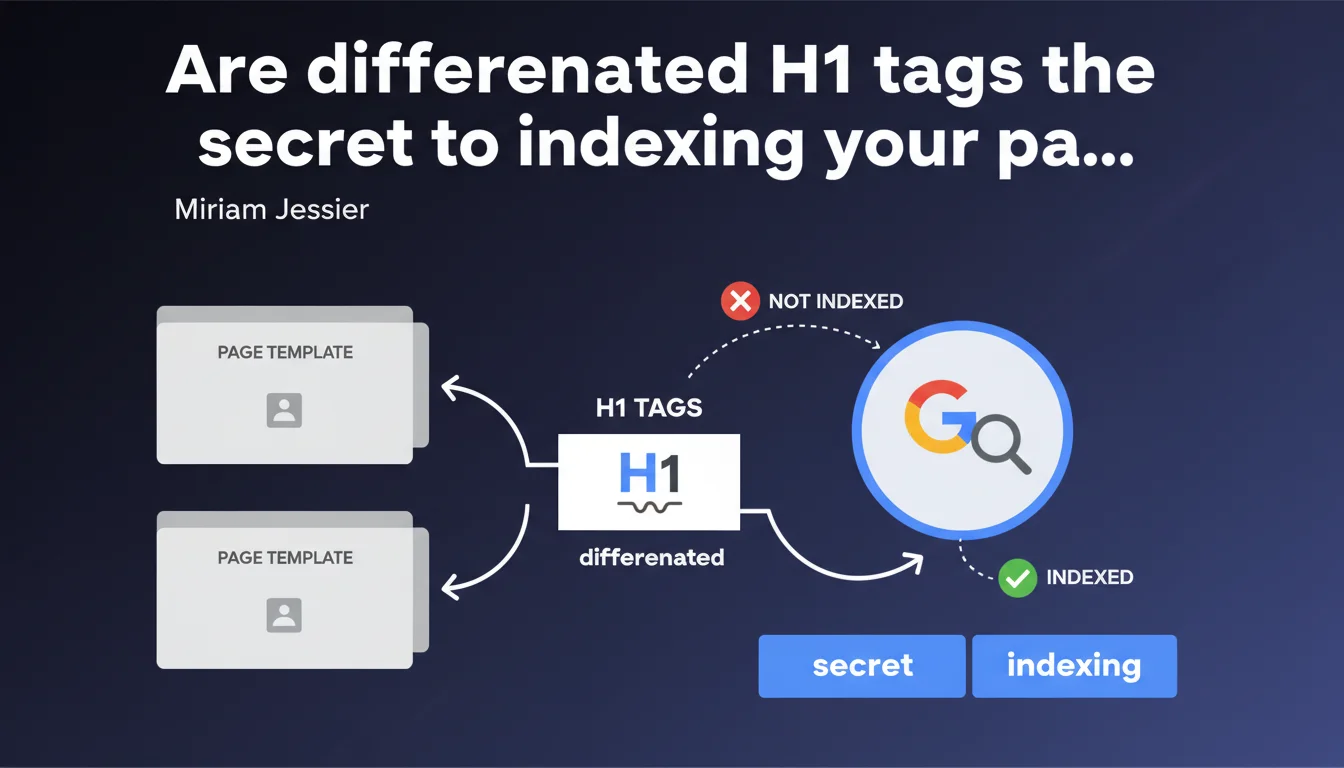
Google recommends optimizing H1 tags to make them meaningful and distinct when pages with similar templates are not being indexed. The algorithm can perceive pages as identical if their structural elements (particularly H1 tags) are too similar. The first corrective action is to differentiate these main titles to clarify the uniqueness of each page.
What you need to understand
Why does Google struggle to index pages with similar templates?
When a site generates hundreds or thousands of pages via a single template — typical of e-commerce sites, directories, or media outlets — Google must determine whether each page delivers distinctive value. Structural signals like the H1 play a decisive role in this evaluation.
If your H1 tags follow an overly repetitive pattern ("Product + city," "Training + level" without variation), the algorithm may conclude there is duplicate content or pages with low added value. The consequence? These pages remain crawled but not indexed, or placed in secondary indexes.
What does Google mean by "meaningful and distinct H1 tags"?
A meaningful H1 must precisely reflect the unique subject of the page, not just fill a slot with generic keywords. A distinct H1 should not resemble 95% of other H1 tags on the same template.
Concretely: "Plumber Paris 15" is not meaningful if you have 20 districts with the same structure. "Emergency plumbing services 24/7 in the 15th arrondissement" begins to differentiate — provided the content follows suit.
Does this recommendation apply to all types of websites?
The most exposed sites are those that generate pages through parametric combination: filters, geolocation, product variations. Traditional editorial sites generally escape this, unless they automate production.
Google doesn't say that H1 solves everything — it's the "first action," not the only one. But if your pages aren't indexed despite substantial content, checking H1 tags is indeed the fastest initial diagnosis.
- The H1 tag is a major structural signal for Google to understand a page's uniqueness
- Repetitive templates with similar H1 tags trigger duplicate-content filters
- This optimization is the first diagnostic step, not a guarantee of indexation
- Page content must support the promise of the differentiated H1
SEO Expert opinion
Is this statement consistent with observed field practices?
Yes, it aligns perfectly with recurring observations. For several years, crawl audits have revealed that Google crawls massive portions of certain sites but indexes only a fraction of pages. Identical or near-identical H1 patterns consistently emerge in analysis of excluded pages.
What's missing here: no quantitative metrics. At what degree of similarity does an H1 become problematic? 80% token overlap? 90%? Google doesn't say. [To be verified] empirically through progressive testing.
What nuances should be applied to this recommendation?
Differentiating H1 tags does not mean fabricating content that doesn't exist. If your "Plumber City A" page and "Plumber City B" page offer exactly the same service with no local specificity, even a distinct H1 won't save an otherwise hollow page.
The real challenge: semantic differentiation must reflect actual content differentiation. Otherwise, you're temporarily hiding the symptom without treating the cause — and Google will eventually downrank these pages for thin content.
In what cases does this rule not apply?
If your pages aren't indexed for technical reasons — robots.txt, noindex, misconfigured canonicals, low crawl budget — tweaking H1 tags won't help. You must first eliminate these structural blockers via Search Console.
Another case: paginated pages or facet filters. Google often prefers not to index these variations even with distinct H1 tags, as they create indexed noise. Canonical logic or robots directives remain the priority.
Practical impact and recommendations
What should you do concretely to differentiate your H1 tags?
Start with a similarity audit. Export all your H1 tags (via Screaming Frog, Oncrawl, or your CMS), then analyze repetitive patterns. Identify templates generating titles that are 80%+ identical.
Next, for each cluster of similar pages, ask yourself: what actually differentiates this page? Precise location, sub-category, specific use case, target audience? Inject these unique variables into the H1 — but only if the content supports them.
What mistakes should you avoid when optimizing?
Mistake #1: changing H1 tags without touching the content. You create a semantic disconnect that Google detects. Correlation between headline and body text is part of relevance signals.
Mistake #2: over-optimizing with long, keyword-stuffed H1 tags. An effective H1 remains readable to humans. If it sounds like automated SEO, it is — and Google notices.
Mistake #3: neglecting title tags and meta descriptions. Coherence between H1, title tag, and opening paragraphs reinforces thematic clarity for the algorithm. Working on H1 in isolation dilutes impact.
How do you verify your optimization is working?
Monitor indexation status evolution in Search Console — "Pages" section then "Not indexed." Filter by reason ("Duplicate content," "Low quality") and verify whether affected pages gradually disappear from these reports.
In parallel, track crawl rate and indexation rate via server logs. If Google re-crawls modified pages but still doesn't index them after 3-4 weeks, the problem extends beyond H1 — deepen content analysis.
- Audit all H1 tags to detect repetitive patterns and measure similarity
- Identify unique elements of each page justifying H1 differentiation
- Rewrite H1 tags by injecting these distinctive variables without keyword over-optimization
- Align page content with the promise of the new H1
- Harmonize title tag, meta description, and opening paragraphs with the modified H1
- Submit modified URLs for reindexing via Search Console
- Monitor indexation status evolution over a minimum of 4-6 weeks
- Analyze logs to confirm Google crawls and indexes the optimized pages
❓ Frequently Asked Questions
Un H1 unique par page suffit-il à garantir l'indexation ?
Faut-il modifier les H1 de toutes les pages ou seulement celles non indexées ?
Quelle longueur optimale pour un H1 différencié ?
Les variations géographiques dans les H1 sont-elles suffisantes pour différencier ?
Combien de temps avant de voir l'effet d'un changement de H1 sur l'indexation ?
🎥 From the same video 8
Other SEO insights extracted from this same Google Search Central video · published on 03/11/2022
🎥 Watch the full video on YouTube →
💬 Comments (0)
Be the first to comment.