
Official statement
Other statements from this video 8 ▾
- □ Does Google really prefer subdomains or subdirectories for SEO? Here's what actually matters
- □ Will backlinks really lose their importance in SEO?
- □ Does Google really detect link schemes 100% algorithmically without manual intervention?
- □ Should you really limit the Organization schema to just your homepage?
- □ Can you really add any schema markup without risking your SEO performance?
- □ Are structured content templates really a game-changer for SEO performance?
- □ Should your alt attributes describe the image's context on the page, not just what's visually shown?
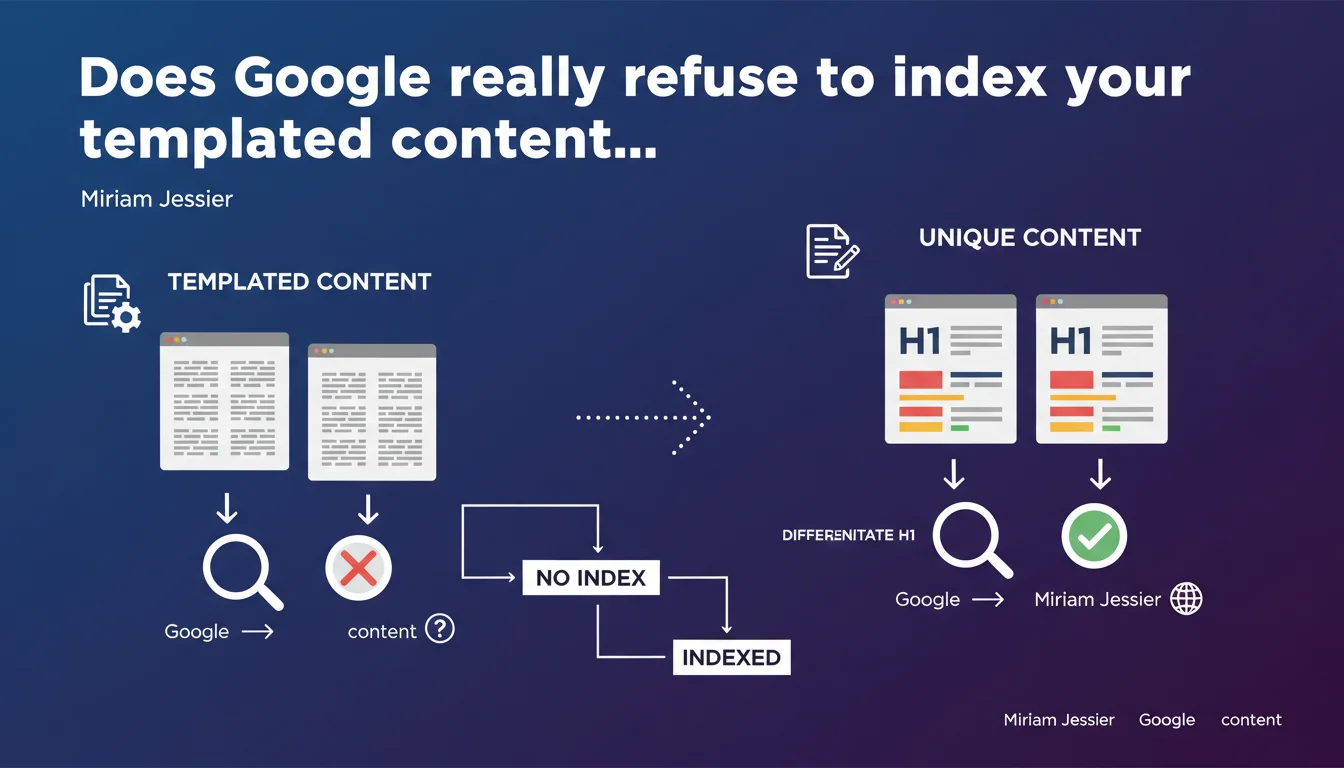
- □ Are differentiated H1 tags the secret to indexing your pages with similar templates?
Google does not guarantee indexing of content created from templates, even if you manually submit it. When multiple pages present overly similar structures, the search engine may decide not to include them in its index. The solution: differentiate key structural elements like H1 tags, but that's just the beginning.
What you need to understand
What does "templated content" really mean to Google?
We're talking about automatically generated pages created from the same template, with minimal variations. E-commerce sites with thousands of nearly-identical product sheets, local directories broken down by city, category pages that only change a keyword in the title.
Google doesn't say this content is bad — it simply says it doesn't guarantee its indexation. Important distinction. The search engine has no contractual obligation to rank everything you submit to it, especially if the added value remains unclear.
Why this statement now?
Because too many sites still believe that submitting a URL via Search Console = guaranteed indexation. That's false. Submission is just a suggestion, not an order. Google crawls, evaluates, compares — and decides.
This clarification probably targets the practice of generating massive amounts of "SEO-optimized" but substance-free pages. Pages that only differ by a variable in the URL or a city name in the H1.
What does "differentiate key elements like H1s" really mean?
The official recommendation highlights H1 titles, but that's reductive. What matters is overall semantic differentiation: unique meta-descriptions, distinct text content, structured data adapted to context.
Simply changing the H1 from "Plumber Paris" to "Plumber Lyon" obviously isn't enough. Google has detected these patterns for years. You need real editorial work or intelligent parameterization logic.
- Indexation ≠ submission: submitting a URL guarantees nothing
- Massive templated content risks index exclusion
- Differentiating only the H1 is insufficient — you need true semantic distinction
- Google evaluates actual added value before indexing
SEO Expert opinion
Is this statement consistent with what we observe in the field?
Absolutely. For years, we've seen Google massively de-index automatically generated pages the moment it detects a repetitive pattern. Classified ad sites, marketplaces, content aggregators — all affected.
What's new is that Google openly admits it. Before, we talked about "low-quality content" or "duplicate content." Now they're directly targeting template-based generation. Clear message: stop spamming the index with cosmetic variations.
What nuances should we add to this position?
First, not all templates are created equal. A well-designed e-commerce site with rich product sheets — customer reviews, detailed FAQs, complete technical descriptions — won't be treated like an empty directory that just changes a city name.
[To verify]: Google provides no precise metrics to define where the boundary sits between "acceptable" and "too similar." How many variations are needed? What percentage of textual difference? No official answer. We're navigating blind.
Second, this statement doesn't mean you should abandon programmatic generation. It means you need to accompany it with genuine editorial strategy. Automate, yes — but with a layer of substantial personalization.
In what cases does this rule apply less strictly?
Sites with strong domain authority benefit from some tolerance. An Amazon or Booking can afford repetitive structures — their trust compensates. For an average site? That's a different story.
Practical impact and recommendations
What should you do concretely if your templated pages aren't being indexed?
First step: audit the real differentiation of your pages. Use tools like Screaming Frog or Sitebulk to extract H1s, meta-descriptions, opening paragraphs. Compare them. If 80% of the text is identical from one page to another, you have a problem.
Next, enrich the content programmatically — but intelligently. Integrate actual local data, user reviews, FAQs generated from specific frequent questions. Not just a generic paragraph where you change one word.
What mistakes should you absolutely avoid?
Don't settle for modifying just the H1 and title tag thinking that will suffice. Google analyzes all visible content in its entirety, not just HTML tags.
Also avoid massively resubmitting your pages via Search Console hoping to force indexation. If Google rejects them once, resubmitting without changes won't help. Worse, it can signal spam behavior.
How do you verify that your site meets these criteria?
Use Search Console to identify pages with "Discovered, currently not indexed" status. If this status affects hundreds of structurally similar pages, you're probably facing a case of rejected templated content.
Also test with targeted site: searches. If Google indexes only 10% of your category pages when you have 500, that's a red flag.
- Audit the textual similarity between your templated pages
- Enrich each page with unique, contextualized content
- Don't limit yourself to modifying the H1 — work on all visible content
- Monitor indexation status in Search Console
- Avoid repeated mass submission of rejected pages
- Favor a qualitative approach over a quantitative one
❓ Frequently Asked Questions
Si je modifie seulement le H1 de mes pages, est-ce suffisant pour les faire indexer ?
Soumettre mes pages via Search Console peut-il forcer leur indexation ?
Tous les sites e-commerce avec des fiches produits similaires sont-ils pénalisés ?
Comment savoir si mes pages sont rejetées pour cause de contenu templated ?
Peut-on utiliser du contenu généré automatiquement sans risque ?
🎥 From the same video 8
Other SEO insights extracted from this same Google Search Central video · published on 03/11/2022
🎥 Watch the full video on YouTube →
💬 Comments (0)
Be the first to comment.