
Official statement
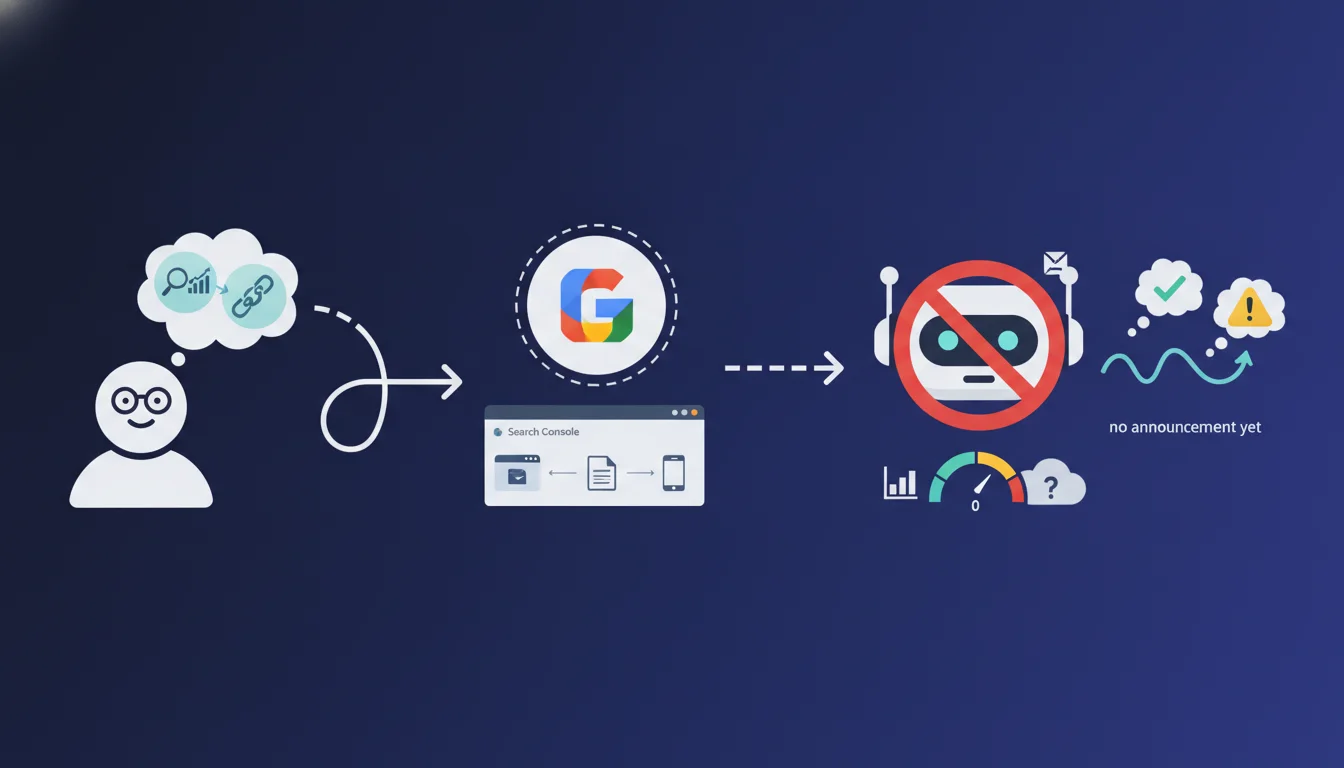
Gary Illyes refuses to confirm the arrival of click and query data in the AI report from Search Console, only mentioning future data 'that makes sense.' John Mueller challenges Barry Schwartz's negative interpretation, leaving room for doubt. SEOs remain completely unclear about access to essential metrics from the AI Overview.
What you need to understand
Why is there controversy over the data in the AI report?
The AI performance report in Search Console already exists, but it currently shows extremely limited metrics. Practitioners have been requesting click and query data since its launch, which are fundamental indicators for measuring the actual impact of the AI Overview on organic traffic.
A LinkedIn post claimed that Google planned to add these metrics, without a timeline. Gary Illyes immediately clarified: the team is working on 'more meaningful data,' but no official announcement is planned. He never stated that clicks and queries were part of this future data.
How should we interpret the contradictory statements from Illyes and Mueller?
Barry Schwartz sees it as a classic implicit refusal from Google, this evasive wording that the Search team has been using for years to say no without saying it. John Mueller considers this interpretation 'strange,' which could signal either a misinterpretation or a slightly open door.
The fundamental problem remains: without click or query data, it is impossible to quantify the real impact of the AI Overview on organic performance. SEOs are working blind on a significant portion of the SERPs that may represent a substantial share of exposure.
What current data does this report provide?
Currently, the AI report mainly shows limited impressions and positions. These partial metrics do not allow for establishing an ROI or prioritizing optimizations properly for the AI Overview.
Practitioners must cross-reference these fragmented data with other analytics tools to indirectly deduce the impact, a methodological exercise that multiplies margins of error and blind spots.
- The current AI report lacks critical metrics: clicks, CTR, detailed queries
- Gary Illyes refuses to confirm their arrival, only mentioning future 'meaningful data'
- John Mueller disputes the negative interpretation without clarifying what Google actually plans
- SEOs remain confined to indirect estimation methods to measure AI impact
SEO Expert opinion
Does this evasive response follow a known Google communication pattern?
Absolutely. The phrase 'we are working on meaningful data' is a standard response that the Search team has been using for fifteen years when they do not want to promise anything. It theoretically leaves a door open while committing to no deliverable or timeline.
Barry Schwartz is right to highlight the pattern: this language often precedes either an unannounced definitive refusal or an implementation so late that it loses its relevance. The fact that Gary Illyes has never mentioned clicks or queries explicitly in his response is a strong signal. [To be verified]: this deliberate absence could indicate that these metrics are not within the current scope.
Does Mueller's reaction really change anything?
Not necessarily. John Mueller describes the negative interpretation as 'strange,' but he does not factually contradict Schwartz's analysis. He does not say 'Barry is wrong, clicks are coming soon.' He questions the interpretation without providing a concrete alternative.
This intervention could simply reflect an internal divergence of perception at Google between teams, or a desire to keep options open without commitment. In any case, no sensible practitioner should plan their SEO roadmap by betting on the arrival of this data.
What are the implications for measuring AI performance?
The confirmed absence of clicks and queries creates a major strategic blind spot. SEO budgets allocated to optimization for the AI Overview currently rely on assumptions, not on solid ROI data.
In concrete terms, a client asks you if investing €20k in AI optimization is worth it: you cannot respond with solid numbers, just cross-verified estimates via GA4, average positions, and overall conversion rates. This is insufficient for rigorous management. [To be verified]: some B2B players report significant AI impacts detected through other means, but without direct Search Console validation.
Practical impact and recommendations
What can you practically do with the data currently available?
Continue to leverage the AI impressions and positions from the current report, even though they are limited. Always cross-reference them with your GA4 data to identify indirect correlations between AI visibility and organic traffic variations.
Set up manual tracking of the queries where the AI Overview appears frequently. Note the pages cited, extracted contents, and monthly compare the evolution. It is rudimentary, but it's all that remains while waiting for official data that may never arrive.
How to prioritize AI Overview investments without measurable ROI?
Adopt a progressive and testable approach. Start with optimizations that also benefit traditional SEO: content structuring, structured data, enriched FAQs, clear authorship. The investment is never wasted.
Meticulously document each AI test: before/after, modified contents, observed appearances. This empirical basis partially replaces missing metrics and allows you to justify or stop efforts. If after three months of targeted optimization you see no positive signal even indirectly, redirect the budget elsewhere.
Should we keep requesting this data or adapt permanently?
Continue to signal the need during Search Console feedback, but don't block your strategy waiting for it. Google has repeatedly proven that it does not always deliver what SEOs ask, especially when it comes to transparency of AI mechanisms.
Develop robust alternative methods: user panels, automated legal SERP scraping, specialized third-party tools. Some SEO agencies have already built proprietary frameworks to measure AI impact through proxies. These optimizations may prove complex to implement alone, especially when it involves cross-referencing multiple data sources and interpreting indirect signals. For personalized support and proven methodology, engaging a specialized SEO agency can significantly accelerate the implementation of these measurement setups.
- Systematically utilize the AI impressions and positions available in Search Console
- Cross-reference this data with GA4 to detect indirect correlations with traffic
- Document each AI test methodically: before/after, modified pages, observed results
- Favor AI optimizations that also enhance traditional SEO (structure, schema, FAQ)
- Establish manual tracking of queries where the AI Overview appears regularly
- Do not halt your roadmap waiting for metrics that may never come
💬 Comments (0)
Be the first to comment.