
Official statement
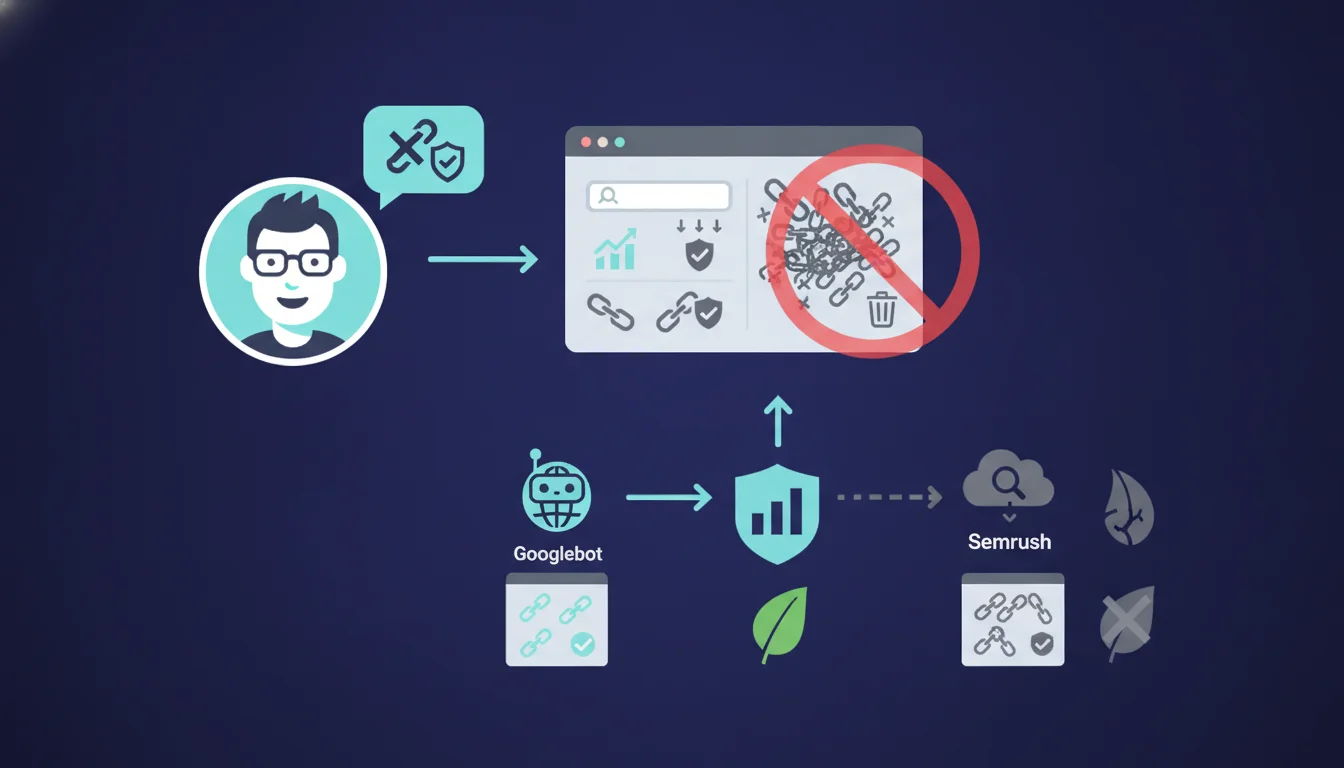
John Mueller's advice aligns with Google's consistent stance on the matter: Spammy links are neutralized: Since Penguin 4.0, Google devalues bad links instead of penalizing targeted pages. This is why it does not alert sites that receive them.
The disavow file is not recommended: Google has repeatedly stated not to use the disavow tool, which can do more harm than good. He has also criticized agencies selling disavowal services.
Reports of 'toxic links' should be ignored: John Mueller is openly wary of them, and Google advises against disavowing links based on third-party metrics such as those from Semrush.
Google asserts that spammy backlinks detected by third-party tools require no action, even if they do not appear in the Search Console. The algorithm neutralizes them automatically without penalizing the target site. The practical advice is clear: do not waste time disavowing links, unless in exceptional cases of coordinated negative attacks.
What you need to understand
Why doesn’t Search Console display all backlinks detected by third-party tools?
Search Console only reports backlinks crawled and indexed by Googlebot. Tools like Semrush, Ahrefs, or Majestic use their own bots to explore the web, and often detect links that Google has never discovered or has intentionally excluded from its index.
This discrepancy is explained by crawl budget: Google does not visit all websites on the web with the same frequency, and some low-quality spam pages are never crawled. When a third-party tool detects a link from an obscure link farm, there is no guarantee that Google has ever seen it.
How does Google handle spammy backlinks since Penguin 4.0?
Since the integration of Penguin into the real-time algorithm, Google devalues manipulative links instead of penalizing the sites that receive them. In practice, these links are ignored in the calculation of PageRank, as if they did not exist.
This approach explains why Google no longer alerts webmasters when their link profiles present anomalies. If the system detected a manual penalty, a notification would appear in the Search Console. The absence of a message means that automated filters are functioning.
When can toxic link reports be misleading?
SEO tools assign toxicity scores based on proprietary metrics that do not necessarily match Google's criteria. A link from a site with low Trust Flow may be flagged as toxic, while Google simply ignores it.
These reports generate unnecessary anxiety and lead some SEOs to disavow links that had no impact. The risk is to erroneously disavow legitimate links, which can indeed harm rankings.
- Google automatically filters spammy links without any action required from the webmaster
- Search Console only displays a fraction of the backlinks detected by third-party tools
- SEO tool toxicity metrics do not reflect Google's algorithm
- Disavowing links can do more harm than good if misused
- The absence of notifications in Search Console means that no manual action is needed
SEO Expert opinion
Is this stance from Google consistent with field observations?
In hundreds of analyzed cases, websites receiving random link spam (auto comments, spammy directories, scrapers) show no negative correlation with their performance. Rankings remain stable as long as the overall link profile is healthy.
However, coordinated negative SEO attacks — thousands of toxic links in just a few days, all with identical over-optimized anchors — have sometimes caused measurable drops. [To be verified] whether these cases genuinely relate to an algorithmic effect or a manual intervention triggered by the abnormal pattern.
When does Google's advice reach its limits?
The official narrative works well for passive spam but becomes ambiguous regarding targeted aggressive campaigns. When a competitor buys 5,000 links from PBNs with money keyword anchors, ignoring the problem is not always sufficient.
In these extreme situations, disavowing remains the only tool available. But one must document the attack, show the abnormal spikes in the temporal profile of backlinks, and disavow at the domain level rather than link by link. The risk of error remains high.
Why does Google criticize disavowal services?
Unscrupulous agencies sell link profile cleaning by massively disavowing, sometimes up to 80% of the entire profile. This practice destroys valuable historical signals, even if the links are old or inactive.
Google has observed that most disavowal requests are unnecessary or counterproductive. Hence the systematic advice to ignore them, unless a manual action notification appears in Search Console. In this specific case, disavowing becomes mandatory to lift the penalty.
Practical impact and recommendations
What should you do about spammy backlinks detected by Semrush?
The first rule is to do nothing if the links come in a scattered and random manner. Instead, monitor the metrics that matter: organic traffic, rankings on your main queries, click-through rates in Search Console.
If you notice a simultaneous drop along with an influx of toxic links, first check the Manual Actions section in Search Console. If there's nothing, the cause lies elsewhere: algorithm update, technical issues, content cannibalization.
When is disavowing still justifiable?
Disavowing is only warranted if you document a coordinated negative SEO attack: thousands of links in a few days, all from clearly spammy sources, with aggressive anchor patterns. Even in this case, wait 2-3 weeks to see if Google neutralizes them.
If you decide to disavow, work at the domain level rather than link by link, and limit the list to obviously manipulative sources. Keep a backup of the file and a record of the dates. Never disavow a legitimate domain based on a Semrush score.
How do you distinguish harmless spam from a real threat?
Harmless spam presents scattered sources, varied or neutral anchors, and an irregular rhythm. A coordinated attack shows a sharp spike in the temporal graph, domains created en masse recently, and identical over-optimized anchors.
Use the filters in your Search Console to isolate new links from the last 30 days. If you see 10-20 links per week from varied sources, it's background noise. If you see 500 links in 3 days from .xyz domains with anchors 'cheap car insurance', there is cause for suspicion.
- Check the Manual Actions section before taking any action
- Monitor your traffic metrics and rankings rather than toxicity scores
- Only disavow if you document a coordinated attack with an abnormal temporal spike
- Work at the domain level, never link by link
- Keep a record and backup of each submitted disavow file
- Ignore automated reports of toxic links from third-party tools
💬 Comments (0)
Be the first to comment.