
Official statement
Other statements from this video 11 ▾
- □ Should you really keep the 'priority' tag in your sitemaps?
- □ Should you really remove the 'changefreq' tag from your sitemaps?
- □ Why does Google ignore the 'lastmod' tag in your sitemaps?
- □ Does submitting a sitemap really guarantee that Google will crawl your URLs?
- □ Should you replace sitemap extensions with structured data?
- □ Should You Stop Using Video and Image Tags in Your XML Sitemaps?
- □ Should you update lastmod when adding structured data to your pages?
- □ Why does creating a sitemap expose more technical problems than it solves?
- □ Are session identifiers in URL parameters still sabotaging your site's crawlability?
- □ Does a crawlable site really guarantee better user navigation?
- □ Does submitting your URLs via API really guarantee indexation without Google crawling them?
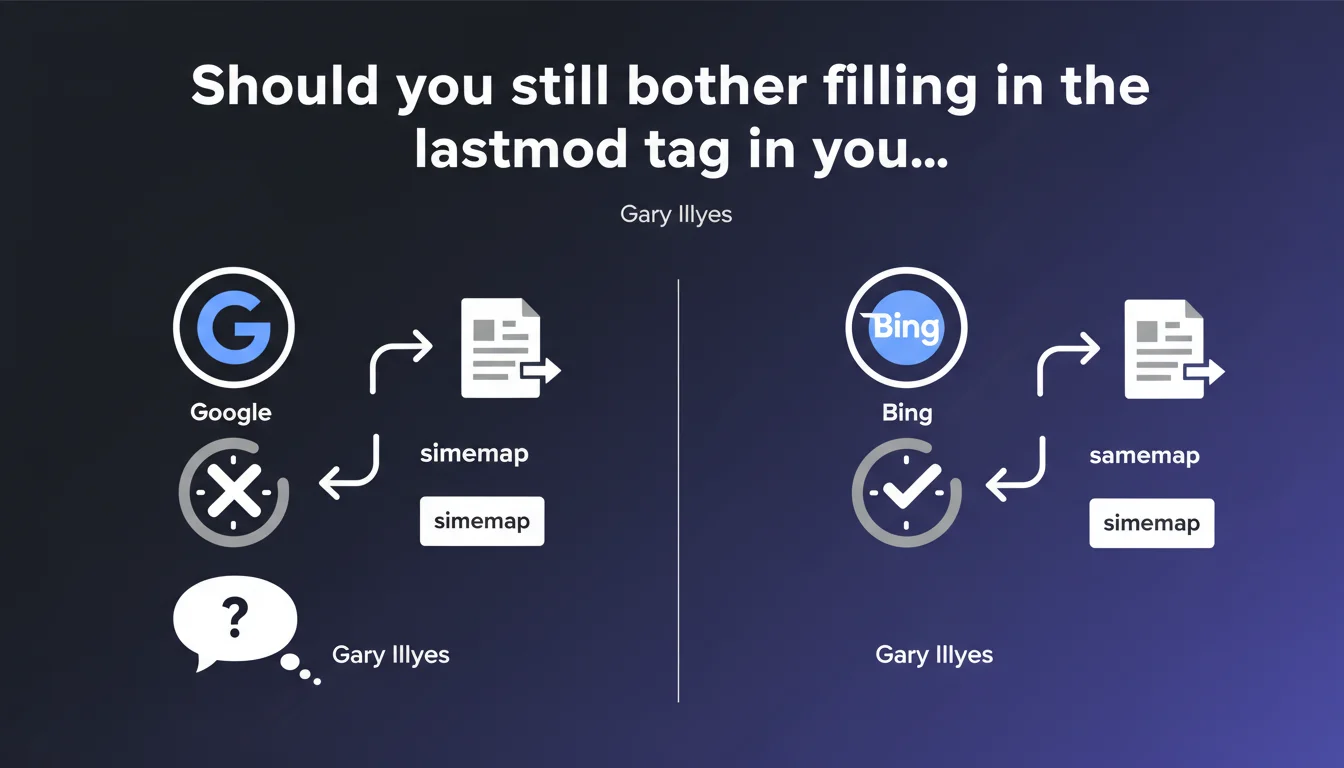
Google ignores the lastmod tag in sitemaps because it's updated far too often without any valid reason. Bing, on the other hand, still uses it. In practice? If you're optimizing solely for Google, this tag is useless — but it remains useful for Microsoft's search engine.
What you need to understand
Gary Illyes is direct: Google does not take the lastmod tag into account in XML sitemap files. The reason given? Its chronic unreliability.
Many sites update this tag automatically with every republication, recrawl, or cosmetic modification — while the actual page content remains identical. As a result: Google receives thousands of parasitic signals and decided to simply ignore this data.
Why does this tag create problems for Google?
The issue stems from widespread poor implementation. Popular CMSs (WordPress, Drupal, Magento) often update lastmod whenever you touch any metadata, republish an article, or modify a single pixel in the sidebar.
Google crawls billions of pages. If the tag constantly lies, it becomes counterproductive: the bot wastes time recrawling unchanged pages at the expense of new critical URLs. Gary Illyes' team made the call: we're not using it anymore.
Bing still uses lastmod — why this divergence?
Bing takes a different approach to crawl budget. With a smaller index and proportionally fewer resources, Microsoft's search engine can afford to take risks on imperfect signals.
Or to be honest — Bing simply hasn't yet been polluted enough by millions of misconfigured sitemaps to abandon this data. But Gary doesn't say that explicitly.
What should you take away for your sitemaps?
- Google completely ignores the lastmod tag for years now
- Bing continues to use it as a freshness signal
- If you're targeting non-negligible Bing traffic (B2B, certain verticals), keep it clean
- For Google, focus on actual update frequency rather than sitemap metadata
- Don't waste time perfecting a tag that Google doesn't read
SEO Expert opinion
Does this statement really change anything for us?
Not really. Most experienced practitioners already knew that lastmod was a weak signal for Google — this official statement just formalizes what we've been observing for years.
What's interesting is that Gary justifies this position through a data quality problem, not a technical limitation. That means if CMSs were to implement lastmod correctly tomorrow, Google could reconsider. But realistically? That will never happen.
Should you remove this tag from your sitemaps?
No. First, because Bing uses it, and depending on your sector (finance, B2B tech, corporate), Bing can represent 5 to 15% of organic traffic. Not negligible.
Second, because removing a tag requires development, testing, and will get you absolutely nothing from Google. Better to leave it — as long as it's not generating massive false positives that could disrupt your internal monitoring.
What are the real priorities for your sitemaps?
If Google doesn't read lastmod, what does it read? The structure of your URLs, their frequency of appearance in the sitemap, and especially the consistency with your robots.txt. [To verify]: we have no official confirmation that Google uses the sitemap to prioritize crawl — but field observations show that a well-segmented sitemap often accelerates indexation.
Another point: don't put 50,000 URLs in a single XML file. Segment by content type, by language, by date. It helps Google understand your site's structure — and it helps you monitor what's actually being crawled.
Practical impact and recommendations
What should you concretely do with the lastmod tag?
If you're optimizing solely for Google: don't touch anything. Let your CMS generate whatever it wants, it will have no impact. Don't waste time manually correcting dates for a search engine that ignores them.
If Bing matters to your strategy (English-speaking markets, B2B, corporate): make sure lastmod reflects a genuine content modification. Not a template change, not an automatic republication, not a sidebar update.
How do you verify that your lastmod is reliable?
Crawl your sitemap with Screaming Frog or an equivalent tool. Compare lastmod dates with the actual history of your modifications (Git, CMS logs, Internet Archive). If 80% of your pages have been "modified" last week when you haven't touched anything, you have a problem.
Also audit your CMS: what events trigger a lastmod update? Publishing, content modification, template change, plugin update? Disable anything that isn't a genuine editorial modification.
What mistakes should you absolutely avoid with your sitemaps?
- Not segmenting your sitemaps (a single file of 50,000 URLs)
- Including URLs blocked by robots.txt
- Generating automatic lastmod updates with every site build
- Forgetting to submit your sitemaps in Bing Webmaster Tools if you're targeting that search engine
- Putting noindex URLs in the sitemap (an inconsistency Google hates)
- Never checking for sitemap errors in Search Console
In short: Google doesn't read lastmod, Bing does. If you want to optimize for both search engines, keep this tag but make sure it's reliable. Otherwise, focus on the structure and consistency of your sitemaps — that's what really matters.
Fine-tuning sitemaps, especially in complex architectures (multilingual, millions of URLs, redesigns), requires pointed technical expertise. If you're managing a large-scale site or handling a critical migration, working with a specialized SEO agency can help you avoid costly mistakes and significantly accelerate your results.
❓ Frequently Asked Questions
Google utilisera-t-il de nouveau la balise lastmod un jour ?
Dois-je supprimer lastmod de mes sitemaps pour Google ?
Bing fait-il vraiment confiance à lastmod ou c'est marginal ?
Si Google ignore lastmod, quelles balises de sitemap lit-il vraiment ?
Comment savoir si mon CMS génère des lastmod fiables ?
🎥 From the same video 11
Other SEO insights extracted from this same Google Search Central video · published on 05/05/2022
🎥 Watch the full video on YouTube →
💬 Comments (0)
Be the first to comment.