
Official statement
Other statements from this video 11 ▾
- □ Faut-il supprimer la balise 'priority' de vos sitemaps ?
- □ Faut-il vraiment supprimer la balise 'changefreq' de vos sitemaps ?
- □ Pourquoi Google ignore-t-il la balise 'lastmod' dans vos sitemaps ?
- □ Faut-il encore remplir la balise lastmod dans vos sitemaps XML ?
- □ Pourquoi soumettre un sitemap ne garantit-il pas le crawl de vos URLs ?
- □ Faut-il remplacer les extensions de sitemap par des données structurées ?
- □ Faut-il abandonner les balises vidéo et image dans vos sitemaps XML ?
- □ Pourquoi créer un sitemap révèle-t-il plus de problèmes techniques qu'il n'en résout ?
- □ Pourquoi les identifiants de session en paramètres URL menacent-ils encore le crawl de votre site ?
- □ Un site crawlable garantit-il vraiment une meilleure navigation utilisateur ?
- □ Faut-il vraiment attendre le crawl même après avoir soumis ses URLs via API ?
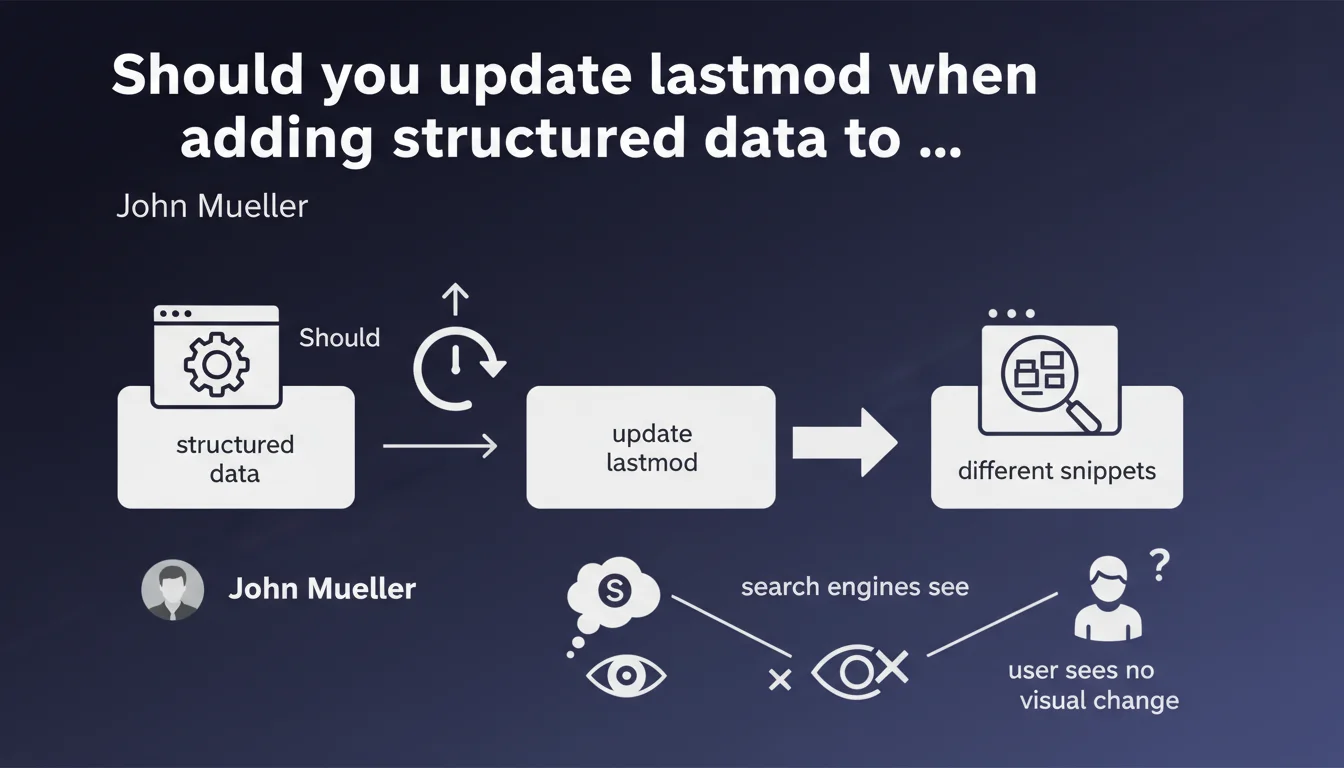
Google confirms that adding structured data to a page justifies updating the lastmod tag, even without any visual changes for the user. This signal can accelerate re-crawling and the display of new rich snippets. A clarification that directly impacts your XML sitemap strategy and change tracking.
What you need to understand
Why does Google consider adding structured data a significant change?
The lastmod tag in an XML sitemap is meant to signal to search engines that a page has been modified. Until now, many practitioners reserved it for visible content changes: paragraph rewrites, image additions, product updates.
Mueller clarifies here that adding structured data — Schema.org, JSON-LD, microdata — constitutes a change significant enough to justify updating this date. Why? Because this data allows Google to display different rich snippets: star ratings, FAQs, breadcrumbs, prices, availability.
Does this mean Google will re-crawl faster?
Yes, that's the goal. An updated lastmod date can trigger priority re-crawling, especially on sites with limited crawl budgets or pages rarely visited by Googlebot.
In practice: you add a FAQ schema to a category page, you update lastmod, and Google can return faster to analyze this change and potentially display questions/answers in the SERP.
What changes for XML sitemap management?
This statement requires a review of automatic sitemap update rules. If your CMS or script only modifies lastmod when content fields change, you must now include structured data additions/removals in this trigger.
Many sites generate lastmod only from publication date or last manual edit. This is insufficient if you're deploying Schema.org incrementally.
- lastmod must reflect any structural change, not just editorial updates
- Structured data impacts SERP display, so they deserve a freshness signal
- An up-to-date XML sitemap can accelerate indexing of new snippet features
- This practice also applies to deletions or modifications of existing schemas
SEO Expert opinion
Is this statement consistent with real-world observations?
Yes, and it confirms what some of us were already practicing empirically. Adding schema to a page and pushing a sitemap update often triggered re-crawling in the following days, especially on stable pages that hadn't changed in months.
What's missing here? An indication of the actual impact timeframe. Mueller doesn't specify whether this signal is as strong as a textual content modification, nor whether Google distinguishes between a minor schema (breadcrumb) and a rich schema (FAQ, HowTo, Product). [To verify] on significant volumes.
In which cases might this rule not apply?
If you modify your structured data multiple times per day (product prices, stock availability), updating lastmod each time can become counterproductive. Google might interpret this as sitemap spam or simply ignore overly frequent signals.
Another edge case: sites with very high crawl budgets. If Googlebot visits all your pages daily, updating lastmod has less impact — Google will discover the schema change anyway. It's mainly useful for medium-sized sites or deep pages.
Is there a risk of over-using lastmod?
Yes, and it's a point Mueller doesn't address. If you update lastmod without valid reason — for example, changing only a non-visible schema attribute that Google doesn't use — you risk diluting the signal's value.
Google has already stated in the past that it ignores sitemaps that consistently lie about modification dates. You must therefore stay consistent: if you declare a change, there must actually be a meaningful change.
Practical impact and recommendations
What should you do concretely on your site?
First step: audit the logic of your XML sitemap generation. Check whether lastmod updates only on editorial changes or if it accounts for structured markup changes.
If you use a typical CMS like WordPress, Shopify, or PrestaShop, most sitemap plugins don't track schema modifications by default. You'll need to either modify the plugin or use a custom detection system that compares structured data versions between passes.
How can you verify that lastmod updates work correctly?
Create a simple test process: add a FAQ schema to a page, verify that lastmod updates in the XML sitemap, then monitor in Search Console whether Google re-crawls the page in the following days.
You can also use the URL Inspection tool to force an indexing request after adding schema. If lastmod is properly updated and the schema is valid, Google should process the page quickly.
What errors should you avoid when implementing this?
Don't update lastmod if you're only changing elements that Google doesn't use. For example, adding an exotic schema attribute with no impact on SERP display doesn't justify a freshness signal.
Also avoid updating lastmod in bulk across your entire site after a global schema deployment. Google might interpret this as manipulation or simply ignore the signal. It's better to stagger updates by sections or page types.
- Verify that lastmod updates automatically when structured data is added/removed
- Test on a few pages before rolling out site-wide
- Monitor crawl logs to measure real impact on Googlebot crawl frequency
- Don't update lastmod for minor changes or elements Google doesn't use
- Document update rules to avoid future inconsistencies
❓ Frequently Asked Questions
Faut-il mettre à jour lastmod si on corrige une erreur dans un schema existant ?
Est-ce que la mise à jour de lastmod garantit un re-crawl immédiat ?
Que faire si mon CMS ne permet pas de mettre à jour lastmod automatiquement lors de l'ajout de schema ?
Est-ce que supprimer des structured data justifie aussi une mise à jour de lastmod ?
Faut-il mettre à jour lastmod si on ajoute du schema sur une page déjà indexée depuis des mois ?
🎥 From the same video 11
Other SEO insights extracted from this same Google Search Central video · published on 05/05/2022
🎥 Watch the full video on YouTube →
💬 Comments (0)
Be the first to comment.