
Official statement
Other statements from this video 11 ▾
- □ Faut-il supprimer la balise 'priority' de vos sitemaps ?
- □ Faut-il vraiment supprimer la balise 'changefreq' de vos sitemaps ?
- □ Pourquoi Google ignore-t-il la balise 'lastmod' dans vos sitemaps ?
- □ Faut-il encore remplir la balise lastmod dans vos sitemaps XML ?
- □ Pourquoi soumettre un sitemap ne garantit-il pas le crawl de vos URLs ?
- □ Faut-il abandonner les balises vidéo et image dans vos sitemaps XML ?
- □ Faut-il mettre à jour lastmod quand on ajoute des données structurées ?
- □ Pourquoi créer un sitemap révèle-t-il plus de problèmes techniques qu'il n'en résout ?
- □ Pourquoi les identifiants de session en paramètres URL menacent-ils encore le crawl de votre site ?
- □ Un site crawlable garantit-il vraiment une meilleure navigation utilisateur ?
- □ Faut-il vraiment attendre le crawl même après avoir soumis ses URLs via API ?
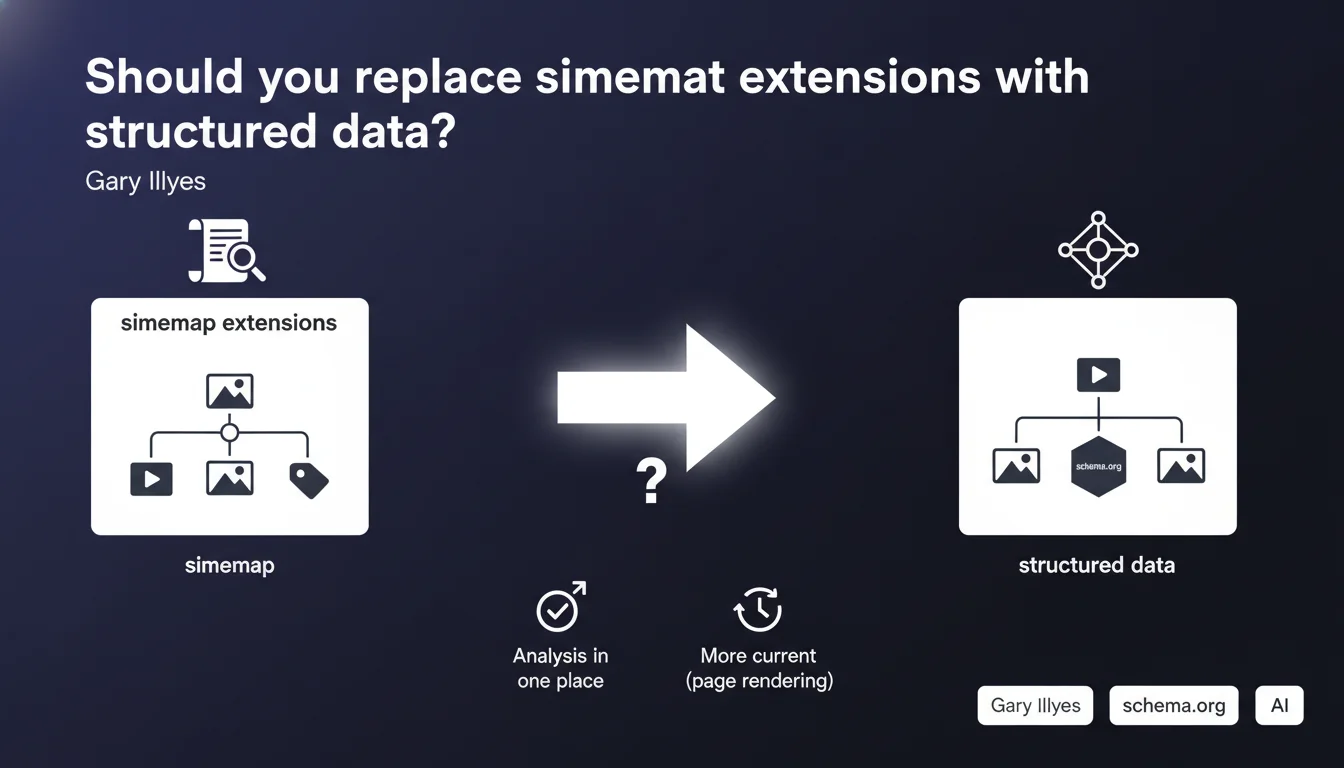
Google favors schema.org structured data over sitemap extensions (video, image) because they are analyzed in a single location during rendering and remain more up-to-date. Information provided via schema.org is therefore processed more efficiently and reliably than data scattered across sitemaps.
What you need to understand
What exactly are these sitemap extensions that Google is talking about?
Sitemap extensions allow you to enrich the standard sitemap.xml file with specific metadata: video tags (VideoObject), image tags, news, etc. Concretely, instead of simply listing your URLs, you add contextual information about the multimedia content present on each page.
This practice has existed for years. Google has long encouraged webmasters to document their videos and images directly in the sitemap to facilitate their discovery and indexing.
Why does Google now prefer structured data?
The reason is simple: centralized processing. When Google renders a page, it analyzes the HTML and structured data in a single pass. The sitemap, on the other hand, is read separately, often asynchronously and less frequently.
Structured data is also more up-to-date. If you modify a video thumbnail or its title, the schema.org immediately reflects this change during the next page crawl. The sitemap, unless you regenerate and manually submit it, remains static.
Does this mean you should abandon sitemap extensions?
Gary Illyes doesn't explicitly say to remove them. He says it is "preferable" to use structured data. Important nuance.
In practice, many sites use both channels simultaneously without apparent issues. Google processes redundant information without penalty — but prioritizes structured data in case of conflict.
- Structured data is analyzed during page rendering, ensuring perfect synchronization with visible content.
- The sitemap remains useful for signaling undiscovered URLs, but becomes secondary for describing multimedia content.
- Google encourages gradual migration toward schema.org to centralize metadata.
- No official disavowal of sitemap extensions, but a clear preference displayed.
SEO Expert opinion
Is this statement consistent with practices observed in the field?
Yes and no. E-commerce and media sites that have heavily invested in detailed video sitemaps have observed for years that Google indexes their videos very well — even without structured data. The machine works.
But tests also show that adding VideoObject as schema.org accelerates appearance in rich results. The delay between publication and display in video carousels is reduced. This is consistent with Gary's statement.
What nuances should be added?
First nuance: volume. A site with 100,000 videos spread across as many pages cannot always guarantee that each page will be crawled and rendered frequently. The video sitemap then remains a safety net for documenting the complete inventory.
Second nuance: processing delays. Google doesn't render all pages immediately. On high-volume sites, some URLs are only rendered several days after the initial crawl. The sitemap, meanwhile, is read quickly after submission. [To verify] on very dynamic sites, the sitemap could temporarily provide a responsiveness advantage.
In what cases does this rule not fully apply?
Sites with automatically generated multimedia content (aggregators, UGC platforms) sometimes struggle to inject clean structured data on each page. Their legacy systems generate video sitemaps by batch, which is simpler to maintain.
Another case: non-indexable pages by choice (noindex) but where you still want to signal their videos to Google. The video sitemap can theoretically work here, although Google offers no guarantees.
Practical impact and recommendations
What should you do concretely to align your strategy?
If you're creating a new site or overhaul an existing one, prioritize schema.org from the start. Implement VideoObject, ImageObject, and relevant types directly in the HTML or via JSON-LD. Don't waste time building complex enriched sitemaps.
For existing sites with sitemap extensions already in place: no urgent need to tear everything down. Add structured data progressively in addition. Once deployed and validated on a sample of pages, you can lighten or remove sitemap extensions if you wish.
What mistakes should you avoid during migration?
Don't blindly duplicate information. If you maintain both sitemap AND schema.org, ensure they remain consistent. Contradictory metadata creates confusion — and Google will choose arbitrarily.
Also avoid brutally removing a video sitemap without having verified that structured data is actually being crawled and interpreted. Test in staging, validate with the rich results testing tool, then deploy in waves.
How can you verify your site complies with Google's recommendations?
Use Search Console to track structured data errors detected. The "Enhancements" tab shows VideoObject, products, FAQs, etc. If problems appear, fix them before disabling sitemaps.
Crawl your site with a tool like Screaming Frog or Oncrawl with schema.org extraction enabled. Compare coverage: how many pages with video actually have valid VideoObject? If the rate is below 95%, there's still work to do.
- Audit multimedia pages to identify those missing structured data.
- Implement VideoObject and ImageObject via JSON-LD or microdata depending on your technical stack.
- Validate structured data with Google's official tool and fix reported errors.
- Monitor indexing and rich results display for 2-3 weeks.
- Keep the sitemap temporarily in parallel to ensure a transition without visibility loss.
- Measure impact on organic traffic for affected pages before permanently disabling extensions.
❓ Frequently Asked Questions
Dois-je supprimer mon sitemap vidéo si j'ajoute des données structurées VideoObject ?
Les données structurées garantissent-elles une indexation plus rapide des vidéos ?
Que se passe-t-il si les métadonnées du sitemap contredisent celles du schema.org ?
Faut-il également migrer les balises image du sitemap vers ImageObject ?
Les sites avec peu de pages ont-ils vraiment besoin de données structurées vidéo ?
🎥 From the same video 11
Other SEO insights extracted from this same Google Search Central video · published on 05/05/2022
🎥 Watch the full video on YouTube →
💬 Comments (0)
Be the first to comment.