
Official statement
Other statements from this video 11 ▾
- □ Should you really remove the 'changefreq' tag from your sitemaps?
- □ Why does Google ignore the 'lastmod' tag in your sitemaps?
- □ Should you still bother filling in the lastmod tag in your XML sitemaps?
- □ Does submitting a sitemap really guarantee that Google will crawl your URLs?
- □ Should you replace sitemap extensions with structured data?
- □ Should You Stop Using Video and Image Tags in Your XML Sitemaps?
- □ Should you update lastmod when adding structured data to your pages?
- □ Why does creating a sitemap expose more technical problems than it solves?
- □ Are session identifiers in URL parameters still sabotaging your site's crawlability?
- □ Does a crawlable site really guarantee better user navigation?
- □ Does submitting your URLs via API really guarantee indexation without Google crawling them?
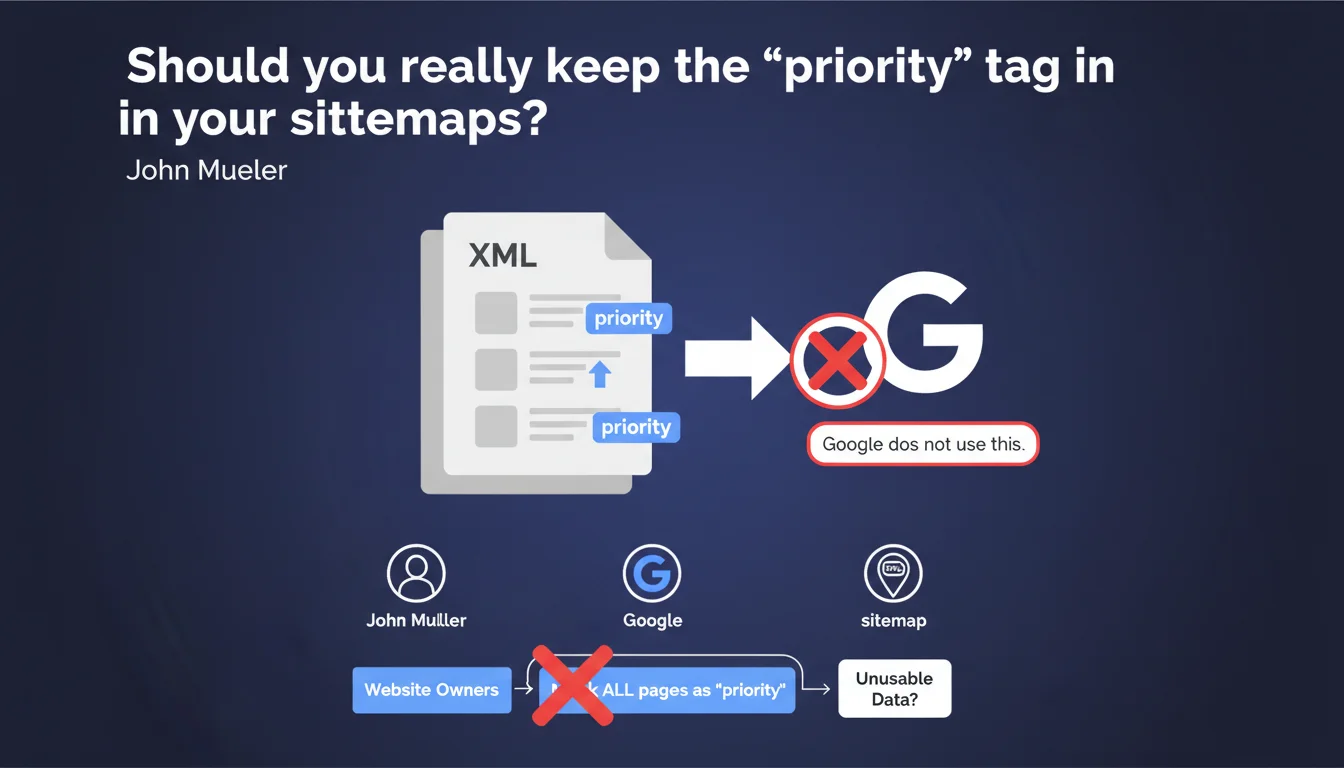
Google completely ignores the 'priority' tag in XML sitemap files. The widespread abuse of this tag by website owners — who mark everything as priority — has rendered it useless. There's no point wasting time optimizing this parameter.
What you need to understand
Why did Google decide to ignore this tag?
The priority tag was supposed to tell Google the relative importance of a page compared to other pages on the site. With a value from 0.0 to 1.0, it was meant to guide crawling and indexation.
The problem? 98% of sites mark all their pages between 0.9 and 1.0. When everything is priority, nothing is. Google found that this data reflected no strategic reality — just mechanical behavior or misunderstanding of the concept.
Has this tag ever had a real impact?
Hard to confirm. Google has never really committed to actually using this tag, even in its early days. Unlike lastmod (which signals recently modified content) or the changefreq tag (which is also ignored now), priority never had clear documentation about its real weight.
John Mueller is clear about it: this tag is not used by Google. Period. It still appears in the standard sitemap protocol, but Google simply doesn't read it.
What does this mean for your crawl budget?
Absolutely nothing. Google's crawl budget relies on much more robust signals: page depth, internal popularity (internal linking), content freshness, actual update rate, user behavior.
If you thought you could direct Googlebot toward your strategic pages with this tag, you were wasting your time. Google determines on its own what deserves to be crawled as a priority.
- Google completely ignores the 'priority' tag in XML sitemaps
- The widespread abuse of this tag by webmasters has made it unusable
- Crawl budget depends on internal signals (linking structure, freshness) and external signals (backlinks, behavior)
- Only the loc and lastmod tags still have documented utility
- Stop wasting time calculating fictional priority scores
SEO Expert opinion
Is this statement consistent with observed practices?
Completely. In the field, no correlation has ever been established between the priority tag and crawl frequency or indexing speed. A/B tests conducted on large sites have never shown measurable differences.
What does work: a clean, up-to-date sitemap with valid URLs and the lastmod tag properly filled in. Focus on that rather than on phantom parameters.
Should you remove this tag from sitemaps?
No, it's not necessary — and it would actually be counterproductive. The tag is part of the standard protocol. If your CMS or sitemap generator includes it automatically, leave it. Google ignores it, but it doesn't harm anything.
What matters: don't spend time optimizing it. Do you still see WordPress plugins that offer to finely tune the priority of each content type? That's wasted time. Disable these options and move on.
What are the real levers to direct crawling?
Internal linking remains the number one lever. A page accessible in 2 clicks from the homepage will be crawled much more often than a page buried 6 clicks deep, regardless of its declared priority in the sitemap.
Next: actual content freshness. If you update a page and lastmod reflects this change, Google will come back faster. But be careful — [To be verified]: if you touch lastmod without actually modifying the content, Google could detect this behavior and lose confidence in your signals.
Practical impact and recommendations
What should you concretely do with your existing sitemaps?
If your sitemaps already contain the priority tag, leave them as is. Removing the tag won't bring any benefit and could break some automated processes. However, stop spending time adjusting these values.
Focus on the tags that really matter: loc (page URL) and lastmod (last modification date). Make sure lastmod reflects real updates — not automatic sitemap regeneration.
How can you redirect your crawl optimization efforts?
Audit your internal linking structure. Strategic pages should be accessible in a maximum of 3 clicks from the homepage. Use tools like Screaming Frog or Oncrawl to identify orphaned pages or pages that are too deep.
Monitor your crawl budget via Google Search Console (Crawl Statistics report). If Google spends too much time on useless pages (URL parameters, facets, archives), block them via robots.txt or canonicalize them.
What mistakes must you absolutely avoid?
Don't manipulate the lastmod tag to force a recrawl. Google detects these manipulations and could completely ignore your sitemaps afterward. A honest sitemap is better than an over-optimized one that loses all credibility.
Also avoid sitemaps that are too large (more than 50,000 URLs per file) or poorly structured. Segment by content type if necessary, and use a sitemap index for large sites.
- Verify that your sitemaps contain only indexable URLs (no 404s, redirects, or pages blocked by robots.txt)
- Ensure that the lastmod tag reflects real modifications, not automatic generation
- Remove the changefreq tag (also ignored by Google) to lighten your files
- Segment your sitemaps by content type (articles, products, categories) to facilitate diagnosis
- Submit your sitemaps via Google Search Console and monitor errors
- Optimize internal linking so strategic pages are accessible in 2-3 clicks maximum
- Regularly audit crawl budget to identify waste
❓ Frequently Asked Questions
Si Google ignore la balise priority, pourquoi figure-t-elle encore dans le protocole sitemap ?
Est-ce que Bing ou d'autres moteurs utilisent cette balise ?
Faut-il supprimer les plugins WordPress qui gèrent la balise priority ?
La balise lastmod est-elle vraiment prise en compte par Google ?
Comment savoir si Google crawle efficacement mon site sans la balise priority ?
🎥 From the same video 11
Other SEO insights extracted from this same Google Search Central video · published on 05/05/2022
🎥 Watch the full video on YouTube →
💬 Comments (0)
Be the first to comment.