
Official statement
Other statements from this video 11 ▾
- □ Should you really keep the 'priority' tag in your sitemaps?
- □ Why does Google ignore the 'lastmod' tag in your sitemaps?
- □ Should you still bother filling in the lastmod tag in your XML sitemaps?
- □ Does submitting a sitemap really guarantee that Google will crawl your URLs?
- □ Should you replace sitemap extensions with structured data?
- □ Should You Stop Using Video and Image Tags in Your XML Sitemaps?
- □ Should you update lastmod when adding structured data to your pages?
- □ Why does creating a sitemap expose more technical problems than it solves?
- □ Are session identifiers in URL parameters still sabotaging your site's crawlability?
- □ Does a crawlable site really guarantee better user navigation?
- □ Does submitting your URLs via API really guarantee indexation without Google crawling them?
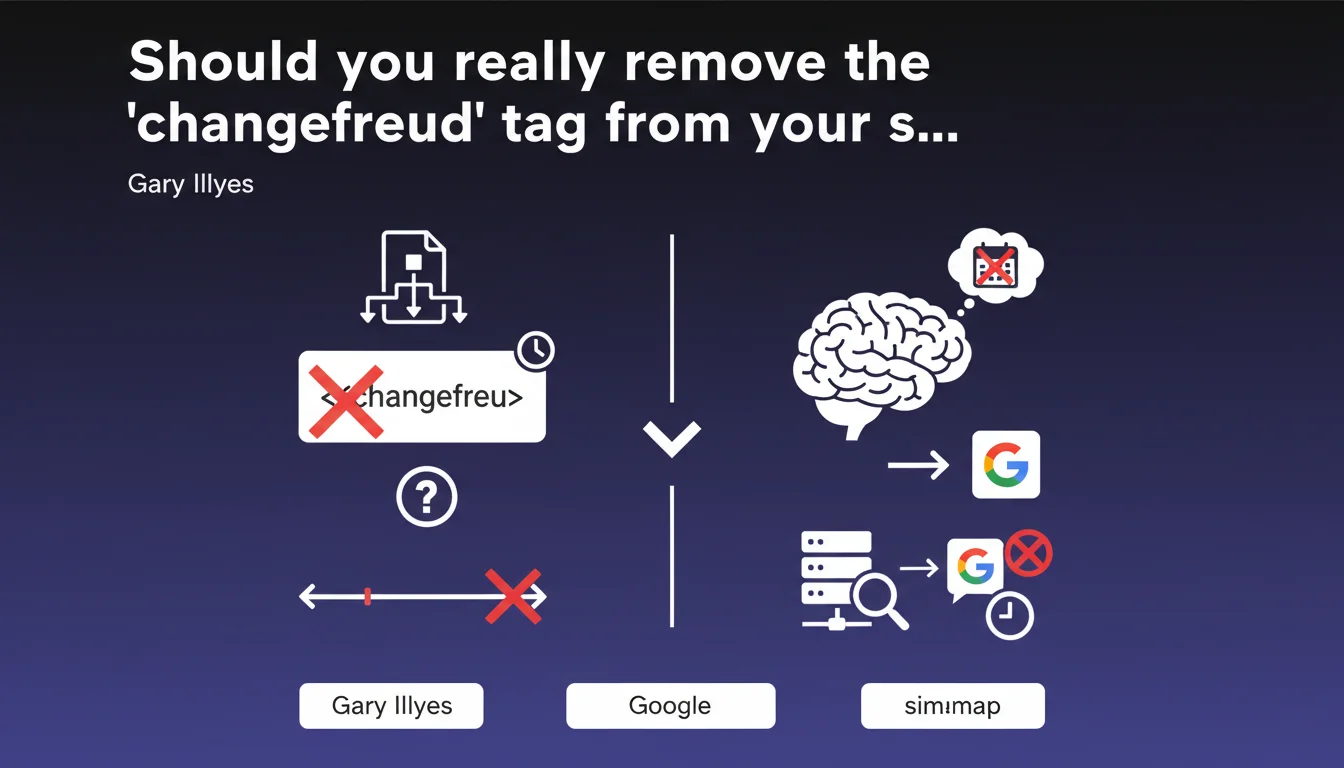
Google completely ignores the 'changefreq' tag in your sitemap files. Why? It's impossible to reliably predict how often a page will actually be updated, making this data unusable for the algorithm. Bottom line: you're wasting your time including it.
What you need to understand
Why does Google reject this tag?
The changefreq tag has been part of the standard XML sitemap protocol for years. In theory, it allows you to indicate how often a page is modified: daily, weekly, monthly, etc.
The problem? This information relies on human prediction, not technical reality. A webmaster can declare that a page changes daily when it actually remains static for months — or vice versa.
Has this information ever actually been used?
Gary Illyes' statement doesn't clarify whether Google ever exploited this tag. What is certain today: the algorithm does not take it into account in its crawling decisions.
Google has its own mechanisms to detect real changes on your pages: DOM analysis, comparison of crawled versions, behavioral signals. The changefreq tag adds nothing that these systems don't already detect.
What about the other sitemap tags?
This statement concerns only changefreq. The tags loc (URL), lastmod (last modification date), and priority remain in the standard protocol.
Be careful though: if Google ignores changefreq for the reasons mentioned, there's no guarantee it gives significant weight to priority either. The lastmod tag, on the other hand, can be useful if it reflects actual content modifications.
- Google does not use changefreq in its crawling algorithms
- The impossibility of reliably predicting changes makes this data unusable
- Other sitemap tags (loc, lastmod) are not affected by this statement
- Google relies on its own change detectors rather than your declarations
SEO Expert opinion
Is this position consistent with what we observe in practice?
Honestly, yes. For years, empirical tests show no correlation between the changefreq value and actual crawl frequency. Sites with changefreq="daily" might be crawled once a week, and vice versa.
What really impacts crawl frequency is your domain's crawl budget, the perceived freshness of your content, your authority, and user behavioral signals. Not a declarative XML tag.
Why does this tag still exist then?
Good question. The sitemap protocol was developed jointly by Google, Yahoo, and Microsoft — at a time when search engines were still figuring out how to optimize their crawling. Changefreq was an attempt at collaboration with webmasters.
Except in practice, this collaboration turned into an incentive to lie: many CMS platforms automatically generated changefreq="daily" for all pages, hoping to boost their crawl. Result: polluted data, therefore unusable.
[To verify]: Gary Illyes doesn't specify whether other engines (Bing, Yandex) still use this tag. It's possible some use it as a weak signal, but no official confirmation exists.
Should you worry about having this tag in your sitemaps?
No. Google ignores it, so it won't penalize you for it. If your CMS automatically generates changefreq, it's not catastrophic — it's just pointless.
The real risk would be wasting time manually optimizing this tag thinking you'll influence crawl frequency. Focus instead on lastmod if you can guarantee its reliability, and especially on the actual quality of your content.
Practical impact and recommendations
What should you concretely do with changefreq?
If your CMS automatically generates this tag and you don't have easy access to the configuration, forget about it. It's not a priority. Googlebot will ignore it anyway.
If you're building a new sitemap or have control over its generation, you might as well not include changefreq. Fewer lines, lighter sitemap, simplified maintenance.
What should you focus your efforts on instead?
The lastmod tag deserves more attention — provided it reflects actual content modifications. Don't update lastmod if you only change a comma in the footer.
Google detects false freshness signals. If you manipulate lastmod to suggest frequent updates when the content remains identical, you risk eroding the trust accorded to your sitemaps.
Focus instead on your sitemap structure: separate by content type, by actual update frequency, by business priority. A well-organized sitemap makes Googlebot's job easier and improves crawl efficiency.
How to verify that your sitemap is optimized?
- Test your sitemap in Search Console to detect syntax errors
- Verify that lastmod reflects actual content changes, not cosmetic updates
- Remove changefreq if you have easy access to sitemap generation
- Segment your sitemaps by content type if your site exceeds 10,000 URLs
- Monitor crawl stats in Search Console to detect anomalies
- Ensure all sitemap URLs return a 200 code and are truly indexable
❓ Frequently Asked Questions
Dois-je supprimer changefreq de mes sitemaps existants ?
La balise priority est-elle également ignorée par Google ?
Comment Google décide-t-il vraiment de la fréquence de crawl ?
La balise lastmod est-elle utile alors ?
Bing et les autres moteurs utilisent-ils changefreq ?
🎥 From the same video 11
Other SEO insights extracted from this same Google Search Central video · published on 05/05/2022
🎥 Watch the full video on YouTube →
💬 Comments (0)
Be the first to comment.