
Official statement
Other statements from this video 14 ▾
- □ Do ccTLDs Really Give You a Geographic SEO Advantage?
- □ Does your domain extension really impact SEO rankings?
- □ Why does Google treat certain ccTLDs the same way as generic domain extensions?
- □ Do .edu and .gov domains really provide an SEO advantage?
- □ Does your domain extension (TLD) really impact your search rankings?
- □ Does a .coffee or .tech domain really boost your search rankings?
- □ Should you always verify a domain's history before buying it?
- □ Why can't you detect manual actions before buying an expired domain?
- □ Do keywords in your domain name really matter for SEO rankings?
- □ Do hyphens in domain names really hurt your SEO rankings?
- □ Should you prioritize branding over exact keywords in your domain name?
- □ Does your choice between www and non-www really impact your search rankings?
- □ Is it time to ditch the m. subdomain for mobile?
- □ Should you really avoid publishing a 'Coming Soon' page on a new domain?
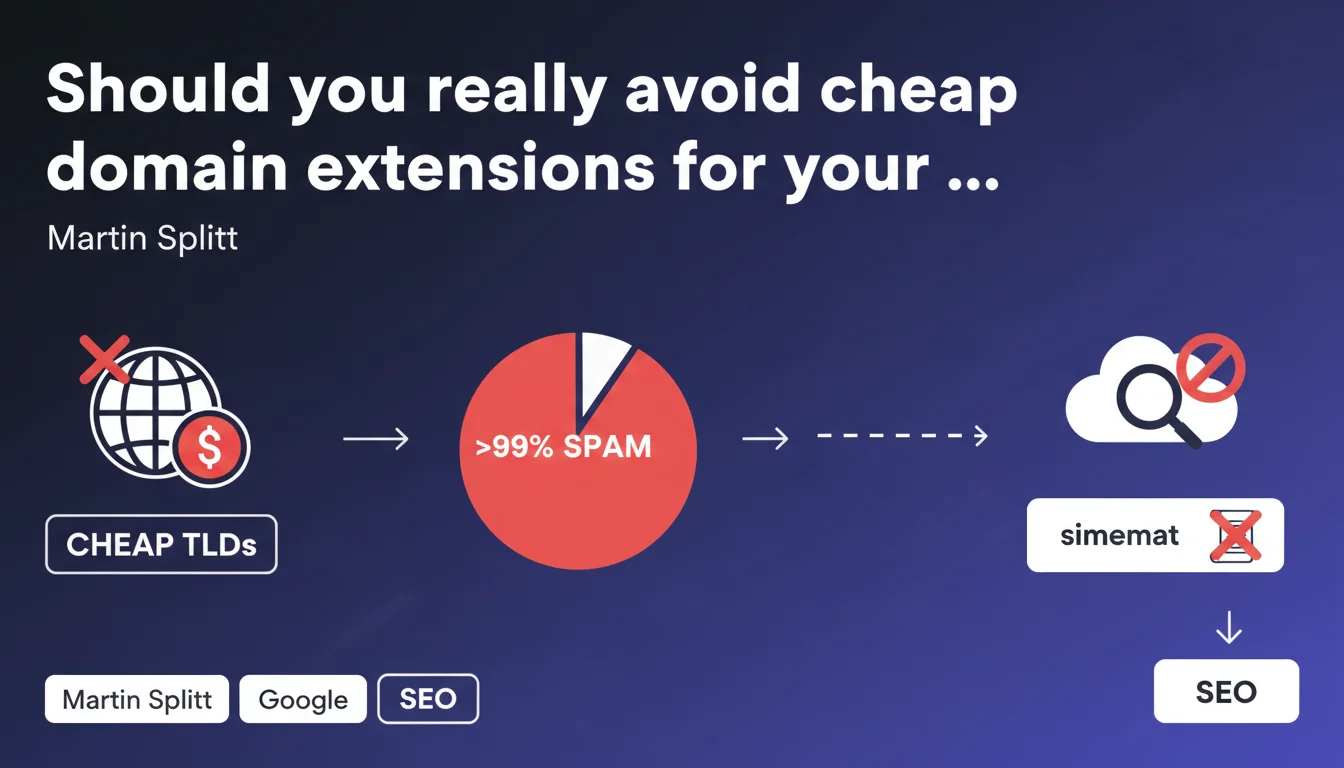
Google may decide to stop crawling sitemaps on a TLD if more than 99% of its content is spam. Free or very cheap extensions (.tk, .ml, .ga, .cf) are particularly exposed. In practice, choosing a poor TLD can handicap your site's indexation from the start.
What you need to understand
Why does Google penalize certain TLDs collectively?
Martin Splitt points out a phenomenon well known to SEOs: certain domain extensions massively attract spammers, particularly free TLDs like .tk, .ml, .ga, or .cf. When more than 99% of content hosted on an extension is spam, Google adapts its global crawl budget for that extension.
Result: even a legitimate site hosted on a poor TLD can see its sitemap ignored or crawled at a ridiculously low frequency. Google won't waste resources exploring extensions saturated with toxic content.
How does Google identify that a TLD is saturated with spam?
The exact mechanism remains unclear — Google never details its internal thresholds — but we can assume the engine analyzes the average quality of sites by extension. If 99% of domains in .tk are link farms, phishing, or autogenerated content, the algorithm draws statistical conclusions.
Splitt uses a precise figure: 99%. It's an enormous threshold, but one that clearly exists. Once crossed, Google can massively deprioritize crawling of the entire extension, with no distinction between spam and legitimate content.
Which TLDs are concretely targeted by this policy?
The free extensions offered by certain registrars (Freenom notably) are the first concerned: .tk (Tokelau), .ml (Mali), .ga (Gabon), .cf (Central African Republic), .gq (Equatorial Guinea). These TLDs have been massively exploited for spam, phishing, and low-cost PBN networks.
Very cheap extensions (some promotions at €0.99 for the first year) also attract this type of use. A throwaway domain at €1 costs spammers nothing — and Google knows it.
- Google may stop crawling sitemaps on a TLD saturated with spam (threshold: 99%)
- Free TLDs (.tk, .ml, .ga, .cf, .gq) are particularly exposed
- A legitimate site on a poor TLD can be handicapped from the start
- The issue affects the global crawl budget allocated to the extension, not just spam sites
- Even quality content can be invisible if the sitemap is never retrieved
SEO Expert opinion
Is this statement consistent with field observations?
Yes, completely. SEOs who experimented with PBNs or satellite sites on free TLDs often noticed abnormally long indexation delays, or even complete lack of indexation despite clean sitemaps and backlinks pointing to the site.
Splitt confirms what we suspected: Google doesn't allocate the same crawl budget to all TLDs. Certain extensions are treated as suspect by default. This isn't a manual penalty, it's a collective algorithmic deprioritization.
What nuances should we add to this advice?
The figure of 99% is extreme. Few TLDs ever reach this threshold — but when they do, the impact is brutal. Realistically, a .com, .fr, .org, or .net has virtually no chance of reaching this saturation level. We're really talking about exotic or free extensions.
[To verify]: Google doesn't specify whether this policy applies in a binary manner (on/off) or progressively. Does a TLD at 95% spam already suffer partial crawl degradation? Splitt doesn't say. We can assume there are gradations, but no public data confirms it.
When is a cheap TLD still acceptable?
A .xyz or .club purchased at €2 on sale is not automatically toxic — as long as it comes from a reputable registrar (Gandi, OVH, Namecheap) and you build a legitimate site on it. The problem isn't the price itself, it's the price/spam correlation.
If you're launching a side project and hesitating between a .xyz at €2 and a .com at €12, get the .com. The cost difference is negligible compared to the risk of degraded indexation. A domain is an investment over 5-10 years — saving €10 in the first year makes no sense.
Practical impact and recommendations
What should you do concretely when launching a new site?
Prioritize mainstream extensions: .com, .fr, .org, .net, or serious country TLDs (.de, .co.uk, .ca). Absolutely avoid free TLDs (.tk, .ml, .ga, .cf, .gq) unless you want to experiment with a throwaway site — and even then, expect Google to ignore it.
If you must choose an alternative TLD for branding reasons (.io, .tech, .design), make sure it comes from a reputable registrar and you pay a normal price. A .io at €40/year poses no problem — it's an expensive TLD, therefore unattractive to spammers.
What mistakes should you absolutely avoid?
Don't be tempted by "free domain for 1 year" promotions if the extension is exotic. Never launch a serious commercial project on a free TLD — you risk losing months waiting for indexation that will never come.
If you manage a portfolio of expired domains or 301 redirects, avoid repurchasing domains on suspect TLDs even if they have clean history. Google may have deprioritized the entire extension since the last time this domain was active.
How can you verify that your TLD isn't blacklisted by Google?
It's impossible to know for certain — Google doesn't publish a list. But you can analyze the average indexation speed of new domains on the extension you're interested in. Create a test site, submit the sitemap, and observe how long Google takes to crawl your first pages.
If after 3-4 weeks no pages are indexed despite a clean sitemap and some backlinks, that's a red flag. A standard .com typically indexes within 48-72 hours under normal conditions.
- Prioritize mainstream TLDs (.com, .fr, .org, .net) for any serious project
- Absolutely avoid free TLDs (.tk, .ml, .ga, .cf, .gq) except for throwaway tests
- If you choose an alternative TLD (.io, .tech), ensure it's expensive (therefore unattractive to spammers)
- Never launch a commercial project on a €1 domain — the price difference isn't worth the risk
- Test indexation speed before migrating an important site to an exotic TLD
- Beware of expired domains on suspect TLDs, even if they have good history
❓ Frequently Asked Questions
Google pénalise-t-il individuellement les sites sur des TLD spam ou c'est collectif ?
Un .xyz ou un .club en promo est-il dangereux pour le SEO ?
Peut-on récupérer un site bloqué sur un TLD spam en migrant vers un .com ?
Les TLD nationaux (.fr, .de, .co.uk) sont-ils toujours sûrs ?
Comment savoir si mon TLD est saturé de spam ?
🎥 From the same video 14
Other SEO insights extracted from this same Google Search Central video · published on 20/07/2023
🎥 Watch the full video on YouTube →
💬 Comments (0)
Be the first to comment.