
Official statement
Other statements from this video 4 ▾
- □ Can Google Trends really generate actionable SEO content ideas for your strategy?
- □ Should you really be monitoring Google Trends to anticipate search peaks before your competitors do?
- □ Should you really align your Trending Now time window to your editorial objective?
- □ Should you really use Google Trends to create relevant SEO content?
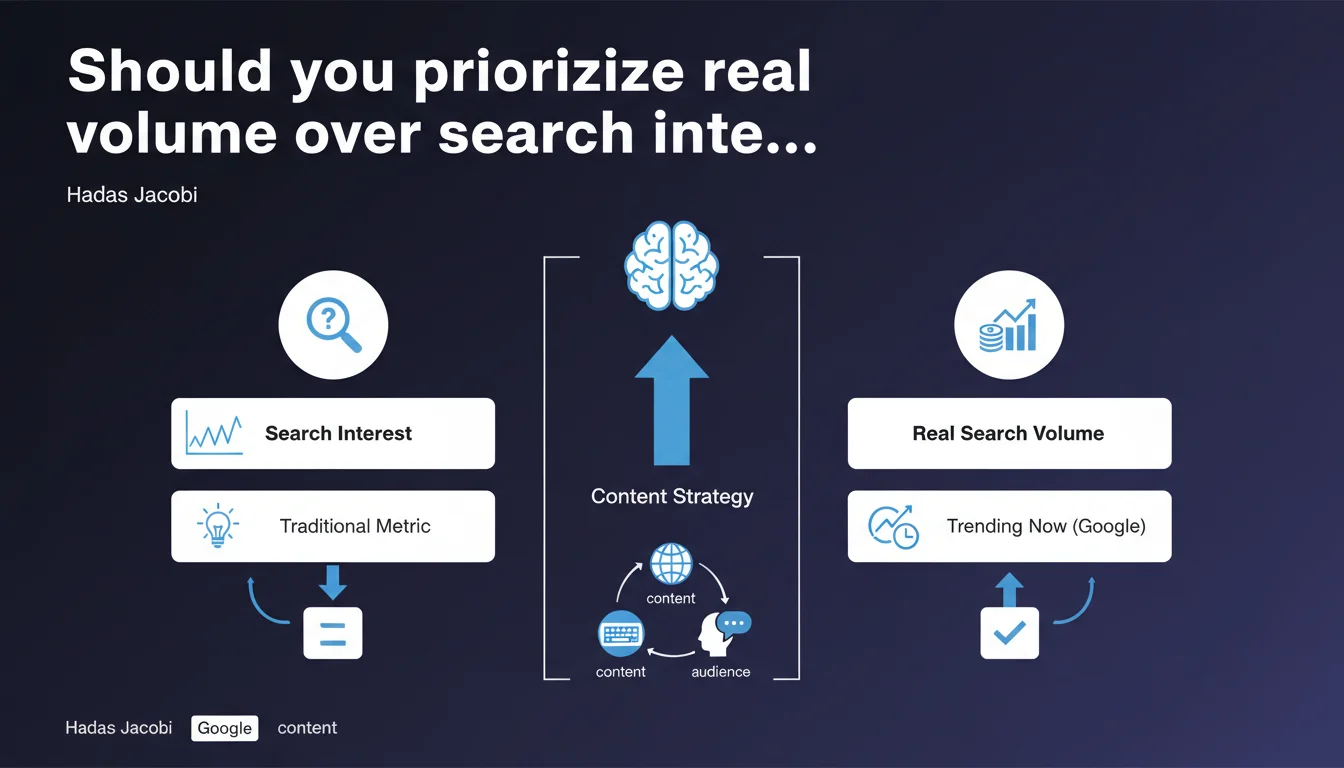
Google Trends is introducing a new metric in Trending Now that displays approximate real search volume, rather than just the traditional relative interest index. This data allows you to evaluate the absolute scale of a trend, which changes everything when prioritizing content opportunities based on their real traffic potential.
What you need to understand
What is the difference between real search volume and search interest?
Google Trends search interest is a relative index on a scale of 0 to 100. It measures the popularity of a term relative to its historical peak within a given period, but tells you nothing about absolute volume. An interest score of 100 could represent 500 searches or 500,000 — impossible to know.
Real search volume displayed in Trending Now is a concrete estimate of the number of queries performed on Google. This metric changes everything: it allows you to compare trends against each other on an objective basis and prioritize between topics based on their real traffic potential.
Why is Google introducing this metric now?
For years, SEO professionals have been juggling fuzzy Trends data and approximate ranges from Search Console or third-party tools. Google seems to want to make content opportunity analysis easier by providing a more tangible view of volumes.
In practical terms, this allows you to quickly identify whether an emerging trend is worth allocating editorial resources to — or if it's just media noise with no actual search volume behind it.
Where is this data accessible?
The metric is available in Google Trends' Trending Now section. It appears for queries experiencing strong popularity spikes, with an estimate of volume over a given period.
Caution: this data remains approximate. Google does not disclose the exact methodology or margin of error. It's far from the precision you might expect from a tool like Keyword Planner, which has its own biases.
- Trending Now now displays approximate real search volume, not just a relative index
- This data allows you to quantify the scale of a trend in a more concrete way
- It appears for high-growth queries only
- Still an estimate — Google doesn't detail the methodology or accuracy
- Useful for prioritizing content opportunities based on their real traffic potential
SEO Expert opinion
Is this data really reliable for driving an editorial strategy?
Let's be honest: Google doesn't specify the exact source of these volumes, whether the data includes all query variations, or what the margin of error is. [To verify] on the ground by comparing with the volumes you observe in Search Console for queries where you rank well.
In my preliminary tests, the volumes displayed in Trending Now seem consistent with those observed through third-party tools (SEMrush, Ahrefs) for mass trends. However, in niche markets, the gaps can be significant — probably because the data granularity varies.
Does real volume replace the traditional interest index?
No. Both metrics answer different questions. The interest index remains relevant for analyzing the temporal evolution of a query, spotting seasonality, or comparing trends across different geographic contexts.
Real volume, on the other hand, serves to quantify the opportunity: how many potential visitors can I expect to capture if I rank for this topic? It's complementary, not substitutive. A smart SEO uses both in parallel.
What limitations should you keep in mind?
First bias: Trending Now focuses on high-growth queries. If your strategy relies on evergreen keywords with stable volume, this metric will be useless to you. It's designed for reactive content, not long-term pillar editorial content.
Second bias: the displayed volume is a snapshot. A trend can spike and then crash within 48 hours. If you're producing content over 3 weeks, you'll arrive after the battle is over. This data doesn't eliminate the need to analyze whether the trend is sustainable.
Practical impact and recommendations
How do you integrate this metric into your content production workflow?
First step: monitor Trending Now daily or through an automated monitoring tool. Identify trends that align with your subject matter and whose volume justifies quick production. Compare with your historical data to avoid false signals.
Next, cross-reference the real volume with estimated SEO difficulty (authority of already-ranked sites, quality of existing content). A trend with 100k monthly searches is worthless if the top 10 positions are locked by major players and your site doesn't have the authority to compete.
What mistakes should you avoid with this data?
Don't confuse search volume with conversion potential. A query with 500k volume can generate zero business if the intent is purely informational and your model relies on transactions. Always analyze the intent behind the query before mobilizing resources.
Another trap: jumping on every emerging trend without editorial coherence. Your site loses thematic authority if you publish opportunistic content disconnected from your core business. Stay disciplined with your editorial line, even in the face of big volume.
How do you verify this data is exploitable for your site?
Compare the volumes displayed in Trending Now with those you observe in Search Console for queries where you already rank. If the orders of magnitude are consistent, you can rely on this metric with reasonable confidence.
Also test the correlation between announced volume and traffic obtained. Take 3-4 past trends, look at the volume displayed at the time, and compare with the traffic you captured if you published on them. This will give you a correction factor specific to your site and industry.
- Monitor Trending Now to spot opportunities aligned with your subject matter
- Cross-reference real volume, SEO difficulty, and search intent before producing content
- Validate the consistency of displayed volumes with your Search Console data
- Avoid chasing every trend — stay consistent with your editorial line
- Measure the correlation between announced volume and actual traffic obtained to calibrate expectations
- Never use this metric alone — supplement with third-party tools and analytics
❓ Frequently Asked Questions
Le volume de recherche réel affiché dans Trending Now est-il plus précis que celui des outils tiers ?
Cette métrique remplace-t-elle l'indice d'intérêt de Google Trends pour analyser les tendances ?
Puis-je utiliser cette donnée pour piloter une stratégie de contenu evergreen ?
Comment vérifier la fiabilité du volume affiché par Google pour mes sujets ?
Faut-il produire du contenu sur toutes les tendances avec un volume élevé ?
🎥 From the same video 4
Other SEO insights extracted from this same Google Search Central video · published on 11/09/2024
🎥 Watch the full video on YouTube →
💬 Comments (0)
Be the first to comment.