
Official statement
Other statements from this video 4 ▾
- □ Google Trends peut-il vraiment générer des idées de contenu SEO exploitables ?
- □ Faut-il vraiment surveiller Google Trends pour anticiper les pics de recherche ?
- □ Faut-il privilégier le volume de recherche réel plutôt que l'intérêt de recherche pour bâtir sa stratégie de contenu ?
- □ Faut-il vraiment utiliser Google Trends pour créer du contenu SEO pertinent ?
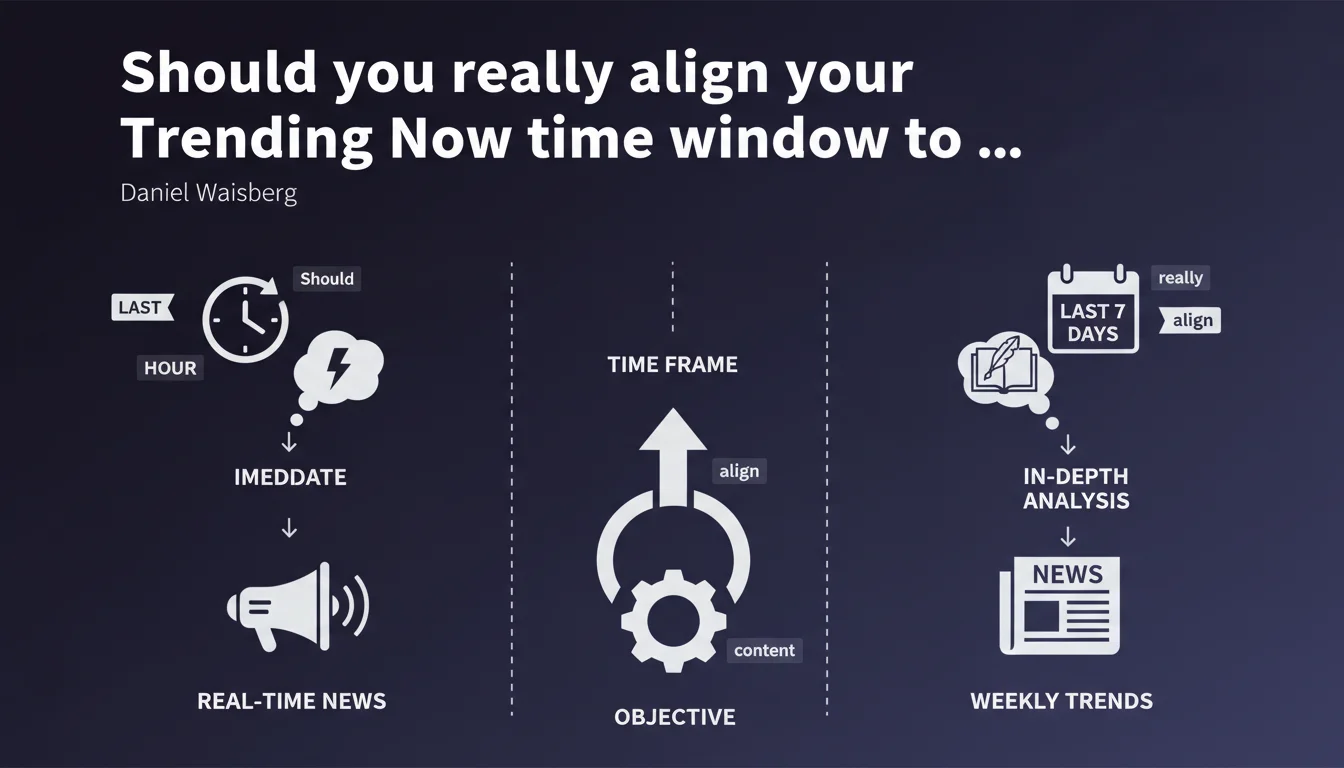
Google clarifies that choosing the right temporal filter in Trending Now (last hour vs. last 7 days) must match your intended editorial angle. Each time period serves a different purpose: breaking news demands the last hour, while a weekly overview requires the last 7 days. It's fundamentally about alignment between the data you're using and your editorial promise.
What you need to understand
What is Trending Now and why does this temporal filter matter?
Trending Now is Google Search Console's tool that reveals queries with strong growth over a given period. Unlike the standard Performance tab, it shines a light on emerging trends rather than raw volumes.
The temporal filter determines the very nature of the data displayed. The last hour captures ultra-recent spikes — breaking news, live sporting events, instant buzz. The last 7 days smooths out fluctuations and surfaces more structured trends, exploitable for content that won't become obsolete within the hour.
Why does Google insist on this distinction?
Because too many writers use the wrong filter and produce misaligned content. Writing about "weekly trends" based on last-hour data is comparing apples and oranges — the result will be skewed or already outdated.
Google is reminding us of an obvious truth that's too often overlooked: editorial objective dictates the time frame. If your angle is "what's buzzing right now," the last hour is essential. If you're targeting "the big movements of the past week," the 7-day window is non-negotiable.
What concrete errors does this confusion cause?
Publishing a "top weekly trends" article based on an hourly snapshot creates editorial misalignment. Readers spot the disconnect — the content doesn't match the headline. Google does too, via behavioral signals (bounce rate, time on page).
Conversely, trying to cover a live event using weekly data dilutes your responsiveness. You miss the SEO opportunity window. Timing is crucial to capture the search peak — a few hours' delay can cost you 80% of potential traffic.
- Objective-tool alignment: The temporal filter must reflect the editorial promise of your content
- Last hour: Reserved for ultra-reactive topics, live events, breaking news
- Last 7 days: For analyzing consolidated trends, producing content with medium lifespan
- Editorial consistency: A headline "weekly trends" demands weekly data, not an hourly snapshot
- SEO timing: Using the right filter at the right time maximizes your chances of capturing the search peak
SEO Expert opinion
Is this distinction really applied in the field?
Let's be honest: many SEO writers use Trending Now without thinking about the temporal filter. They click on whatever tab appears first and build their content around it. The result? Articles titled "top 10 weekly trends" based on the last 28 days, or worse, the last hour.
This Google statement doesn't revolutionize anything — it restates a rule of common sense that's too often ignored. The problem is that Trending Now doesn't prevent you from doing whatever you want. The interface won't warn you if you're mixing time frames.
What nuances should we add to this recommendation?
Google presents this in binary terms (last hour vs. 7 days), but reality is more fluid. Some topics require subtle trade-offs. Example: a major sporting event lasting 3 days — neither the last hour nor 7 days perfectly captures the optimal window.
Moreover, this logic assumes your editorial objective is crystal clear from the start. Yet many opportunistic pieces emerge from a trend spotted in the tool — the angle is built after the fact. In this case, the temporal filter influences the objective as much as the reverse. [To verify]: Google doesn't specify whether mixing multiple time windows to enrich your analysis is acceptable or counterproductive.
In what cases doesn't this rule apply?
For evergreen or semi-evergreen content, Trending Now simply isn't the right tool. If your objective is covering a substantive topic with trend as a secondary dimension, temporal filters become secondary — you'll draw from other sources (Google Trends long-term, competitive analysis, historical data).
And for news-focused sites publishing continuously, hourly granularity becomes insufficient. Some events unfold in 10-15 minute windows. Trending Now remains a detection tool, not real-time piloting — you must cross-reference with other signals (social media, Google Alerts, competitive monitoring).
Practical impact and recommendations
What should you concretely do before publishing trend-based content?
First step: define your editorial angle before opening Trending Now. What do you want to cover? An ongoing event (last hour), a weekly recap (7 days), a monthly synthesis (28 days)? The tool follows the objective, never the reverse.
Next, use the corresponding temporal filter and record the date/time of consultation. Trending Now data isn't static — what appears "trending" at 10am may disappear by 2pm. Document your sources to avoid inconsistencies if you publish hours after data extraction.
What errors should you avoid when using this data?
Never mix multiple time windows in the same piece without explicitly signaling it. If your article "weekly trends" incorporates a focus on something from the last hour, clearly separate the two sections — readers must understand there are two levels of analysis.
Also avoid publishing too late. A topic detected in "last hour" has an ultra-short lifespan — if you publish 3 hours after the peak, you're late. Better to pass than publish already-cold content. Timing trumps perfection for this type of topic.
How can you verify your content aligns with the right time window?
Reread your headline and intro: is the editorial promise consistent with the data you used? If you're announcing "what defined the week," did you actually use the last 7 days, or did you cheat with a shorter filter?
Also verify the freshness of identified queries. A 7-day trend can include ephemeral peaks that have already dropped — only cover what remains relevant at publication time. A quick Google Trends audit (last 24h) validates whether interest persists.
- Define editorial objective before consulting Trending Now
- Select the corresponding temporal filter (last hour / 7 days / 28 days)
- Record the date/time of data extraction for traceability
- Never mix multiple windows without clear editorial segmentation
- Publish quickly on "last hour" topics (1-2 hour window max)
- Verify headline/intro consistency with exploited data
- Cross-reference with Google Trends to validate trend persistence
- Document sources and filters used in your editorial process
❓ Frequently Asked Questions
Peut-on utiliser plusieurs filtres temporels Trending Now pour un même article ?
Quelle est la latence des données dans Trending Now ?
Les 7 derniers jours incluent-ils la journée en cours ?
Faut-il systématiquement publier dès qu'une tendance apparaît dans la dernière heure ?
Trending Now fonctionne-t-il différemment selon les secteurs ?
🎥 From the same video 4
Other SEO insights extracted from this same Google Search Central video · published on 11/09/2024
🎥 Watch the full video on YouTube →
💬 Comments (0)
Be the first to comment.