
Official statement
Other statements from this video 4 ▾
- □ Google Trends peut-il vraiment générer des idées de contenu SEO exploitables ?
- □ Faut-il privilégier le volume de recherche réel plutôt que l'intérêt de recherche pour bâtir sa stratégie de contenu ?
- □ Faut-il vraiment adapter la fenêtre temporelle de Trending Now à son objectif éditorial ?
- □ Faut-il vraiment utiliser Google Trends pour créer du contenu SEO pertinent ?
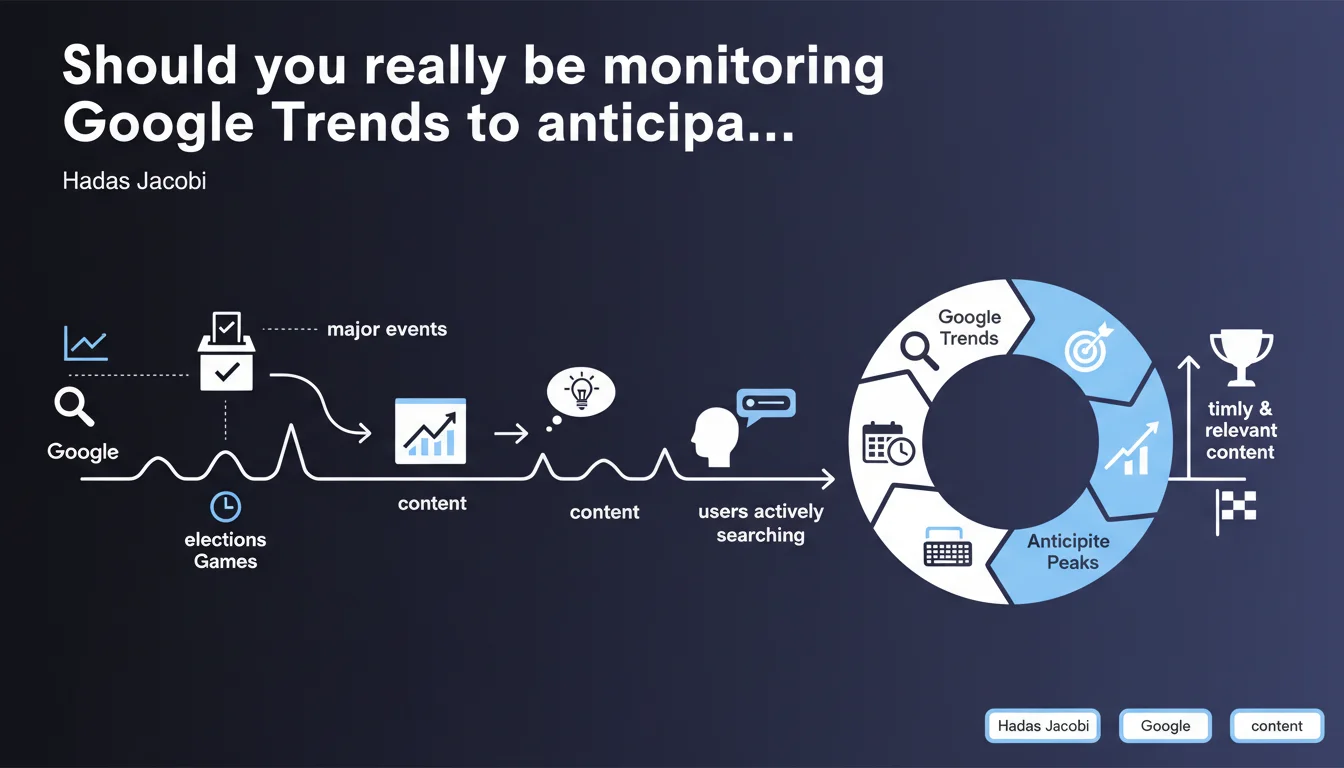
Google confirms that Trends now displays the starting point of a trend, not just its peak. This makes the tool usable for creating timely content before the competition saturates the SERP. The challenge is knowing how to interpret these signals and act fast enough to capitalize on them.
What you need to understand
What's changing with this Trends feature?
Google Trends has long been a lagging indicator: you could see a topic was trending, but there was no way to know when it actually emerged. The platform now displays the precise moment a trend starts, transforming the tool into a genuine opportunity radar.
For major events like elections or international sports competitions, this data helps you identify gradual increases in interest rather than just already-saturated explosions. Practically speaking? You can see a topic starting to emerge 48 hours before it becomes mainstream.
Why is Google emphasizing "timely" content?
Timing has become a relevance criterion in its own right. An article published at the right moment on an emerging topic statistically has better chances of ranking than content published late, even if the latter is technically superior.
Google values contextual freshness: answering a question users are actively asking now, not yesterday. This statement confirms that the algorithm takes the temporality of demand into account when evaluating relevance.
Does this approach work for all industries?
No, and that's where Google's messaging becomes vague. Major events create predictable spikes (elections, Olympics, Black Friday), but for niche or B2B topics, trends rarely reach enough volume to appear in Trends.
The tool is primarily designed for the general public and media outlets. If you work on an industrial or SaaS site, search volumes often don't exceed Trends' detection threshold, making this recommendation hardly applicable.
- Trends now shows the starting point of a trend, not just its peak
- Publication timing becomes a documented relevance factor according to Google
- The tool is effective for mass-market events, less so for low-volume niches
- The opportunity window is measured in hours or days, not weeks
- Google confirms that creating content based on what users are actively searching for improves relevance
SEO Expert opinion
Is this recommendation realistic for an average website?
Let's be honest: most sites don't have the resources or production speed to exploit these opportunity windows. Google describes an ideal scenario where you monitor Trends daily, identify an emerging trend, write a quality article, publish it, and get it indexed within hours.
In reality? Only news outlets and major publishers have this operational capacity. For a typical e-commerce or corporate site, the validation/writing/publication cycle rarely takes less than 48-72 hours, which eliminates the timing advantage. [Needs verification]: Google provides no data on the optimal timeframe between detecting a trend and publishing to maintain a competitive edge.
What nuances should be added to this statement?
Google mentions major events as examples but doesn't specify the minimum volume threshold for a trend to be detectable. In practice, Trends only shows queries that have already reached significant volume — meaning you rarely arrive in the first position.
Another limitation: instant saturation. The moment a trend appears in Trends, hundreds of sites are already on it. The timing advantage is microscopic, especially against players with instant indexing via IndexNow or real-time sitemaps.
Is Google implicitly admitting that opportunistic content ranks better?
Yes, and that's the most interesting insight from this statement. By encouraging the creation of content based on users' active searches, Google confirms that the algorithm favors pages answering immediate, high-volume demand.
This strengthens the hypothesis that organic CTR and rapid engagement rates are relevance signals. Content published at the peak of a trend mechanically generates more initial clicks, creating a virtuous cycle of visibility. But be aware — once the peak subsides, these pages often lose their position if they haven't accumulated other authority signals.
Practical impact and recommendations
How do you integrate Trends into a realistic editorial strategy?
Don't transform your site into a news outlet if that's not your business model. For most sites, Trends serves to identify occasional opportunities related to your sector, not to drive your entire content strategy.
The real question: can your team produce quality content in under 24 hours? If not, you're better off focusing on optimized evergreen content that captures long-tail traffic rather than chasing trends you'll never catch.
What mistakes should you avoid with this approach?
The classic mistake: see a trend rising, publish a rushed article to "be there," and end up with thin content buried on page 3. Google values timing, but not at the expense of quality.
Another trap — believing that Trends replaces a real keyword strategy. Trends are volatile; if your site relies solely on them, your traffic will be a rollercoaster. Major events pass; stable organic traffic comes from well-optimized recurring queries.
What concrete steps should you take?
If you decide to exploit this tactic, the key is monitoring automation and fast production capacity. This requires smooth editorial workflows and a responsive team, which isn't available to everyone.
- Set up Google Trends alerts on strategic topics in your sector
- Prepare editorial templates to speed up writing for recurring formats (sports events, industry news)
- Ensure your publishing pipeline allows for launch in under 6 hours (validation, on-page SEO, indexing)
- Use IndexNow or Google Indexing API to force rapid indexing of new content
- Test publishing to dedicated sections (like an news blog) to avoid polluting your main architecture with ephemeral content
- Measure the temporal ROI: how long does opportunistic content remain profitable? Should you update it or let it fade?
- Never sacrifice quality for speed — poor content published fast won't rank better than good content published late
❓ Frequently Asked Questions
Google Trends affiche-t-il toutes les tendances ou seulement celles qui dépassent un certain volume ?
Combien de temps ai-je pour publier un contenu après avoir détecté une tendance émergente ?
Est-ce que publier du contenu opportuniste améliore l'autorité globale de mon site ?
Dois-je supprimer ou mettre à jour les contenus opportunistes une fois la tendance retombée ?
Google Trends est-il suffisant pour une veille SEO efficace ?
🎥 From the same video 4
Other SEO insights extracted from this same Google Search Central video · published on 11/09/2024
🎥 Watch the full video on YouTube →
💬 Comments (0)
Be the first to comment.