
Official statement
Other statements from this video 4 ▾
- □ Faut-il vraiment surveiller Google Trends pour anticiper les pics de recherche ?
- □ Faut-il privilégier le volume de recherche réel plutôt que l'intérêt de recherche pour bâtir sa stratégie de contenu ?
- □ Faut-il vraiment adapter la fenêtre temporelle de Trending Now à son objectif éditorial ?
- □ Faut-il vraiment utiliser Google Trends pour créer du contenu SEO pertinent ?
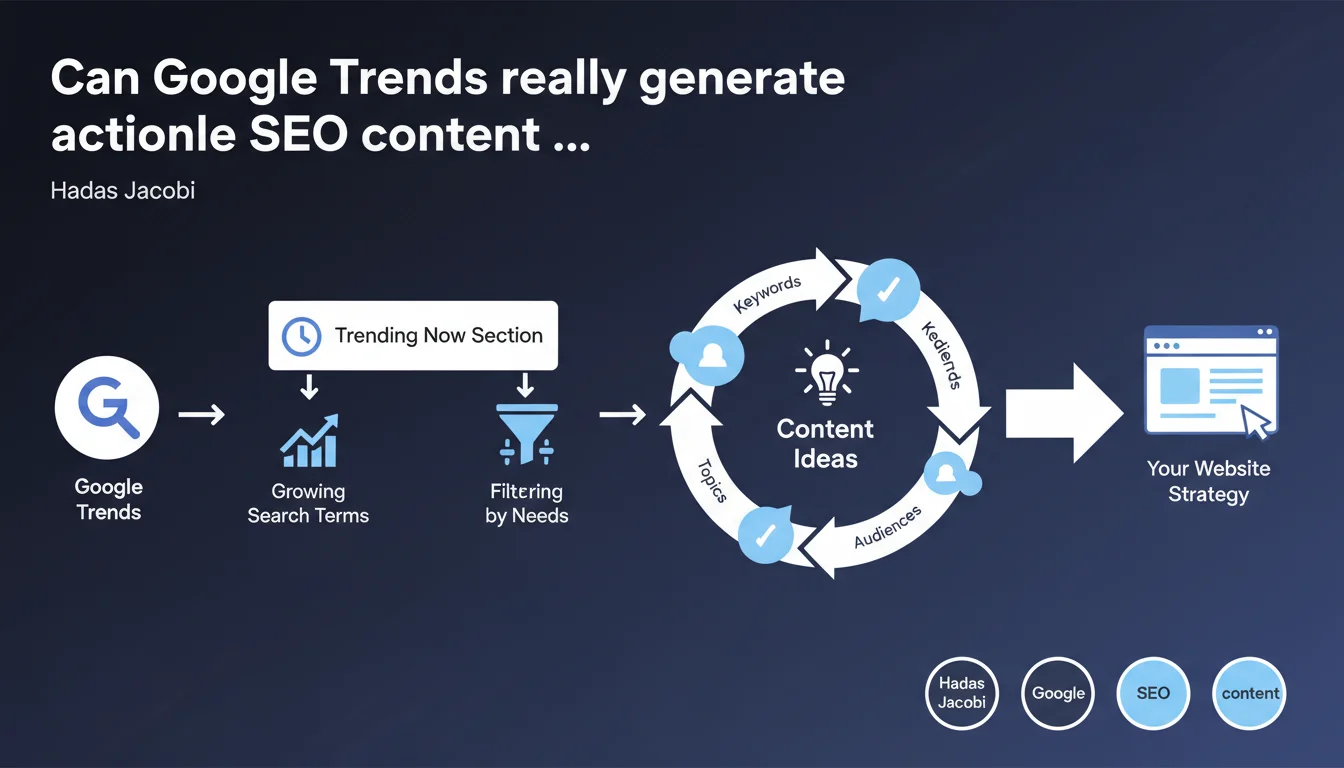
Google recommends using the Trending Now section of Google Trends to identify content opportunities. The approach involves starting with rising trends rather than keywords you already master, by filtering according to your specific needs.
What you need to understand
What is this "inverted" approach that Google is talking about?
Unlike traditional keyword research where you start from your semantic universe to validate volumes, Google suggests here to start from emerging trends and then adapt them to your context. It's the principle of riding the wave: you first identify what's rising, analyze if it fits your domain, and produce content while demand is climbing.
Concretely, the Trending Now section displays queries whose volume is increasing significantly over a recent period. The idea is to capture traffic on topics that are gaining in popularity before they become ultra-competitive.
Why is Google highlighting this tool now?
Let's be honest — Google Trends has existed for years, but its prominence in an SEO context is not insignificant. With the multiplication of AI-generated content and content saturation on oversaturated queries, Google may be pushing creators to explore less exploited territories.
It's also a way to encourage the production of fresh and reactive content, aligned with the Helpful Content guidelines that value temporal relevance and real utility.
What filtering options are available to refine your search?
Google Trends allows you to filter by geographic location, time period, category, and search type (Web, Images, News, Shopping, YouTube). These filters are essential to avoid launching into trends unsuitable for your audience or business model.
- Start from rising trends rather than known keywords to discover opportunities
- Use Trending Now to capture growing queries before saturation
- Filter geographically and by category to align trends with your target market
- Prioritize responsiveness: produce content while the trend is rising, not after
SEO Expert opinion
Does this statement really change the game in SEO?
Honestly? No. Google Trends is a well-known tool that has been used for a long time by SEOs doing monitoring. What's interesting is that Google is officializing this practice and presenting it as a valid method of generating ideas, whereas some considered it mainly as a tool for journalists or market analysts.
The problem is that this approach works mainly for sites with strong editorial responsiveness: media outlets, news blogs, e-commerce sites capable of creating categories or product pages quickly. For a corporate or technical site with a long validation process, the interest is limited — the trend will have dropped before publication.
What nuances need to be added to this recommendation?
First point: Trending Now trends are often ephemeral. Riding a wave that drops in a few days can generate short-term traffic, but rarely builds a lasting SEO asset. You must distinguish between seasonal or recurring trends (interesting) and one-off buzz (risky).
Second point: [To be verified] Google doesn't specify how these trends align with E-E-A-T criteria. Producing content on a trending topic without real expertise can backfire, especially on YMYL topics. Responsiveness should not sacrifice quality and legitimacy.
In what cases does this approach not work?
For complex B2B sites, professional services, or technical niches, Google Trends data rarely reflects the actual search intentions of your target audience. A financial audit firm has no interest in riding mainstream trending topics.
Another limitation: Google Trends data is indicative, not absolute. They show relative variations, not precise volumes. Without cross-referencing with keyword research tools (Semrush, Ahrefs, even Search Console), you're navigating blind. And that's where it sticks — Google pushes a free tool that remains incomplete without paid third-party solutions.
Practical impact and recommendations
How to exploit Google Trends without wasting time?
First, define a strict thematic perimeter. Filter trends by categories relevant to your sector. A tech site should only monitor Tech, Business, and possibly Science categories — ignoring the rest avoids dispersion.
Next, cross Google Trends data with your own analytics. A rising trend that corresponds to a query already present in your Search Console with impressions but few clicks? That's an opportunity to strengthen existing content rather than create new content.
Finally, automate your monitoring. Setting up alerts on specific categories via Google Trends or third-party tools connected to it (Glimpse, Exploding Topics) allows you to avoid spending two hours per week manually browsing trends.
What mistakes should you absolutely avoid?
Classic mistake: confusing search volume with traffic quality. A trend can explode in volume but attract a completely off-target audience. Always verify the intent behind the query and relevance to your conversion funnel.
Another pitfall: producing shallow content in bulk to capitalize on multiple simultaneous trends. Google detects opportunistic content without added value, especially since the Helpful Content updates. Better to have three solid pieces than ten hollow articles.
And be careful with temporal keyword stuffing — stuffing an article with variations of a trend to capture maximum traffic. Google has moved well beyond this stage; the algorithm understands synonyms and context.
What is the checklist for effective exploitation?
- Define categories and geographic zones relevant to your business
- Set up automated monitoring rather than manual weekly consultation
- Cross Trends data with Search Console data and keyword tools
- Evaluate trend sustainability (seasonal, recurring, ephemeral)
- Verify thematic coherence with your site before producing content
- Analyze search intent and quality of potential traffic, not just volume
- Prioritize enriching existing content when possible
- Measure ROI of content produced on trends to adjust strategy
❓ Frequently Asked Questions
Google Trends remplace-t-il les outils de recherche de mots-clés classiques ?
Quelle est la différence entre Trending Now et les autres sections de Google Trends ?
Combien de temps une tendance Trending Now reste-t-elle exploitable ?
Peut-on utiliser Google Trends pour du SEO local ?
Les tendances Google Trends influencent-elles directement le classement ?
🎥 From the same video 4
Other SEO insights extracted from this same Google Search Central video · published on 11/09/2024
🎥 Watch the full video on YouTube →
💬 Comments (0)
Be the first to comment.