
Official statement
What you need to understand
What exactly is Alexa Rank and why does this question even come up?
Alexa Rank is a ranking system developed by Amazon that evaluates the popularity of websites based on traffic and visitor engagement. This service is separate from Google and belongs to the Amazon ecosystem.
Some SEO practitioners wonder whether Google uses external signals from other platforms to assess the quality or popularity of a site. This question reflects a common confusion about the ranking factors used by Google.
What is Google's official stance on Alexa Rank?
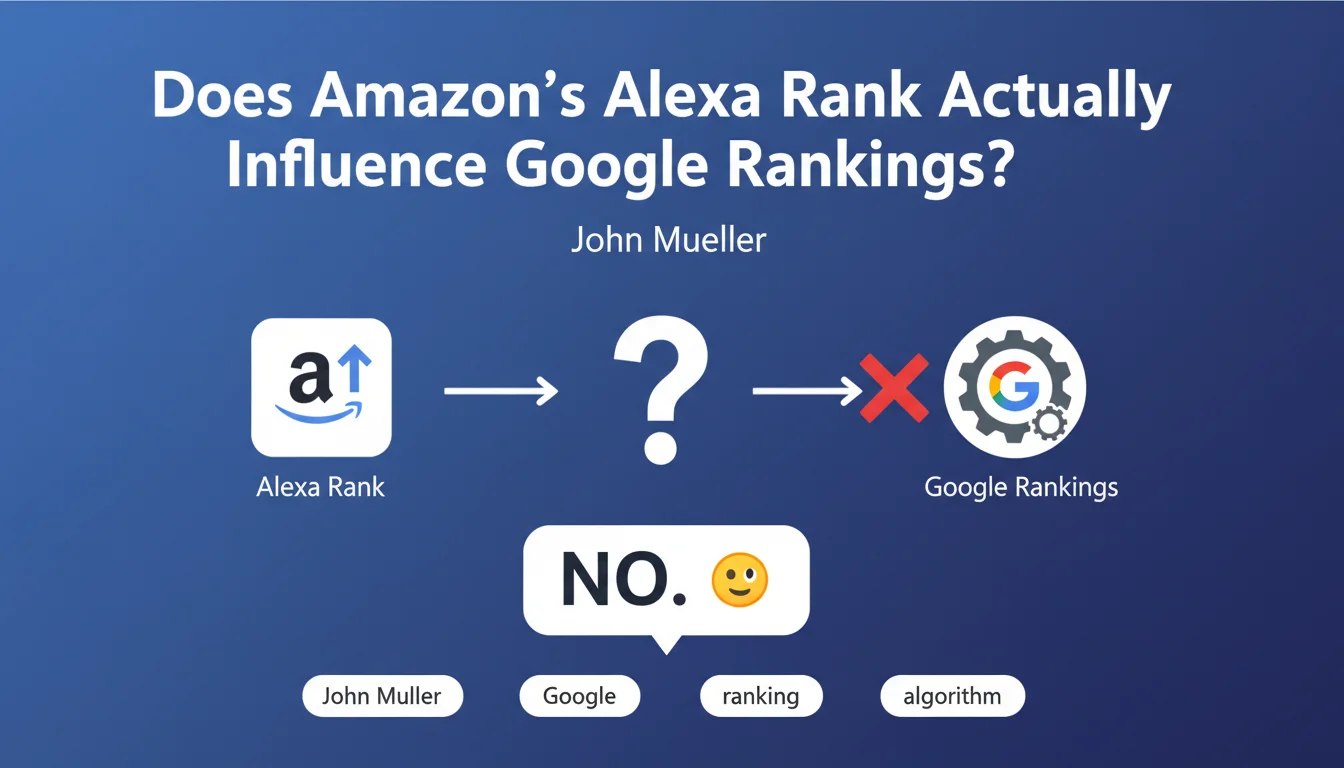
John Mueller clearly indicated that Alexa Rank plays no role whatsoever in Google's relevance algorithm. This unequivocal response dispels any doubt about the use of this metric by the search engine.
Google develops its own internal metrics to evaluate the quality and popularity of websites. It has no technical or strategic reason to use data from a competitor like Amazon.
Why does this confusion persist in the SEO community?
This confusion stems from an era when third-party metrics like visible PageRank or Alexa Rank were widely used to evaluate the quality of a site. Many legacy SEO tools still included these indicators.
- Google does not use Alexa Rank in its ranking algorithm
- Third-party metrics do not replace Google's proprietary signals
- Focus on Core Web Vitals and official signals rather than external indicators
- Alexa Rank may have utility for competitive analysis, but not for Google SEO
SEO Expert opinion
Is this statement consistent with practices observed in the field?
Absolutely. In 15 years of experience, I have never observed any correlation between Alexa Rank and Google positions. Sites with excellent Alexa rankings can have mediocre SEO performance, and vice versa.
Google has access to far superior traffic data through Chrome, Android, Google Analytics, and Search Console. Using an external metric would be technically absurd and strategically risky for a direct competitor of Amazon.
What nuances should be brought to this statement?
It's important to distinguish the metric itself (Alexa Rank) from the factors it indirectly measures. If a site has a good Alexa Rank, it means it generates traffic and engagement, two elements that can indirectly influence SEO.
High traffic can generate more branded searches, natural backlinks, and engagement signals. It's not the Alexa metrics that Google uses, but the actual user behaviors measured by its own tools.
Why do some SEO tools still display Alexa Rank?
Many SEO tools include Alexa Rank out of tradition or to provide an overview of a site's popularity. This remains useful for competitive analysis or benchmarking, but has no value for direct SEO optimization.
Since Amazon shut down Alexa.com in 2022, this metric has become obsolete. Professionals must focus on Google's official metrics: Core Web Vitals, click-through rates, session duration, etc.
Practical impact and recommendations
Which metrics should you monitor instead of Alexa Rank?
Focus on official Google data available in Search Console: impressions, clicks, CTR, average position. These metrics directly reflect your performance in search results.
Core Web Vitals (LCP, FID, CLS) are confirmed ranking factors. Google Analytics provides data on user behavior: bounce rate, pages per session, visit duration. These signals have real SEO value.
What mistakes should you avoid regarding third-party metrics?
Don't invest time or money to improve third-party metrics like Alexa Rank (now obsolete), Moz's Domain Authority, or Majestic's Trust Flow. These indicators are useful for analysis, but are not Google ranking factors.
Avoid tools or agencies that promise to improve your SEO by boosting these external metrics. An effective SEO strategy focuses on Google's official criteria and actual user experience.
- Set up and monitor Google Search Console daily
- Optimize your Core Web Vitals measured by PageSpeed Insights
- Analyze user behavior via Google Analytics 4
- Track your actual positions for your strategic keywords
- Build natural backlinks from recognized authority sites
- Improve organic CTR with optimized titles and descriptions
- Ignore third-party metrics as direct optimization factors
How can you build an SEO strategy based on the right indicators?
An effective SEO strategy starts with a comprehensive technical audit based on Google's official criteria: indexability, structure, speed, mobile-first, Core Web Vitals. These technical foundations are essential for any sustainable improvement.
Next, develop your content strategy around search intent and user satisfaction. Measure your performance with official Google tools and continuously adjust your approach.
💬 Comments (0)
Be the first to comment.