
Official statement
What you need to understand
What does the nofollow attribute actually mean to Google?
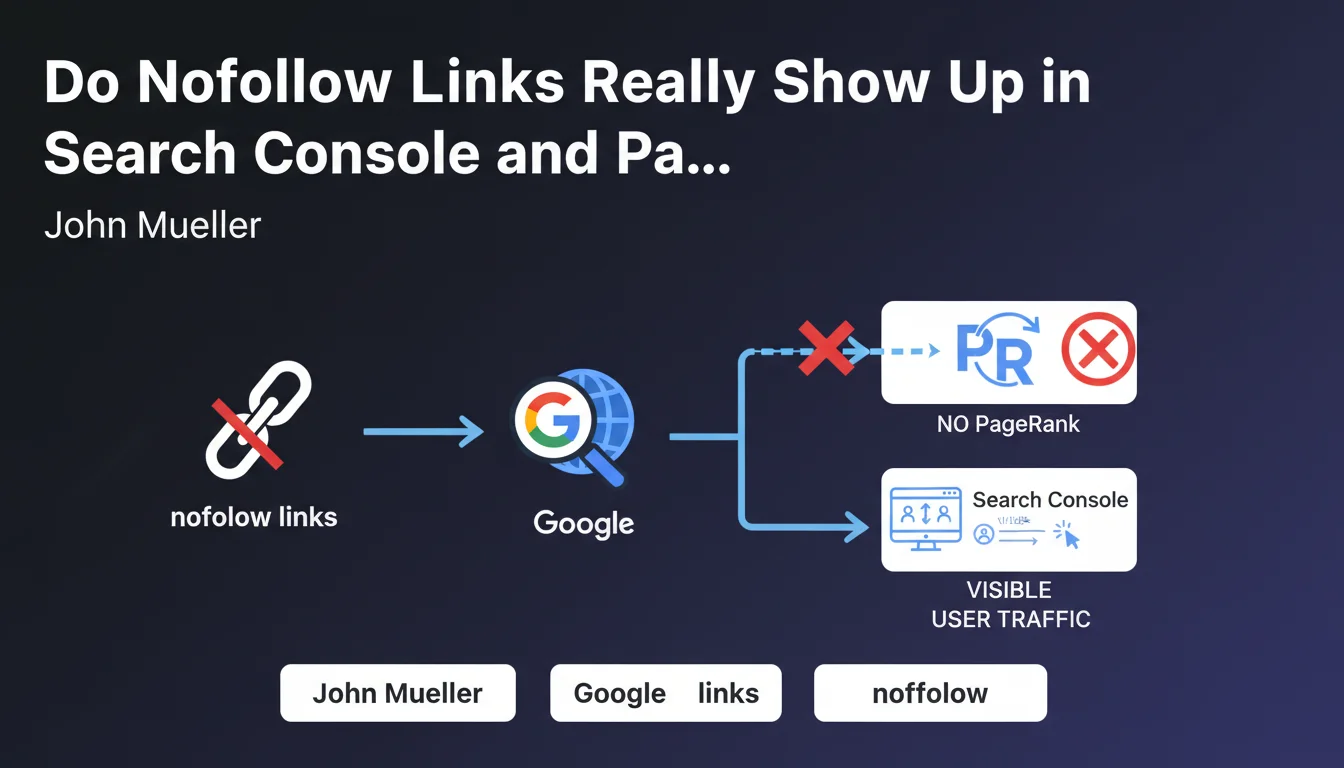
The nofollow attribute tells Google not to follow a link and not to transmit any ranking signals through it. Contrary to common belief, this explicitly includes PageRank, which does not flow through these links.
This directive is strictly respected by Google's algorithm. A nofollow link exists solely for users, not for the search engine.
Why do these links appear in Search Console if they don't count?
Search Console lists all detected links pointing to your site, whether they are followed by the algorithm or not. It reflects the reality of the web as Google crawls it, not necessarily what influences rankings.
These nofollow links generate direct traffic when users click on them. That's why Google considers it useful to display them in the console, even though they have no algorithmic SEO impact.
What are the key takeaways?
- Nofollow links do not transmit any PageRank or any ranking signals
- They still appear in Search Console because they actually exist on the web
- Their value lies solely in potential direct traffic, not in SEO
- Not all links listed in Search Console are taken into account by the search algorithm
- A link's presence in the console does not equate to its algorithmic validation
SEO Expert opinion
Is this statement consistent with practices observed in the field?
This clarification from John Mueller confirms what empirical testing has demonstrated for years. Sites receiving massive nofollow links do not progress in rankings, unlike those obtaining natural dofollow links.
However, there is an important subtlety: since 2019, Google has treated nofollow as a hint rather than an absolute directive in certain contexts. But for classic PageRank, the rule remains strict and without exception.
What nuances should be applied to this statement?
The indirect value of nofollow links should not be completely overlooked. They contribute to a natural and diversified link profile, which is a positive signal of authenticity for Google.
Furthermore, a nofollow link on a high-traffic site generates qualified visits. These visitors can create positive behavioral signals and potentially link naturally to your content from their own platforms.
In what cases might this rule evolve or present exceptions?
Google introduced the sponsored and ugc attributes in 2019 to qualify links more precisely. These attributes may be treated differently from classic nofollow in specific contexts, particularly for content discovery.
It is likely that Google will continue to refine how it treats these attributes. The algorithm might eventually extract other contextual signals from nofollow links without necessarily transmitting traditional PageRank.
Practical impact and recommendations
What should you actually do with this information?
Focus your link building efforts on obtaining dofollow links from thematically relevant and quality sites. These are the ones that effectively transmit link juice and impact your rankings.
Don't systematically reject nofollow link opportunities, especially if they come from sources with high qualified traffic. Evaluate them for their visibility potential and audience acquisition rather than for their direct SEO value.
Use Search Console intelligently: don't be alarmed by seeing nofollow links listed, but analyze the proportion of dofollow versus nofollow to understand the real health of your link profile.
What mistakes should you avoid in your link strategy?
Don't invest significant budget in campaigns aimed solely at obtaining nofollow links. Their SEO return on investment is zero from an algorithmic standpoint.
However, don't neglect your presence on platforms that impose nofollow. These spaces contribute to your overall digital ecosystem and brand awareness, which are indirect factors of SEO success.
Avoid asking webmasters to remove the nofollow attribute. This practice is often perceived negatively and can harm your professional relationships. Prioritize creating content that naturally deserves dofollow links.
How can you optimize your link building strategy accordingly?
- Audit your link profile to identify the current dofollow/nofollow ratio
- Prioritize tactics for acquiring natural dofollow links (quality content, press relations, partnerships)
- Leverage nofollow links for their traffic and visibility value, not for SEO
- Don't disavow nofollow links in Search Console, they are not harmful
- Create linkable content that naturally encourages dofollow links (studies, infographics, tools)
- Track the evolution of your inbound links and the real impact on your organic rankings
- Diversify your link sources to maintain a natural and balanced profile
💬 Comments (0)
Be the first to comment.