
Official statement
Other statements from this video 7 ▾
- □ Does Page Experience on desktop really deserve your attention as a ranking factor?
- □ Is Google really rewarding in-depth product reviews over surface-level content?
- □ Is Google finally opening up URL inspection through API automation?
- □ Should you really migrate to Google Analytics 4 to avoid losing your traffic data?
- □ Should you really leverage Search Console with Data Studio to optimize your SEO tracking?
- □ Will Google's 'indexifembedded' tag revolutionize how you control content indexation?
- □ Does Search Console Insights make traditional Search Console obsolete for content creators?
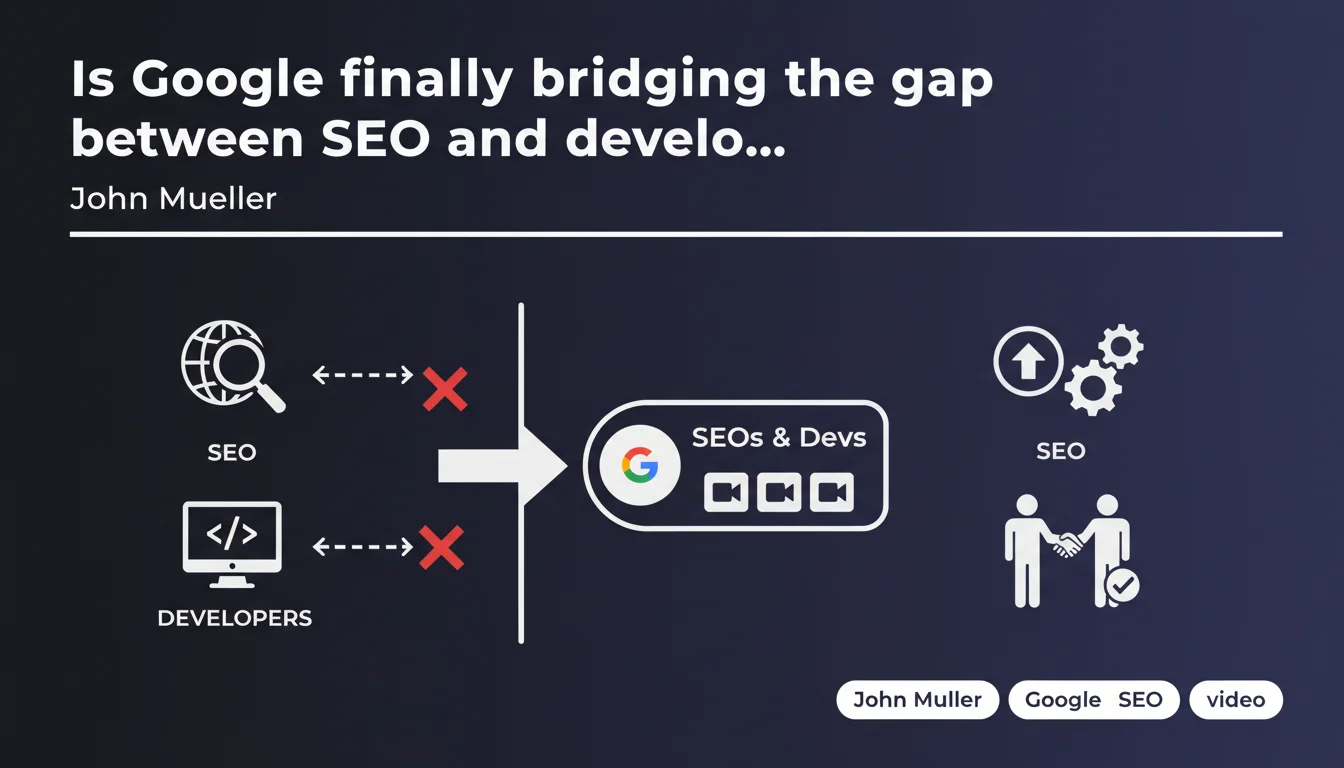
Google launches 'SEOs & Devs', a video series designed to improve collaboration between SEO professionals and developers. The goal: facilitate the technical implementation of SEO recommendations by creating a common language between these two often-conflicting professions. An implicit acknowledgment that the gap between these disciplines still hinders optimization efforts on many websites.
What you need to understand
What does this video series actually cover?
Google doesn't detail the specific content of the episodes in this announcement. We know they address the intersection between SEO and development, but without a concrete list of topics covered — which limits the assessment of real relevance for practitioners.
The approach clearly aims to create bridges of understanding: explaining to developers why certain SEO requests make sense technically, and to SEO professionals how to formulate their needs in a language that developers can effectively implement.
Why is Google investing in this format now?
The friction between SEO and developers remains a recurring problem in the field. SEO professionals formulate recommendations that technical teams reject due to lack of clear technical context. Developers implement solutions that break SEO fundamentals through lack of understanding of the stakes.
Google has likely realized that this lack of collaboration slows the adoption of its own recommendations: Core Web Vitals, JavaScript SEO, structured data. By creating educational content targeting both audiences simultaneously, they hope to accelerate site compliance.
Who is this initiative really targeting?
The video format suggests a rather junior to intermediate audience. Experts from both disciplines already know these intersections — they practice them daily. This series is probably aimed at professionals discovering the other discipline or struggling to communicate effectively.
The lack of technical detail in the announcement suggests the content will remain relatively accessible, not necessarily adapted to advanced issues like rendering budgets or complex crawl optimization.
- Google officially acknowledges the communication gap between SEO and development as a barrier to optimization
- The video format targets accessible education rather than exhaustive technical documentation
- The initiative reflects Google's interest in having its technical recommendations better understood and implemented
- No specific information on the topics covered or the depth level of the proposed content
SEO Expert opinion
Does this approach signal a failure of existing documentation?
Let's be honest: Google already has tons of documentation on its technical guidelines. Search Central, office hours, conferences, case studies... If this video series is coming out, it's because these resources clearly haven't been enough to solve the collaboration problem.
In the field, we indeed observe that Google's documentation is often fragmented by discipline. Articles for SEO professionals remain superficial on the technical side; those for developers ignore business considerations of search optimization. This series seems to attempt a cross-functional approach — whether it brings something genuinely new or recycles existing content remains to be seen.
Is the video format really the most appropriate?
That's debatable. Developers generally prefer written documentation, searchable and versioned. Videos are difficult to maintain, impossible to index deeply, complicated to update when specs change.
This choice probably reflects a strategy of reach and engagement — YouTube remains a massive platform — rather than optimization for operational efficiency. [To verify] whether these videos will be accompanied by detailed transcriptions or complementary documentation usable in production.
What are the foreseeable limitations of this initiative?
The real problem between SEO and developers is not purely educational — it's also organizational and political. Product priorities, business trade-offs, technical roadmap constraints regularly override SEO recommendations, even when everyone understands the stakes.
A video series won't change anything in contexts where SEO has no decision-making weight, where sprints are saturated, where technical debt prevents any serious optimization. Google can explain a thousand times why client-side rendering is problematic — if rewriting in SSR requires 6 months of development, it won't happen.
Practical impact and recommendations
How to use this resource concretely?
If you manage SEO projects involving technical teams, use these videos as a dialogue foundation. Share them before technical meetings to establish common vocabulary. They can serve as a neutral introduction — backed by Google — for developers who systematically reject your recommendations.
Avoid, however, treating them as exhaustive training. They won't replace a thorough technical analysis of your specific context or an SEO roadmap adapted to your technology stack.
What mistakes should you avoid when using this series?
Don't fall into the trap of "Google said it so it must be true". These videos remain content oriented according to Google's interests — promoting adoption of their technologies, pushing their standards. Keep a critical perspective on the recommendations, especially those involving dependencies on the Google ecosystem.
A second common pitfall: assuming that watching 3 videos will be enough to transform the SEO-dev relationship in your company. Effective collaboration is built over time, through practice, not through passive content. Use these resources as a starting point, not as a miracle solution.
How can you measure if this approach actually improves collaboration?
Track concrete operational metrics: average time between SEO recommendation and production deployment, technical ticket acceptance rate, number of back-and-forths before validation. If sharing these videos doesn't change these indicators after a few months, the problem lies elsewhere.
Also document recurring misunderstandings between your teams. If certain friction points persist despite watching the series, you'll have identified areas where more intensive support is needed — likely through custom internal training or practical workshops.
- Identify relevant episodes for your specific technical challenges before distributing them
- Organize joint viewing sessions for SEO+dev teams followed by a debriefing applied to your projects
- Consistently complement with written documentation adapted to your technology stack
- Never substitute these videos for a thorough technical SEO analysis of your site
- Measure real impact on the velocity of SEO recommendation implementation
- Formalize a post-viewing collaboration process to anchor learnings
❓ Frequently Asked Questions
Cette série vidéo remplace-t-elle la documentation Search Central de Google ?
Faut-il être développeur pour comprendre le contenu de ces vidéos ?
Google va-t-il introduire de nouvelles recommandations techniques via cette série ?
Cette initiative signifie-t-elle que Google constate un problème généralisé d'implémentation technique SEO ?
Où trouver cette série vidéo 'SEOs & Devs' ?
🎥 From the same video 7
Other SEO insights extracted from this same Google Search Central video · published on 31/03/2022
🎥 Watch the full video on YouTube →
💬 Comments (0)
Be the first to comment.