
Official statement
Other statements from this video 7 ▾
- □ Page Experience sur desktop : faut-il vraiment s'inquiéter de ce nouveau facteur de classement ?
- □ Pourquoi Google ouvre-t-il enfin l'inspection d'URL en API ?
- □ Faut-il vraiment migrer vers Google Analytics 4 pour ne pas perdre ses données de trafic ?
- □ Faut-il vraiment exploiter Search Console avec Data Studio pour optimiser son suivi SEO ?
- □ La balise 'indexifembedded' de Google va-t-elle changer votre stratégie d'indexation ?
- □ Search Console Insights : l'outil qui rend Search Console inutile pour les créateurs de contenu ?
- □ Pourquoi Google lance une série vidéo pour rapprocher SEO et développeurs ?
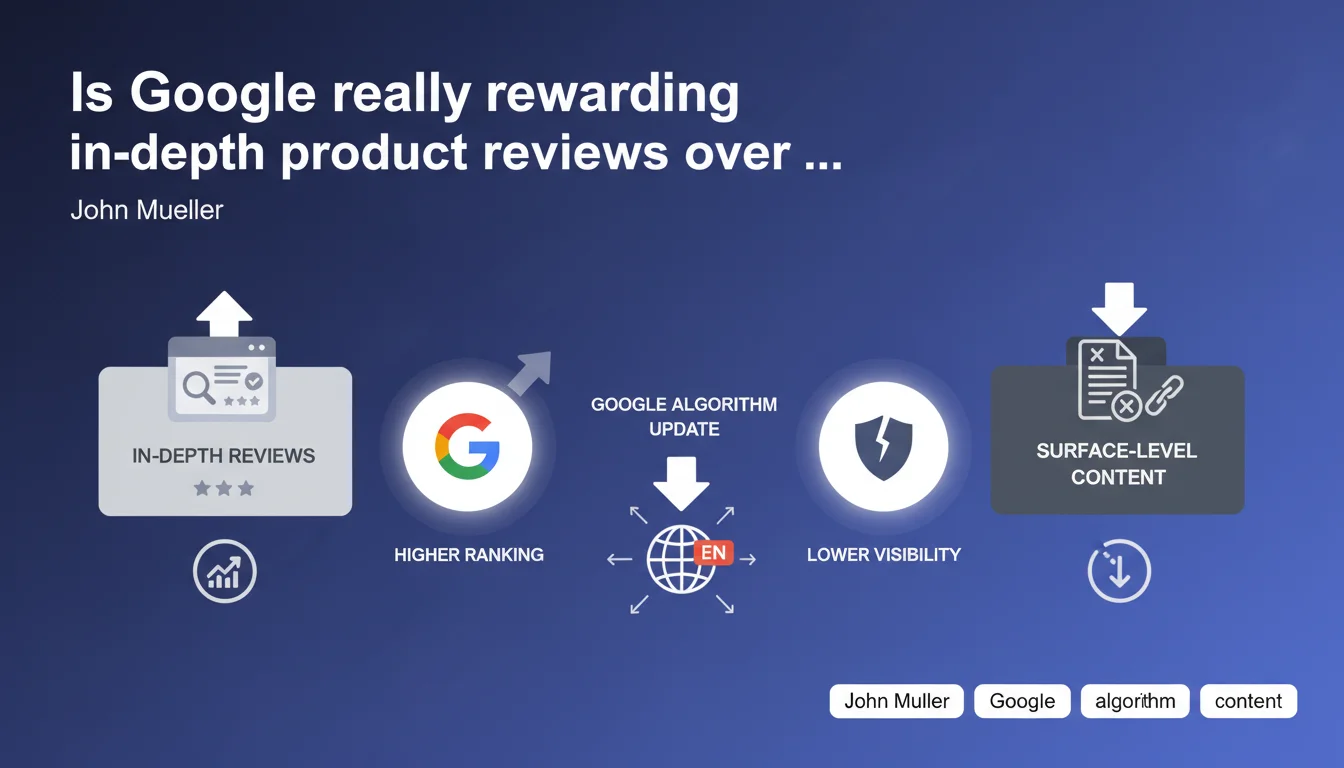
Google is rolling out a specific algorithmic update to distinguish and favor in-depth, authentic product reviews. Initial rollout in English only, with expansion to other languages planned. The stakes: stand out from mass-generated content and demonstrate real hands-on expertise.
What you need to understand
Why is Google specifically targeting product reviews?
The product review format is one of the most polluted spaces on the web. Between affiliate sites that simply reword Amazon tech specs and AI-generated content from people who've never touched the product, Google is seeking to reward verifiable expertise.
This update aims to identify signals of authenticity: real testing, original photos, substantiated comparisons, evaluation of a product's limitations. Pages that merely synthesize technical specs without adding value should logically lose ground.
What counts as an "in-depth" review according to Google?
Google deliberately keeps criteria vague — classic move. But the Product Review guidelines provide clues: subject matter expertise, comparison with similar products, analysis of both strengths AND weaknesses, evidence of actual use.
In practice, a review that just says "this product is great, 5 stars" won't make the cut. You need context around usage, measurements, concrete use cases. The signal "I actually tested this" needs to be apparent.
Why start with English only?
Google's standard gradual rollout approach. The English-speaking market concentrates the highest volume of product searches and likely the most spam. Logical to test and refine the algorithm before expanding.
For multilingual sites: don't get complacent. What launches in English inevitably rolls out elsewhere, sometimes with adaptations. Start preparing your FR/DE/ES content now to meet the same standards.
- Primary target: shallow product review content, spec rewrites
- Rewarded signals: demonstrable expertise, proof of use, comparative analysis
- Initial scope: English only, progressive expansion to other languages
- Expected impact: traffic redistribution toward sites with genuine added value
SEO Expert opinion
Is this statement consistent with real-world observations?
Yes and no. On competitive English queries ("best X," "Y review"), we've indeed seen increased volatility and a rise of specialized sites with rich content over recent months. Wirecutter, RTINGS, and credible vertical sites are gaining ground.
But — and here's where it gets tricky — lightweight affiliate sites continue to rank decently if they have solid backlink profiles. The "content quality" signal alone isn't enough. Domain authority remains a determining factor. [Needs verification] exactly how heavily this update weighs compared to traditional ranking signals.
What nuances should we add?
Google says "in-depth reviews" but doesn't define a depth threshold. A well-structured 500-word review can outperform a bloated 3,000-word piece. Information density matters more than raw volume.
Another point: authenticity is hard to measure algorithmically. Google likely relies on indirect signals — presence of original images (EXIF metadata), vocabulary specific to the product, user engagement. But a good writer can simulate these signals without ever testing the product. Let's be honest.
In what cases does this update not apply?
Navigational queries ("iPhone 15 review Apple.com") and direct transactional searches ("buy X cheap") are less affected. Google prioritizes other signals — brand, clear commercial intent.
Standard e-commerce product pages (description + specs + customer reviews) aren't directly targeted. Google distinguishes between "product page" and "product review page." If your content is a seller sheet, not a test article, you're theoretically out of scope.
Practical impact and recommendations
What should you do concretely to adapt?
Audit your existing product review pages. Identify those that merely restate specs or compile third-party reviews without added value. Prioritize refactoring pages that already generate traffic — that's where immediate ROI lies.
Enrich with tangible proof elements: original product photos in real-world settings, test screenshots, short videos, itemized comparison tables. The goal is to make your content non-replicable by competitors who haven't tested the product.
What mistakes must you absolutely avoid?
Don't fall into the trap of "longer is better." A 5,000-word review that drowns useful info in filler will be penalized by engagement metrics (time on page, scroll depth). Density beats volume.
Avoid fraudulent Review schema markup. Google has tightened its policy: if you display SERP stars without real user reviews or verified testing, you risk a manual action. Structured data should reflect existing content, not the reverse.
How do you verify your content is compliant?
Use Google's official Product Review checklist (available in Search Central docs). Match your pages against criteria: demonstrated expertise, quantitative measurements, product comparison, limitations mentioned, sources cited.
Analyze competitors ranking well on your target queries. Deconstruct their structure, proof points, angle. Not to copy — to understand what level of evidence Google expects on your specific vertical.
- Audit current product review pages and score their depth
- Add original visual proof (photos, videos, test graphs)
- Structure with clear sections: specs, real-world use, comparison, verdict
- Incorporate quantified measurements where relevant (battery life, performance, lifespan)
- Explicitly discuss product limitations or weaknesses
- Verify Review schema markup matches actual content
- Monitor ranking and CTR of review pages post-update rollout
❓ Frequently Asked Questions
Cette mise à jour concerne-t-elle uniquement les sites affiliés ?
Faut-il obligatoirement avoir testé physiquement le produit ?
Les avis utilisateurs agrégés comptent-ils comme contenu approfondi ?
Quand cette mise à jour sera-t-elle déployée en français ?
Peut-on utiliser l'IA pour générer des avis produits conformes ?
🎥 From the same video 7
Other SEO insights extracted from this same Google Search Central video · published on 31/03/2022
🎥 Watch the full video on YouTube →
💬 Comments (0)
Be the first to comment.